
A calm before, during, and after plan
A power outage refrigerator and freezer food safety plan replaces hurried guessing with a short sequence. It tells an older adult or family helper what to prepare, what not to open, when a cooler may help, and how to decide what to keep or discard after electricity returns.
This guide is for households in Los Angeles County. It follows current federal food-safety guidance and points City of Los Angeles customers to LADWP outage information. It does not predict restoration time, diagnose foodborne illness, set rules for refrigerated medicine, or replace instructions from a utility, public-health agency, clinician, pharmacist, or emergency responder.
Key takeaways
Keep the doors closed
An unopened refrigerator can keep food safe for about four hours. A closed full freezer can hold a safe temperature for about 48 hours, or about 24 hours when half full.
Use a real time and temperature history
Record when power stopped, use appliance or food thermometer readings when available, and follow the official chart for the specific food. Smell and appearance alone are not proof.
Never taste to test
FoodSafety.gov and CDC say not to taste food to decide whether it is safe. If the food history is uncertain, use the safer discard decision.
Separate food from medicine
Refrigerated medicine, medical nutrition, and powered medical equipment need their own clinician, pharmacist, manufacturer, and utility plan. Do not apply food timing rules to them.
Why does a separate food-safety plan matter for older adults?
CDC identifies adults 65 and older as a group at increased risk from foodborne illness. That does not mean every older adult needs a complicated kitchen system. It means the household should make conservative decisions, keep the rules easy to find, and avoid testing questionable food by taste.
Outages also create practical obstacles. A person may have limited grip strength, use a mobility aid, live alone, or rely on a helper who is not present when the lights go out. A heavy cooler on the floor, repeated bending into a freezer, or a late rush to buy ice can create another hazard. The plan should reduce door openings and lifting, not add them.
Food readiness is only one part of an outage. The power-outage flashlight and phone-charging check covers safer light and communication. The emergency drinking-water supply check covers a separate water reserve. Keep the three plans connected but do not treat one as a substitute for another.
What should be prepared before a power outage?
FDA recommends an appliance thermometer in both the refrigerator and freezer. Before an outage, the refrigerator should be at 40°F or below and the freezer at 0°F or below. Put each thermometer where it can be read without moving heavy shelves. A helper can confirm the display during an ordinary kitchen check.
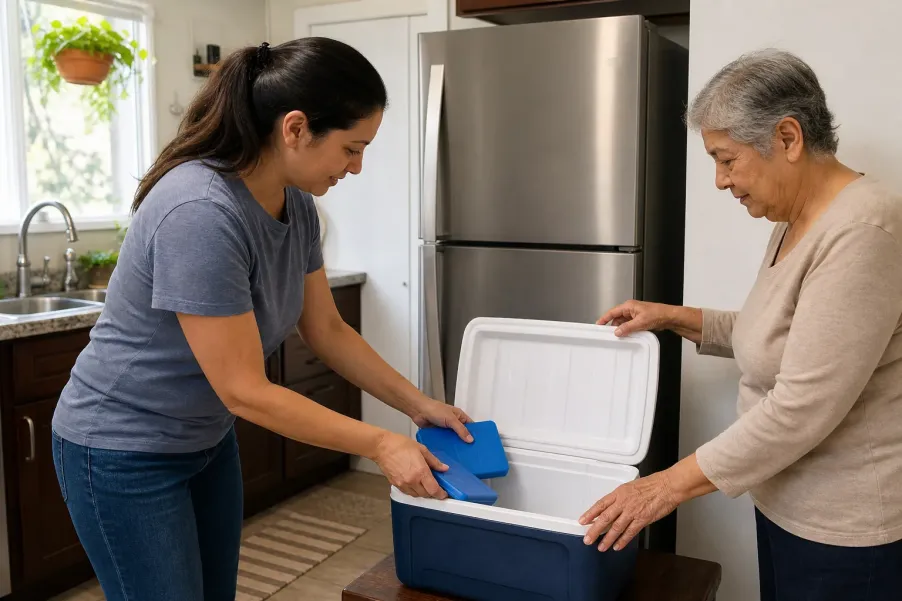
Freeze several sealed containers of water or reusable gel packs. Keep a clean cooler available for refrigerated perishables if an outage is expected to last beyond four hours. The cooler should sit on a stable waist-level surface when it is packed, and it should not block a walkway. Use several small cold packs instead of one heavy block when that makes handling safer.
Group frozen food together so it holds cold longer, but keep air vents clear and do not overfill beyond the appliance instructions. Move items that may leak into secure containers before an emergency. A routine leftover date-label check also makes later decisions easier because unidentified containers do not have to be investigated during an outage.
Choose one way to record the outage start time that works without home internet. It might be a battery clock plus a note in a familiar household location, or a phone entry while service remains available. Avoid putting private account numbers or medical details on a public-facing board.
A ready kitchen has six basics
- A working appliance thermometer in the refrigerator and freezer.
- A clean cooler that the intended person or helper can manage safely.
- Frozen cold packs or sealed frozen water containers.
- A simple way to record when the power stopped and returned.
- The current FoodSafety.gov outage chart saved or printed.
- The correct utility outage route and one family check-in owner.
What should you do when the power goes out?
First, record the start time. Then keep the refrigerator and freezer closed. Do not open a door just to check whether the light is off or the food still feels cold. Every unnecessary opening releases cold air and shortens the useful time window.
If power is likely to remain off longer than four hours and cold packs or ice are ready, move refrigerated perishables to a cooler once, not in repeated trips. Keep the cooler at 40°F or below and add more ice as it melts. Ask for help before lifting a packed cooler. Do not place dry ice in a small closed room or touch it with bare hands; use only current vendor and official safety instructions.
Use shelf-stable food first when practical so the refrigerator remains closed. Keep pets and visitors from opening appliance doors. If a helper arrives, share the recorded start time, whether either door was opened, whether food moved to a cooler, and any temperature readings. That short handoff is more useful than saying that the food “seems fine.”
For current local status, City of Los Angeles customers can check the LADWP power outage map and reporting route. Other Los Angeles County residents should use the outage route for their own electric utility. Restoration estimates can change, so do not base a food decision on an old screenshot or an unverified social post.
How should food be checked after power returns?
Start with the recorded timeline, not appearance. If the refrigerator was without power for no more than four hours and the door stayed closed, federal guidance says the food should be safe. After four hours without power or another cold source, discard refrigerated perishables such as meat, poultry, fish, eggs, milk, and leftovers.
If food was transferred to a cooler, check that it stayed at 40°F or below. When a specific item is known to have been above 40°F, use the time limit and food category in the current official chart. FoodSafety.gov provides separate refrigerator and freezer decision tables because butter, hard cheese, cut produce, meat, leftovers, sauces, and baked goods do not all receive the same answer.
Refrigerator perishables
After four hours without power or a cold source, discard meat, poultry, seafood, milk, eggs, cooked leftovers, and other refrigerated perishables identified by the official chart.
Frozen food
Food may be refrozen or cooked when it still contains ice crystals or measures 40°F or below. Quality may change even when the safety criteria are met.
Unknown history
Do not rely on taste, smell, or appearance to prove safety. If the time, temperature, or handling history cannot be confirmed, choose the safer discard decision.
Check each freezer package separately. A soft package is not automatically unsafe, and a solid-looking package is not automatic proof. Ice crystals or a measured temperature of 40°F or below provide the official decision point. Ice cream and some other foods have stricter chart instructions, so do not apply one freezer answer to everything.
Photographing discarded items may help with a household inventory or insurance question, but food safety comes first. Do not keep unsafe food solely to document it. The home inventory photo walkthrough explains how to document belongings without including private account or identity information.
What is an eight-step refrigerator and freezer outage routine?
Check normal temperatures
Confirm that the refrigerator is at 40°F or below and the freezer is at 0°F or below before an emergency.
Stage cold supplies
Keep a manageable cooler, frozen cold packs, and the official food-safety chart ready and easy to reach.
Record the outage start
Write down or securely save the time when power stops. Record any later door opening or cooler transfer.
Keep both doors closed
Use shelf-stable options and avoid checking food repeatedly. Tell visitors and helpers which appliances must stay closed.
Use a cooler once when needed
If the refrigerator window will be exceeded, transfer perishables with enough ice to keep them at 40°F or below.
Check the timeline after restoration
Note when power returns, read appliance temperatures, and preserve the time history before opening and sorting.
Sort by official category
Use the FoodSafety.gov chart for each food group. Never taste an item to settle an uncertain decision.
Reset the household kit
Clean the cooler, refreeze cold packs, replace thermometer batteries if needed, and update the family plan.
How can a family helper make the plan easier to use?
Assign one person to maintain the chart, thermometers, cooler, and utility route. Assign a second person only as backup. During an outage, the handoff should state four facts: the start time, whether appliance doors opened, whether food moved to a cooler, and the latest temperature readings.
Test the family communication route before it is needed. The family contact ring-through test helps a chosen caller confirm whether calls can reach the older adult through quiet settings, although no setting guarantees delivery. The Los Angeles emergency alert setup check provides a separate route for official notices.
Keep medication and medical-device plans outside the food checklist. If refrigerated medicine loses power, call the pharmacist, clinician, or manufacturer for product-specific instructions. Do not discard or use it based only on refrigerator food guidance. A person who depends on powered medical equipment should contact the utility about available emergency programs before an outage and follow the individualized backup plan.
Ready LA County advises checking on neighbors and notes that older adults can be especially vulnerable during temperature extremes. A check-in should protect privacy and choice: ask what help is wanted, do not enter a home without permission, and do not move heavy food or appliances without a safe plan.
Which common outage mistakes should be avoided?
- Opening the refrigerator to look: the visual check releases cold air but does not prove safety.
- Relying on smell alone: unsafe food may look and smell normal.
- Tasting a small amount: official guidance says never taste food to determine safety.
- Using one rule for every food: consult the category-specific refrigerator and freezer chart.
- Guessing the start time: record it as soon as the outage is noticed and state any uncertainty.
- Lifting a packed cooler alone: divide the load or ask a helper before creating a fall or strain risk.
- Applying food rules to medicine: use product-specific medical and pharmacy guidance instead.
- Trusting an old restoration estimate: check the current utility route and make food decisions from actual time and temperature evidence.
Frequently asked questions
How long is refrigerator food safe during a power outage?
An unopened refrigerator keeps food safe for up to four hours. After four hours without power or another cold source, discard refrigerated perishables identified by the official FoodSafety.gov chart.
How long does a freezer stay cold without power?
A closed full freezer can hold a safe temperature for about 48 hours. A closed half-full freezer can hold it for about 24 hours. Door openings shorten that protection.
Can frozen food be refrozen after an outage?
Food may be refrozen or cooked when it still contains ice crystals or measures 40°F or below. Check the official category chart because quality may change and some foods have stricter instructions.
Can smell or taste prove that food is safe?
No. Never taste food to decide whether it is safe, and do not rely on smell or appearance alone. Use the recorded time, measured temperature, handling history, and official food category.
Should refrigerated medicine follow the same four-hour rule?
No. Food timing rules do not determine medication safety. Contact the pharmacist, clinician, or manufacturer for product-specific instructions and follow the individual emergency plan.
Where can Los Angeles residents check current outage information?
City of Los Angeles customers can use the current LADWP outage map and reporting route. Other county residents should use their own electric utility and Ready LA County for local safety guidance.
Choose one next step today
Place one appliance thermometer in each cold appliance, identify a manageable cooler, and save the current FoodSafety.gov decision chart. If your family also needs help organizing general senior-support questions in Los Angeles County, All Seniors Foundation can help identify a starting point.
Educational boundary: This Article provides general food-safety and emergency-preparedness information. Follow current FDA, CDC, FoodSafety.gov, utility, local public-health, manufacturer, clinician, pharmacist, and emergency instructions. Call 911 for an immediate life-threatening emergency.





