
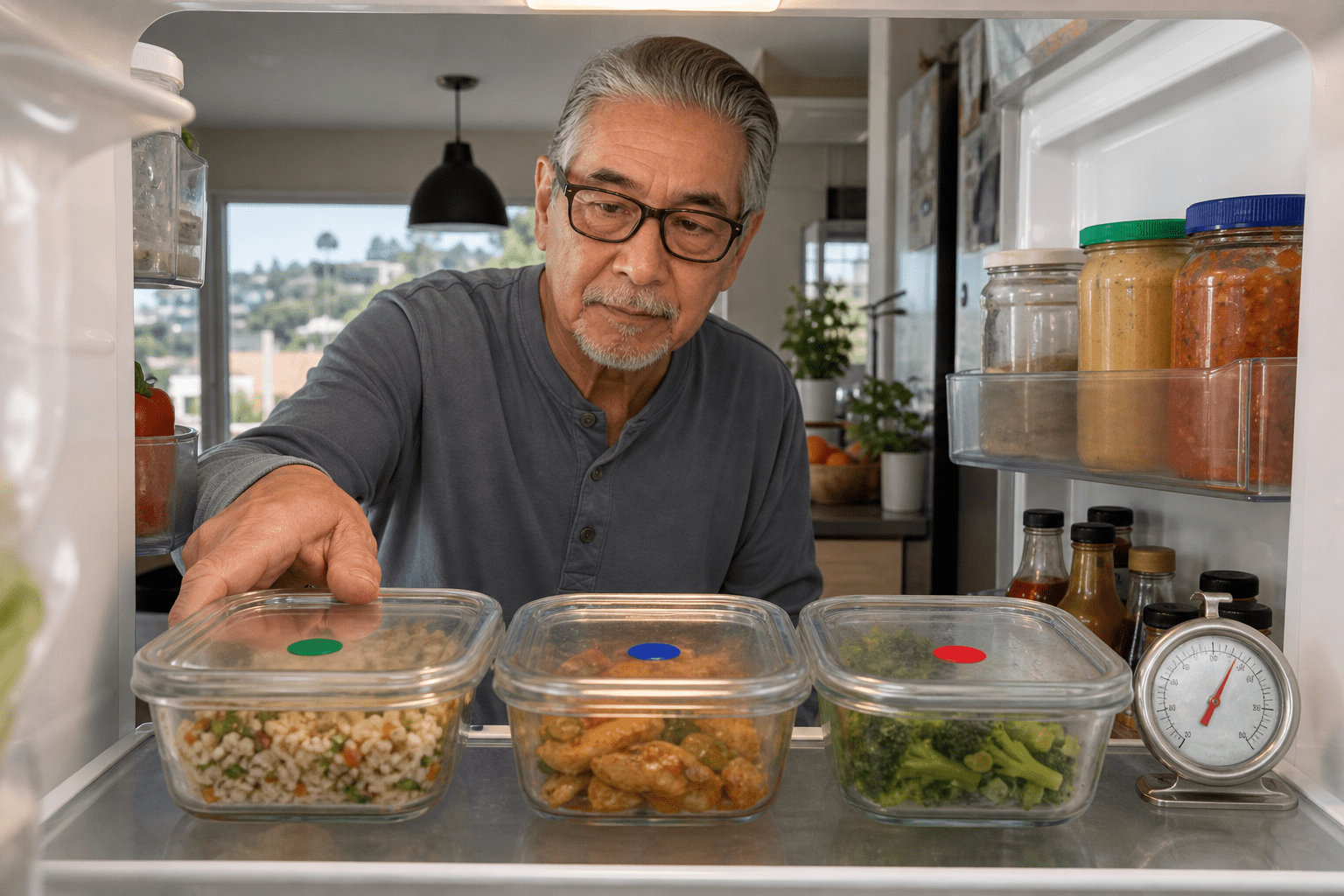
A refrigerator leftover date-label routine turns a vague question into a visible decision: label each covered container with the food name and storage date, place the oldest safe item in a front-row “use first” zone, and review that zone twice a week. When the date or storage history is unknown, do not rely on memory, smell, or a taste test.
Label the date
Write the food name and the day it was cooked, delivered, purchased, or opened. A clear date is more useful than a color alone.
Cool promptly
Use shallow covered containers and move perishable leftovers into refrigeration within the official time limit.
Make one use-first zone
Put the oldest safe leftovers at eye level near the front so they do not disappear behind new groceries.
Review on set days
Choose two dependable days each week. A short, repeated check works better than waiting for the refrigerator to look crowded.
Do not guess
If nobody can confirm the date or time out of refrigeration, discard the food. Smell and appearance cannot prove that food is safe.
Why a visible leftover routine helps older adults
Leftovers often become difficult to judge for ordinary reasons. A container moves behind a carton. Two family members remember different cooking dates. A delivered meal arrives while the person receiving it is busy. A helper assumes someone else added a label. None of those situations calls for a complicated tracking system. They call for one shared rule that is easy to see and repeat.
The routine matters because adults age 65 and older are among the groups more likely to become seriously ill from foodborne germs. The Centers for Disease Control and Prevention identifies adults 65 and older as a higher-risk group. That does not mean every older adult needs someone else to manage the refrigerator. It means a clear system can reduce avoidable uncertainty for the older adult and anyone who helps with meals.
A date label is not a safety guarantee. It is a decision tool. Safe storage still depends on prompt refrigeration, a cold refrigerator, clean containers, package directions, and the kind of food. The label simply makes those facts easier to use before memory fades.
Set up a simple front-row system
Start with the smallest possible kit. Keep a roll of removable labels or low-adhesive tape and a large-tip marker in one consistent place outside the refrigerator. Use writing that the person who will make the decision can read without picking up every container. If color dots help draw attention, use them in addition to the written date, not as the only code.
Choose one shelf
Reserve a reachable front section for cooked leftovers and opened prepared foods. Avoid a shelf that requires deep bending or moving heavy containers.
Create a use-first row
Place the oldest safe item at the front left or another agreed location. Newer containers go behind it only when they will remain visible.
Add an appliance thermometer
Keep a refrigerator thermometer where it can be read without unloading the shelf. The FDA says the refrigerator should stay at 40 degrees Fahrenheit or below.
Do not overfill the zone. When several similar containers are stacked, a person may need to lift each one to find the label. A single row is easier to scan. Use shallow containers that close securely and are not too heavy for the intended user.
If a family member already uses the shared grocery list and delivery handoff checklist, add one question to that handoff: “Which foods need a date label before we put them away?” This keeps ordering, delivery, and leftover storage as separate responsibilities while connecting them at the right moment.
The two-minute after-meal labeling routine
Use the same sequence after a home-cooked meal, restaurant takeout, or a delivered prepared meal. The goal is not to save every bite. The goal is to make the storage history clear enough for the next person to decide safely.
- Start the clock mentally. Note when the meal ended or when the food arrived. The FDA says perishable food should generally be refrigerated within two hours, or within one hour when the outside temperature is above 90 degrees Fahrenheit.
- Transfer food to shallow containers. The FDA safe food handling guidance recommends shallow containers for faster cooling. Divide a large amount rather than leaving it in a deep pot.
- Cover the container. Use a fitted lid or appropriate wrap. Do not reuse a cracked lid that no longer closes securely.
- Write the food name and date. Use the cooked date for home-cooked food, the purchase or delivery date for takeout, or the opened date when package instructions depend on opening.
- Place it in the use-first zone. Put the older safe container in front and the newly labeled container behind it. Keep raw meat or leaking packages away from ready-to-eat food.
- Say the handoff aloud. If another person will review the refrigerator, tell that person what was stored, the label date, and where it is located.
Los Angeles County heat matters during errands, outdoor meals, and deliveries left near a door. When the air temperature is above 90 degrees Fahrenheit, the official one-hour limit applies. The safest plan is to bring perishable groceries or takeout inside promptly rather than trying to calculate how hot a porch or vehicle became.
Four numbers worth posting nearby
- 40 degrees Fahrenheit or below: the FDA refrigerator target.
- Two hours: the usual maximum time for perishable food at room temperature.
- One hour: the limit when the temperature is above 90 degrees Fahrenheit.
- Three to four days: the USDA refrigerator window for most cooked leftovers when they were stored promptly and kept cold.
These are general federal guidelines. Follow a shorter package instruction when one applies, and use current agency guidance for unusual foods or circumstances.
Use a keep, freeze, or discard decision aid
During the review, do not begin by opening every lid. Begin with the label, storage history, refrigerator temperature, and package instructions. Opening a container can spread odors and does not answer whether harmful bacteria are present.
Keep and plan
What you know: The food was stored promptly, stayed at 40 degrees Fahrenheit or below, and is within the applicable storage time.
Action: Keep it in the use-first zone and plan when it will be eaten. The decision rests on time and temperature, not memory alone.
Freeze before the window ends
What you know: The food was stored promptly but will not be used within the recommended refrigerator window.
Action: Freeze it while it is still within that window, if the food freezes well. Add a new label with the food name and freeze date.
Discard an unknown
What you know: The date is missing, two people disagree about it, or the time outside refrigeration is unknown.
Action: Discard it. Do not taste it to decide. Smell, taste, and appearance cannot confirm that food is free of harmful bacteria.
Check the specific food
What you know: The package gives a shorter instruction after opening, or the food is not a typical cooked leftover.
Action: Follow the package or check the official FDA food-safety guide and cold-storage chart for older adults. Different foods can have different limits.
Use outage guidance
What you know: The refrigerator was warm or there was a power outage.
Action: Use current USDA emergency guidance and measured temperature. A date label cannot show whether the food stayed cold during an outage.
When reheating a cooked leftover, the FDA safe food handling guidance lists 165 degrees Fahrenheit for leftovers and casseroles. Use a food thermometer where appropriate rather than judging only by whether the center feels warm.
Run a twice-weekly refrigerator review
Choose two days that already have a reliable cue, such as the evening before trash collection and the morning before grocery shopping. The review should take about five minutes when the use-first zone stays small.
- Read the refrigerator thermometer.
- Scan every label in the use-first row without moving unrelated food.
- Identify the oldest safe container and decide when it will be used.
- Freeze an eligible item before its refrigerator time runs out.
- Discard items with unknown dates or uncertain storage history.
- Wipe a spill promptly with the cleaning method recommended for the appliance.
- Tell the next meal helper what remains in the use-first zone.
A twice-weekly glance is useful for households with frequent meal deliveries or several helpers, but it does not extend any storage time. The applicable official window, package direction, and storage history still control each decision.
Use one clear family handoff script
A good handoff names the food, date, location, and next decision. It avoids vague phrases such as “That should still be good” or “I think it came yesterday.”
Example: “I put the chicken and rice in two shallow covered containers. Both labels say July 20. They are in the front-row use-first zone. Please decide by the next refrigerator review whether to serve or freeze them.”
For an out-of-town relative, use the same four facts in a text message or shared note. The out-of-town family support guide offers a broader framework for assigning one owner to practical follow-up. Keep the refrigerator task narrow: one person labels, one person reviews, and both use the same rule.
When an older adult receives help from more than one person, post the review days near the refrigerator without adding personal medical information. Do not use a visible note to list diagnoses, medications, or private schedules. The routine works with only food names, dates, and a named household responsibility.
Common mistakes that make labels less useful
- Using only a color: red may mean “Monday” to one helper and “discard” to another. Write the date.
- Labeling the lid but swapping lids: keep each lid with its container until the food is used or discarded.
- Writing a planned serving date instead of the storage date: the storage date is the fact needed for the decision.
- Keeping too many containers in the use-first zone: limit the row so every label stays visible.
- Tasting food with an unknown date: a taste test is not a safety test.
- Assuming a date label covers a power outage: it does not. Use the power outage preparation checklist for the household routine, then follow current USDA food guidance for the refrigerator.
A one-card routine to place near the refrigerator
After a meal: cool promptly, use a shallow covered container, write the food name and date, and place it in the use-first row.
On review day: read the thermometer, scan the dates, plan the oldest safe item, freeze early when appropriate, and discard unknowns.
When uncertain: check package instructions or an official storage chart. If time or temperature cannot be confirmed, do not guess.
Primary sources used for this routine
This guide relies on current public guidance from the FDA on safe food handling, the FDA food-safety guide for older adults, the CDC on people at increased risk, and the CDC on promptly refrigerating and using restaurant leftovers. Review source instructions again when a package, appliance, outage, or unusual food creates a different situation.
Frequently asked questions
What should go on a leftover label?
Write the food name and the date it was cooked, purchased, or opened. Add a use first note when several containers look alike.
How long can cooked leftovers stay in the refrigerator?
Federal food-safety guidance says most cooked leftovers can stay in the refrigerator for three to four days when stored promptly at 40 degrees Fahrenheit or below.
Can smell or appearance prove that a leftover is safe?
No. Harmful bacteria may not change the smell, taste, or appearance of food. Use time, temperature, package directions, and official storage guidance.
What should I do when the storage date is unknown?
If the storage date or time outside refrigeration is unknown, do not guess. When safety cannot be confirmed, discard the food.
Who should check the use-first zone?
Choose one named person for each visit or meal handoff. That person labels new containers, moves older food forward, and records any item that needs a decision.
Does the same routine apply after a power outage?
Keep refrigerator and freezer doors closed and follow current USDA guidance for the length of the outage and measured food temperature. Do not rely on smell alone.
Need help organizing practical senior support?
All Seniors Foundation can help Los Angeles County families find the right starting point for general senior-support questions. Food-safety decisions should still follow the responsible agency, package, appliance, or qualified professional.
