
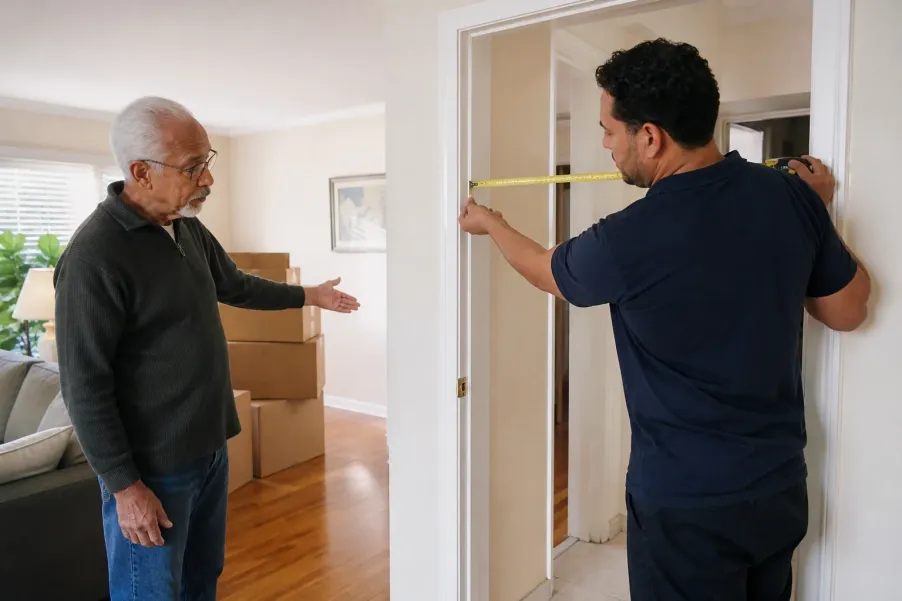
Compare moving company estimates by giving each mover the same household inventory, access conditions, dates, and requested services. Confirm whether the move stays within California or crosses state lines, verify the company with the correct regulator, review every written charge and protection choice, and pause before signing when details are blank, inconsistent, rushed, or hard to explain.
Four useful takeaways before you compare movers
- Route the move correctly. California household moves and interstate moves use different regulators and verification tools.
- Make the estimates comparable. Every mover should inspect the same rooms, belongings, stairs, elevators, parking limits, dates, and optional services.
- Compare the complete written offer, not one large price. Look at included labor, travel, packing, materials, storage, access charges, valuation or protection choices, payment terms, and change procedures.
- Slow the decision down. A trusted helper can take notes, but the older adult should understand the plan and keep copies before signing or paying.
Is the move within California or across state lines?
Start with the destination, because the correct verification path changes with the move. A household move that begins and ends in California is an intrastate move. The California Bureau of Household Goods and Services licenses household movers that operate in the state and publishes consumer guidance for these moves. A move from California to another state is interstate and should be checked through the Federal Motor Carrier Safety Administration.
Do not rely on a familiar company name, a polished website, a referral, or a truck logo to answer this question. Ask the company which legal business is responsible for the move and which California license or federal USDOT number applies. If a broker is involved in an interstate move, identify the broker and the carrier that will actually transport the belongings. Record the exact names and numbers so each estimate can be tied to the same responsible business.
Move stays in California
Use California BHGS consumer information and license search. Confirm that the company identity on the estimate matches the current official record.
Move crosses a state line
Use FMCSA resources to check federal registration, company details, and interstate consumer guidance before relying on an estimate.
Route is unclear
Ask the company to explain who will transport the goods and which regulator applies. Do not sign until the answer can be independently verified.
This guide offers consumer-preparation steps, not legal advice or contract interpretation. Moving rules, rates, company authority, insurance, and dispute procedures can change. Verify the current record with the responsible regulator and seek qualified advice for a legal dispute or contract question.
How do you give every mover the same job to estimate?
An estimate can look lower simply because the mover saw fewer belongings or different access conditions. Before appointments, create one room-by-room inventory that every company will inspect. Name large furniture, appliances, fragile pieces, packed and unpacked boxes, mobility equipment, items in closets, patio or garage contents, and anything going to storage, donation, disposal, or a different address.
You do not need a perfect count on the first pass. The goal is consistency. Walk the same route with every estimator and correct the inventory when something changes. If one mover includes an item that another missed, update the comparison rather than pretending the prices cover identical work. The home inventory photo walkthrough can help organize rooms and belongings, but do not share images containing account numbers, medication labels, identification, alarm details, or unrelated private information.
Include the access details that can change the work
- Origin and destination addresses
- Move date or date range
- Flights of stairs and elevators
- Doorway and hallway limits
- Parking distance and restrictions
- Long carries or shuttle needs
- Disassembly and reassembly requests
- Packing and unpacking requests
- Storage or multiple stops
- Items the mover will not handle
- Who supplies boxes and materials
- Mobility or communication needs during the visit
Separate move preparation from decluttering decisions. If documents need secure disposal, use the community document shredding guide and verify the event rules. If an item may be donated, confirm the receiving organization before arranging pickup; the charity verification guide provides a separate due-diligence path.
What should happen during a moving estimate walkthrough?
California BHGS advises consumers that an in-state household mover provides a written estimate after visually inspecting the goods. Federal guidance for interstate moves also emphasizes an estimate based on an actual or virtual inspection. The practical purpose is the same: the company needs enough information to describe the job and price basis in writing.
Before the appointment, ask whether it will be in person or virtual, how long it should take, who is coming, and what information the estimator needs. If the appointment is at home, verify the company and visitor identity before opening the door. The visitor verification checklist offers a useful call-back-first routine that can be adapted without assuming a uniform or caller ID proves identity.
During the walkthrough, show the estimator every included area and mention known access constraints at both addresses. Ask the estimator to name services that are included, services that cost extra, and assumptions that could change. Take notes in your own words. Do not sign a partially completed form to make the appointment faster.
“I am comparing written estimates for the same move. Please confirm the legal company name, license or USDOT number, inventory, access conditions, included services, optional charges, protection choices, payment schedule, and the process for a change. I need a complete copy to review before I decide.”
If the estimate depends on information you do not have, write down the open question. Examples include elevator reservation rules, parking permits, storage access, a delivery window, or whether a large item can fit. Resolve the issue before treating the quote as final. A lower number with major unknowns is not automatically the better estimate.
How do you compare moving estimates line by line?
Put the estimates beside one another and normalize the categories. Different companies may group charges differently, so ask for clarification rather than guessing. California in-state documents may use a Not to Exceed amount under current BHGS rules. Interstate estimates may use federal terms such as binding or non-binding. Do not apply a term from one system to another without checking the relevant official guidance.
| Comparison line | What to record | Question when it differs |
|---|---|---|
| Company identity | Legal name, address, contact, license or USDOT number | Does this record name the company that will actually move the goods? |
| Inventory and access | Rooms, large items, estimated boxes, stairs, elevators, parking, distance | Which item or condition is missing from this estimate? |
| Labor and transport | Crew assumptions, hours or weight basis, travel, fuel, mileage, delivery window | What event can change the labor or transportation charge? |
| Extra services | Packing, materials, disassembly, storage, shuttle, long carry, multiple stops | Is this included, optional, or charged only if needed? |
| Protection choice | Available valuation or protection option, declared value, stated cost and limits | What document explains loss or damage responsibility for this option? |
| Price and payment | Estimate type, maximum or estimated charge, deposit, due dates, payment methods | What can change the amount, and how will a change be documented? |
Use the same labels for all companies even when their paperwork uses different layouts. Circle gaps, not just totals. If one quote includes packing and another assumes everything is packed, the totals are not comparable. If one includes a difficult staircase and another does not, correct the scope before making a choice.
The home repair estimate preparation guide uses a similar same-scope principle for a different type of service. A moving estimate has its own regulators and documents, but the discipline of comparing the same requested work remains valuable.
How do you verify the company behind the estimate?
For an in-state California household move, use the BHGS license search reached from the state consumer page. Match the legal or business name and identifying number to the estimate. Review the status and any available public enforcement information carefully. A similar name is not enough, and a screenshot saved by the company is not a substitute for a current search.
For an interstate move, use FMCSA tools and consumer guidance. Match the USDOT number and company identity. Confirm whether the business is a carrier, broker, or both, and identify who will take possession of the goods. If the estimate names a different carrier later, repeat the current official check before the move.
Record the date of each search and save the result with the estimate. Official status can change, and a verified record does not guarantee service quality, price, availability, or a dispute-free move. It answers a narrower question: whether the business identity and operating authority shown in the official system match the company asking to handle the move.
What signs should make you pause before signing or paying?
Pause when the paperwork is incomplete, the company identity is unclear, or pressure replaces explanation. Ask for corrections in writing and review a clean copy. A salesperson who will not explain a charge, refuses to connect the estimate to the verified company, or asks you to sign blank spaces has not given you a sound basis for comparison.
Identity concern
The name, address, license, USDOT number, website, email, vehicle, or payment recipient does not match the official record or the estimate.
Scope concern
Important rooms, items, stairs, parking limits, packing duties, delivery conditions, or extra services are missing or described only verbally.
Decision concern
The company demands an immediate signature, discourages questions, leaves blanks, requests an unexplained large payment, or will not provide copies.
Do not solve uncertainty by adding private financial information to an email or text. Use the company contact listed in the verified official record and ask what secure process is required. Never send identity documents, bank details, account passwords, alarm codes, or full medical information merely to obtain an estimate.
If a consumer question remains unresolved, Los Angeles County residents can contact the Department of Consumer and Business Affairs for current education or complaint-routing help. That local resource cannot select a mover for you and does not replace the state or federal regulator responsible for mover authority.
How can a trusted helper support an older adult without taking over?
A family member, friend, caregiver, or case manager can organize appointments, keep the inventory consistent, take notes, and read documents aloud. The helper should not invent answers about belongings, authorize services without permission, or pressure the older adult to accept the cheapest or fastest option.
Agree on roles before the first estimate. Decide who speaks with estimators, who shows rooms, who records open questions, and who receives copies. If hearing, vision, language, memory, or fatigue makes a long appointment difficult, request a slower explanation, accessible format, interpreter information, or a second review period. Confirm what the company can provide rather than assuming.
A respectful helper checklist
- Use the older adult’s preferred name, communication method, and pace.
- Ask permission before sharing contact, health, financial, or household details.
- Write down questions that need an official or professional answer.
- Keep original identification and sensitive records in the older adult’s control.
- Review the complete estimate together after the appointment.
- Leave room for no decision, another estimate, or a different moving plan.
How do you make a documented moving-company choice?
After the estimates are complete and verified, score the practical fit rather than chasing one number. A strong option has a matching official identity, complete scope, understandable price basis, clear change process, realistic schedule, acceptable payment terms, and communication that supports informed decisions.
Ready to compare
The company identity is verified, the inventory and access details match, the written estimate is complete, and every material question has a clear answer.
Needs clarification
The company may remain under consideration, but one or more scope, protection, timing, price, or payment details must be corrected in writing.
Do not proceed yet
The responsible company cannot be verified, paperwork is blank or inconsistent, important charges are unexplained, or pressure prevents a careful review.
Keep the estimates, official search results, notes, messages, and copies of anything signed in one move folder. Photograph the condition of belongings before packing when appropriate, but protect private information. Confirm the selected company, move date, pickup and delivery details, contact route, payment plan, and change procedure again before moving day.
No checklist can guarantee a final price or problem-free move. The purpose is to reduce avoidable uncertainty, make differences visible, and create a record of what each company offered at the time you decided.
Which official resources should you use?
- California BHGS Household Movers Information explains current consumer rules for household moves in California, including written estimates, company authorization, move documents, and complaint routes.
- California BHGS License Search provides the current state verification route for household movers and public enforcement information.
- FMCSA Steps to Select a Mover explains federal verification and estimate steps for interstate household moves.
- Los Angeles County Consumer and Business Affairs lists current local consumer-help contact routes and office information for county residents.
Use the official page that matches the move and verify again near the decision date. A search result, advertisement, review site, social account, or saved copy can become outdated and may not identify the business that will actually handle the belongings.
Organize the next step without rushing the decision
All Seniors Foundation can help an older adult or family helper organize practical questions and related support needs in Los Angeles County. The Foundation does not license movers, interpret contracts, guarantee a price, or choose a company.
Frequently asked questions
How many moving estimates should an older adult compare?
There is no universal required number. Compare enough complete written estimates to understand the scope, company identity, price basis, services, protection choices, and payment terms. Give each mover the same inventory and access details so the comparison is meaningful.
Which agency verifies a mover for a move within California?
Use the California Bureau of Household Goods and Services consumer page and license search for a household move that begins and ends in California. Match the current official business identity and license information to the estimate before relying on it.
Which agency verifies a mover for an interstate move?
Use Federal Motor Carrier Safety Administration resources for a move that crosses a state line. Match the USDOT number and company identity, and determine whether the business is the carrier, a broker, or both.
Is the lowest moving estimate always the best choice?
No. A lower estimate may omit belongings, access conditions, packing, materials, storage, delivery details, protection choices, or other services. Compare the complete written scope and verify the responsible company before considering the total.
Should an older adult sign an estimate with blank spaces?
No. Pause and ask the company to complete or correct the document before signing. Keep a complete copy and do not rely on a promise that important names, dates, prices, services, or terms will be added later.
Can All Seniors Foundation recommend or hire a moving company?
All Seniors Foundation can help organize practical questions and related support needs, but it does not license movers, interpret contracts, guarantee prices, select a company, or hire a mover for the reader.





