
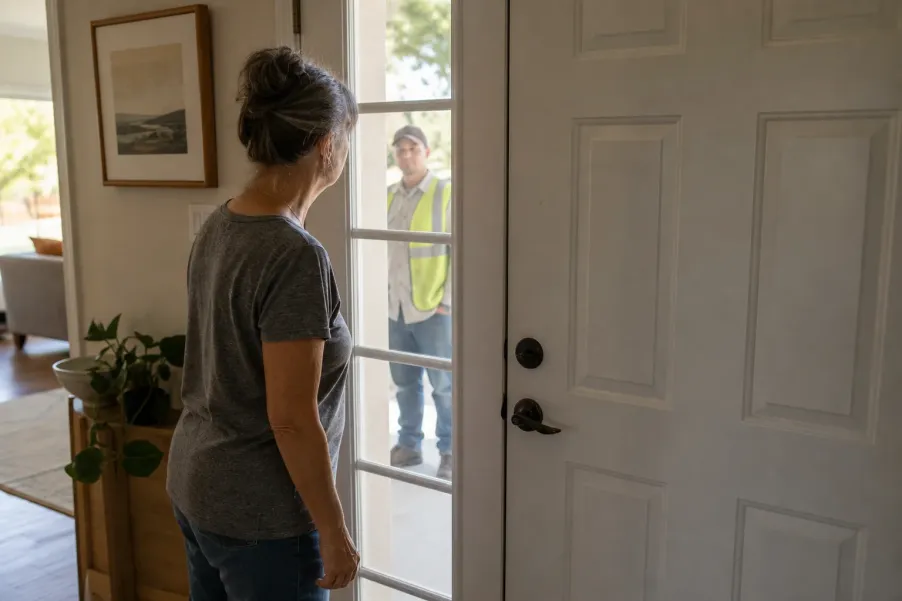
An unexpected knock from someone who says they work for a water, power, electric, or gas company can create pressure to decide quickly. A calm household routine makes that moment easier: keep the door closed, identify the purpose of the visit, and verify the person through a contact route that the household already trusts.
Pause at the door
A uniform, safety vest, badge, vehicle, door hanger, or familiar company name can support a check, but none should replace independent verification.
Use your own contact route
Call the number saved from an official bill, account, or company website. Do not rely on a number supplied by the visitor or an unexpected message.
Separate entry from payment
A home visit is not the time to hand over cash, a gift card, a payment-app transfer, account credentials, or banking information.
Share one household rule
Family members and helpers can agree in advance that an unscheduled visitor waits outside while the account holder verifies the visit.
What should you do in the first minute?
Start by creating time. Speak through the closed door, a window, an intercom, or a doorbell speaker if one is available and comfortable to use. Ask the visitor to state a name, employer, identification number, purpose, and whether the visit was scheduled. You do not need to open the door to ask those questions.
The current LADWP Scam Alert tells customers not to open the door to someone they do not recognize, to ask for photo identification through a window, and to contact LADWP directly when uncertain. It says LADWP employees and contractors carry company identification showing a name, photograph, and identification number. That is a useful company-specific check, but the household should still verify an unexpected visit independently.
Ask the person to wait at a respectful distance while you check. A legitimate field worker may need to explain a service request, inspection, meter task, maintenance notice, or safety issue. The goal is not to argue or accuse. The goal is to avoid making an entry, payment, or information-sharing decision under pressure.
If the visitor becomes threatening, tries to force entry, refuses to step back, or creates an immediate safety concern, move away from the door and contact emergency services when appropriate. Do not physically confront, follow, detain, or photograph the person if doing so would put anyone at risk.
What can a badge, uniform, or vehicle actually prove?
Identification details are clues to check, not automatic proof. A badge can be copied. A safety vest is widely available. A caller ID can be spoofed. A company-looking vehicle or door notice can be imitated. On the other hand, the absence of one expected item does not always prove fraud because utilities use different employees, contractors, uniforms, and field procedures.
For example, SoCalGas scam guidance says all employees on company business carry a photo identification badge, while uniforms can vary. It advises customers to call before allowing entry when no appointment was scheduled. Southern California Edison guidance about authorized crews likewise notes that most, but not all, employees wear uniforms with identification and that contractor identification may include a badge, hard hat, uniform, or vehicle.
That variation is why the best question is not “Does this person look official?” but “Can the utility confirm this specific visit through a contact route I selected?” Verification should connect the person, company, address, work purpose, and timing. A badge alone connects only the person to what the badge claims.
| What you notice | What it may support | What to verify separately |
|---|---|---|
| Photo badge or identification number | The person is presenting a checkable identity. | Whether the utility recognizes that person and visit. |
| Uniform, vest, hard hat, or marked vehicle | The appearance is consistent with some field work. | Whether the company assigned the work at this address. |
| Appointment window or service request | The timing may match a household request. | The work order, provider, and person expected. |
| Door hanger or written notice | The notice may describe planned work. | The notice through the company website or known phone number, not only the printed contact. |
How do you verify an unexpected utility visit?
- Keep the entry closed. Use the safest available way to speak without granting access. Do not announce that you are alone or explain where other household members are.
- Collect only checkable details. Ask for the visitor’s name, employer, identification number, department or contractor, purpose, and any work-order reference. Do not hand over a bill or account number.
- Find the company independently. Use a saved official number, a printed bill already in the home, the official account portal, or a carefully typed company website. Avoid search advertisements and any number the visitor asks you to call.
- Describe the visit without supplying secrets. Tell the utility that a person is at the address and provide the claimed identity and purpose. Ask whether the visit is expected and what identification should be present.
- Match the answer. Confirm the company, worker or contractor, work purpose, address, and timing. If the utility cannot confirm the visit, do not allow entry.
- Decide without pressure. A confirmed visit may still require the account holder to understand what access is needed. Ask the worker to explain the task before opening the door or gate.
- Close the loop. After the visit, note the date, utility, confirmed purpose, and outcome. Keep account numbers, passwords, payment details, and identification copies out of a shared log.
The Federal Trade Commission utility-scam guide says an unexpected caller or visitor who threatens immediate shutoff unless payment is made is using a scam pattern. The FTC advises contacting the utility using a number on the bill or official website and warns against demanded wire transfers, cryptocurrency, payment apps, or gift cards.
How should the routine change for common situations?
A visit was scheduled
Compare the date, time window, provider, and task with the original appointment record. Still ask for identification before entry, especially if a different company or purpose appears.
No one scheduled a visit
Keep the door closed and call the utility. Unscheduled maintenance can occur, but the company should be able to explain how customers can verify the work.
The visitor demands payment
Do not pay, share financial information, or follow a payment link. End the conversation and check the account through an official route.
The visitor reports an urgent hazard
Do not ignore a possible gas leak, damaged line, fire, or electrical danger. Move to a safe location and contact the utility or emergency services through a known official number.
A safety emergency is different from a routine identity check. If anyone smells gas, sees downed electrical equipment, notices smoke or fire, or receives a credible instruction to evacuate, personal safety comes first. Leave the area when advised and use the responsible utility or emergency channel. This Article does not diagnose a hazard or replace emergency instructions.
For other unexpected contacts, ASF’s voicemail safe-callback routine explains the same core idea: record the claim, end the incoming contact, and return through an independently verified route. The method works because the household chooses the channel instead of letting the stranger control it.
How can the household prepare before anyone knocks?
Preparation should make verification easier without creating a new privacy risk. Save the official customer-service and emergency numbers for the actual water, electric, and gas providers serving the address. Los Angeles County contains many cities and utility territories, so do not assume that every household uses LADWP, SoCalGas, or Southern California Edison.
ASF’s large-print phone-list guide can help keep verified numbers readable. Label each number with the provider and purpose, such as customer service, outage, or gas emergency. Do not put account numbers, passwords, security answers, or payment details on the list.
Next, create one household rule: no unscheduled worker enters until the utility confirms the visit. Put the rule in plain language near the phone, not on the outside of the door. Practice the first-minute script once so the words are familiar. A helper can role-play the caller at the company while the older adult practices asking the visitor to wait.
Check the entry area itself. The home address-number visibility guide helps households verify that responders and scheduled providers can identify the correct property without publishing unnecessary personal details. The home inventory photo walkthrough offers a separate way to document household belongings without turning the doorstep check into a photography task.
Finally, decide who can help if verification is difficult. Choose a family member, neighbor, property manager, or other trusted person who understands the closed-door rule. The helper should support the decision, not override the account holder or speak to the visitor through an unverified number.
What are good boundaries for family helpers?
A family helper can stay on the phone, look up an official utility route, read identification details back, or join a three-way call that the account holder places. The helper can also check whether a household member scheduled work and remind everyone not to share payment or account information at the door.
The helper should not pretend to be the account holder, store account credentials, authorize work that the account holder does not understand, or confront the visitor. If the utility requires account verification, let the account holder complete it directly unless a lawful authorization already exists and the provider accepts it.
Use neutral notes. “Utility visit confirmed for meter work at 2 p.m.” is usually more useful than copying a full account number, badge image, driver license, bill, or service record into a group chat. If the visit was not confirmed, record the claimed company, approximate time, and what the official utility advised.
All Seniors Foundation can help Los Angeles County older adults and families think through general support-navigation and household-coordination questions. It cannot verify a utility worker, access a utility account, authorize property entry, resolve a bill, or guarantee that a visitor is legitimate.
What should you record after the visitor leaves?
A short factual note can help if the person returns or the household needs to report the contact. Record the date and approximate time, claimed utility, claimed purpose, whether the utility confirmed the visit, and the outcome. Avoid guessing about identity, motive, or criminal activity.
If money, account credentials, a Social Security number, a payment card, or other sensitive information was shared, act promptly. Contact the financial provider or utility through an official route, ask what protective steps are available, and use the FTC reporting guidance when relevant. Do not call a number supplied by the visitor to “reverse” a payment.
If the visit was legitimate, keep only the records needed for the work and follow the utility’s official instructions. If it was not confirmed, report it to the utility and follow any law-enforcement guidance appropriate to what occurred. A suspicious visit is not proof that every later utility visit is false; return to the same verification routine each time.
For more practical household planning resources, browse ASF’s Senior Support Guides. The strongest routine is short enough to remember: close, ask, call, confirm, then decide.
Common mistakes that weaken the verification check
Trusting appearance alone
A uniform or badge can look convincing. Use it as information for the utility to verify, not as the final decision.
Calling the visitor’s number
A supplied number can lead to an accomplice or fake answering service. Choose the official contact route yourself.
Sharing the bill
A bill can expose account and personal details. The utility should explain how to verify the visit without handing the document to a stranger.
Turning the check into a confrontation
Keep distance, use calm words, and prioritize safety. Verification does not require accusing or physically challenging anyone.
Frequently asked questions
Should I open the door to check a utility worker badge?
No. Ask the visitor to show identification through a window or another closed-door method, then verify the visit through an official utility contact route that you selected.
Does a uniform or company vehicle prove the visitor is legitimate?
No. A uniform, badge, safety vest, vehicle, or door notice can support a check but does not replace confirmation from the utility through a trusted official channel.
What if the utility visit was not scheduled?
Keep the door closed and contact the utility independently. Unscheduled field work can occur, but the company should explain how to verify the person and purpose before entry.
Can a utility worker demand immediate payment at my door?
Do not pay a visitor who threatens immediate shutoff or demands cash, gift cards, wire transfers, cryptocurrency, payment apps, or account credentials. Check the account through the official utility route.
How can a family helper assist with verification?
A helper can find the official number, stay on the call, compare appointment details, and support the account holder. The helper should not impersonate the account holder or confront the visitor.
What if the visitor reports a gas leak or another immediate hazard?
Move to a safe location and contact the responsible utility or emergency services through a known official number. Do not delay a credible safety response to debate identity at the door.
Need help organizing a household verification plan?
All Seniors Foundation can help Los Angeles County older adults and families organize general support-navigation and household-coordination questions. It cannot verify a worker, access a utility account, authorize entry, resolve a bill, or guarantee a visitor’s identity.





