
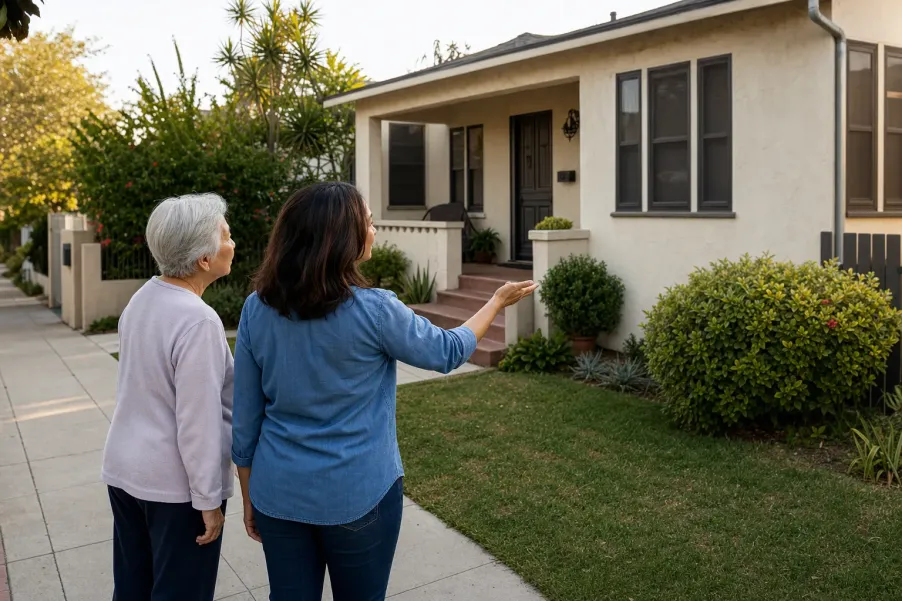
When a home address number is hard to see, a visitor may hesitate at the curb and an emergency responder may need extra time to identify the correct property. A short visibility walk can uncover ordinary problems such as low contrast, deep shadows, overgrown plants, a confusing driveway, or a number that can be seen from only one direction.
Check the real approach
Look from the direction a guest, delivery driver, or responder would normally arrive, not only from the front door.
Stay on safe surfaces
Use a sidewalk, walkway, driveway edge, or another authorized location. Never step into traffic to get a better view.
Separate checking from fixing
A visibility walk identifies an issue. It does not authorize climbing, drilling, wiring, high trimming, or changing rental property.
Repeat after dark
A number that reads clearly at noon may disappear in porch shadows at night, so conduct a second observation from a safe position.
What does “easy to identify from the street” mean?
For this routine, “easy to identify” means that a person approaching normally can distinguish the correct address without stopping in an unsafe place, searching several walls, or relying on a description such as “the beige house after the tall hedge.” It also means the numerals have a useful contrast with their background and are not hidden by ordinary shadows, parked objects, or vegetation.
The Los Angeles Fire Department Street Address Number Guide says address numbers should be easily readable from the street and should contrast with the background. It also notes that shadows, overgrown vegetation, building position, driveways, alleys, walkways, and other access routes can affect what responders see. The U.S. Fire Administration expresses the purpose plainly: first responders should be able to see the house number from the road.
This Article turns those principles into an observation routine. It does not determine whether a building complies with every current code provision. Setback, property type, local enforcement, historic features, a shared driveway, and a multi-unit layout can change the correct solution. When a result is unclear, the responsible owner or Los Angeles Fire Department is the proper source for a property-specific answer.
How should an older adult prepare for the check?
Choose a dry day with good visibility. Wear stable footwear, bring a family helper if balance, vision, hearing, traffic, or an unfamiliar property may make the walk harder, and remain only on public or authorized surfaces. The goal is to observe a sightline, not to touch the sign or prove that it can be reached.
Confirm the exact address privately from a reliable source already available to the household, such as a lease, utility account, property record, or official mail. Do not post a photograph of the address publicly or share it in an open social-media group. For broader household readiness, pair this routine with the large-print phone list setup and the power-outage flashlight and phone-charging check.
How do you complete the six-step address visibility walk?
- Start at the normal arrival direction. Stand on the safe side of the sidewalk, walkway, or driveway from which a visitor would first look toward the property. If most arrivals come from two directions, repeat the view from both.
- Find the address without a hint. The helper should look before the resident points. Notice how long it takes to locate the number and whether another nearby number competes for attention. This reveals confusion that a familiar resident may no longer notice.
- Check distance, contrast, and shape. Ask whether each numeral can be distinguished at the useful approach distance. Look for pale numbers on pale stucco, dark numbers in deep shade, ornate type that changes the shape of a digit, or a background pattern that competes with the address.
- Check ordinary obstructions. View the number with the gate, screen, plants, seasonal decorations, parked vehicles, and trash containers in their usual positions. Do not move a heavy object, cut vegetation, or reach over a railing during the check.
- Check the actual access route. If responders or visitors would use a driveway, side walkway, alley, lobby, or shared entrance, confirm that the route makes the correct building clear. Do not enter a locked or private area merely to finish the test.
- Repeat after dark from a safe location. Observe whether existing lighting makes the number readable without glare or a harsh shadow. Do not change a bulb, open a fixture, run an extension cord, or perform electrical work as part of this routine.
The Los Angeles Fire Department’s Firewise guidance recommends identifying a home and neighborhood with legible, clearly marked street names and numbers. Combined with LAFD’s address-number guide, that supports checking the full arrival sightline rather than treating numeral size as the only question.
What should you do with each result?
Describe only what a person could or could not see. A factual observation such as “the last digit disappears behind the hedge from the east sidewalk” is more useful than “the sign is illegal.” It gives an owner or professional a specific problem to evaluate without overstating the checker’s authority.
| Observation | Practical next step | Do not assume |
|---|---|---|
| Clear from both daytime approach directions | Repeat after dark and after major seasonal growth or exterior changes. | Daylight visibility alone proves every requirement. |
| Readable only after someone points to it | Describe the sightline, contrast, or competing visual element to the responsible owner. | Familiarity means a first-time visitor will find it. |
| Partly blocked by plants or stored items | Ask the owner or property manager for a safe ground-level correction or professional maintenance. | An older adult should trim high growth or move a heavy object. |
| Visible by day but lost in shadow at night | Request an assessment of lighting, placement, or contrast by the responsible party. | A resident should install or rewire a fixture. |
| Building is clear, but the unit route is confusing | Ask management how visitors and responders should identify the correct unit or entrance. | A tenant may add signs in shared areas without permission. |
| No safe observation point exists | Stop and ask a property professional or public-safety authority for guidance. | The check must be completed from the roadway. |
If the household is building a broader visual record, the home-inventory photo walkthrough explains privacy-conscious documentation, while the smoke and carbon monoxide alarm sound check covers a separate no-climb listening routine. Keep each task narrow so one checklist does not become an unsafe all-day inspection.
How does the LAFD setback-based number guide work?
LAFD publishes a Los Angeles-specific sizing method based on the distance from the structure to the street. Its guide says the height of a numeral or letter should be two inches more than one-tenth of the setback distance in feet, expressed in inches. In the LAFD example, a 30-foot setback produces a five-inch numeral: one-tenth of 30 is three, expressed as three inches, plus two inches.
The same guide describes numeral width as one-half of the height and stroke width as one-tenth of the height. Those ratios are useful when a property owner discusses readability with a sign professional. They are not a reason for an older adult to climb, measure from traffic, remove an existing sign, or purchase a replacement without confirming the property-specific requirement.
A number can meet a nominal size and still be hard to identify because it blends into the wall, sits behind leaves, disappears in glare, or faces away from the normal approach. That is why this walk checks the whole sightline rather than focusing only on inches.
What changes for rentals, apartments, and curbside mailboxes?
A renter should report the observation before attaching, relocating, repainting, illuminating, or replacing an address sign. For an apartment or condominium, distinguish three questions: Can a visitor identify the property from the street? Can the visitor find the correct shared entrance? Can authorized responders follow the building’s unit-identification system? The owner or manager controls shared surfaces and should explain the approved route.
A curbside mailbox may carry a street number under applicable U.S. Postal Service rules, but a mailbox marker should not be treated as an automatic substitute for the building identification expected by local authorities. Mail delivery and emergency identification are related sightline problems with different governing rules. Ask the property owner and local authority which locations are required.
When the check reveals a broader coordination need, use the shared household calendar guide to assign a follow-up owner and review date. For additional practical, nonclinical planning topics, browse the Senior Support Guides.
Common mistakes that make the check less useful
Testing only from the front step
The resident already knows where to look. Start where an unfamiliar person first sees the property.
Using a phone zoom as proof
A zoomed photograph can make a distant number look readable even when the unaided arrival sightline is poor.
Turning the check into repair work
Observation should stop before climbing, wiring, drilling, high trimming, or altering shared property.
Publishing the address
Keep property-specific photographs and notes private and share them only with the responsible person or authority.
Frequently asked questions
Do I need to stand in the street to check the address?
No. Use a sidewalk, walkway, driveway edge, or another safe and authorized location. If the address can be evaluated only from moving traffic, stop and ask the owner or a qualified professional to assess it.
How large should house numbers be in Los Angeles?
LAFD publishes a setback-based sizing method and additional readability guidance. Confirm the current property-specific requirement with LAFD or the responsible building professional before installing or replacing numbers.
What if the number is visible during the day but not at night?
Report the nighttime shadow, glare, or lighting problem to the owner or property manager. Do not climb, open a fixture, install wiring, or run an extension cord as part of the check.
What should a renter do when an address is hard to see?
Give the landlord or property manager a factual description of the blocked or confusing sightline. Do not attach, relocate, repaint, or illuminate a sign on shared or rented property without approval.
Should I add the address number to a curbside mailbox?
Follow the property owner’s direction and applicable USPS and local rules. A mailbox number may help with one approach, but it does not automatically replace required building identification.
Is this visibility walk an emergency procedure?
No. It is a routine maintenance observation. During an emergency, call 911, state the correct address clearly, follow the dispatcher’s instructions, and do not delay help to inspect or change a sign.
Need help organizing the next step?
All Seniors Foundation can help Los Angeles County older adults and families think through general support-navigation questions. It does not provide address inspections, code determinations, sign installation, electrical work, or emergency response.





