
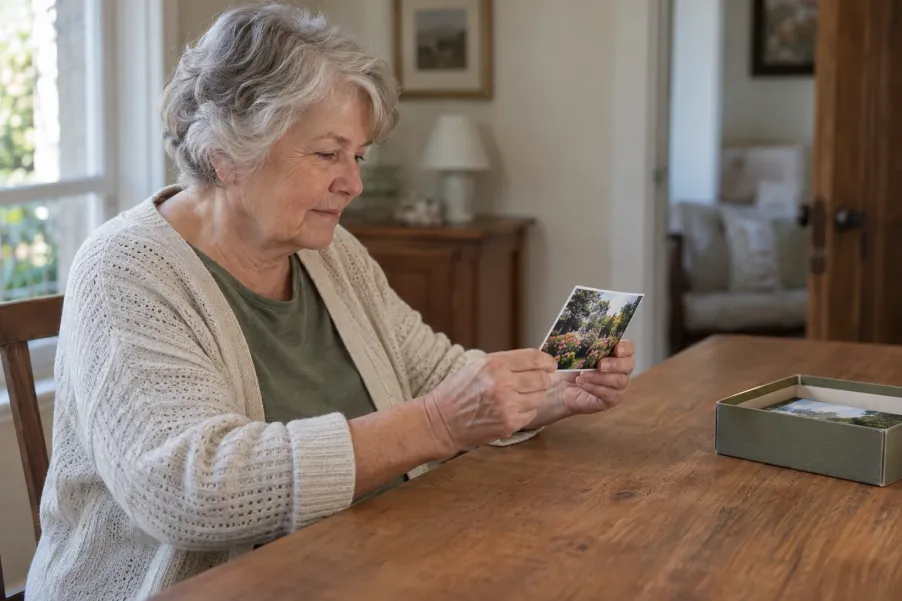
To sort printed family photos without losing their stories, preserve the groups you find before rearranging them. Give each enclosure a stable identifier and connect it to a short finding list. Record existing labels exactly, attribute family recollections, and leave uncertain details unresolved. Finish by checking that someone can use the list to locate a particular print.
Four things to keep connected
- The photograph and the envelope, stack, or album location where it was found.
- The enclosure identifier and its current place in storage.
- A name or date and the source supporting it.
- The owner’s instructions and any limits on handling or sharing.
A box becomes easier to use when you can answer two questions: Where is the photograph? What do we actually know about it? Sorting only by decade may answer neither question when dates are missing or an old envelope contains several occasions.
This All Seniors Foundation guide helps older adults and family helpers in Los Angeles County organize stable, loose paper prints. The result is a physical arrangement and a finding list: a private index connecting descriptions to storage locations. It can stay entirely on paper. The numbering and record examples below are suggested household methods, not an institutional cataloging standard.
What should stay together before you sort printed family photos?
Start by describing the arrangement already present. An envelope, rubber-stamped studio sleeve, handwritten divider, or stack tied to a particular household can contain clues that a new date order would hide. Record where each group was found and any visible sequence before changing it.
The National Archives presentation on preserving family collections and stories explains the importance of a collection’s source history, original order, and documenting findings with their sources. Applying that principle here means keeping a record of the starting arrangement even when you later choose more convenient storage.
For example, call one existing envelope Group G03. Note the room or box where it was found, its exact caption, and whether the prints were already in a recognizable order. If you do not know who assembled it, write that. Do not turn “found in a grandmother’s cupboard” into “photographed by grandmother.” Custody and creation are different facts.
Keep unexamined groups separate. The goal is to preserve a route back to their starting context, not to decide immediately that every photograph belongs to the same event.
Which decisions should the owner and helper agree on first?
Identify who is asking for the sorting and who should approve changes. Agree whether you may open loose enclosures, create a private list, ask relatives about unidentified people, or move a group to another box. Record restrictions alongside the collection description so they do not depend on one helper remembering a conversation.
Permission to sort is not permission to upload images, post them publicly, give them away, discard duplicates, or settle a disagreement about ownership. Treat each of those as a separate decision. If the person directing the project is unsure who may authorize a change, leave that change pending.
Choose a simple division of work. One person can describe what is present while another records the words, then read the entry back. Let the owner choose the descriptions and priorities. A helper can improve legibility without replacing a nickname, familiar place name, or uncertain answer with a more confident invention.
For other everyday planning tasks, browse the Senior Support Guides in Los Angeles for related practical routines.
How does a stable enclosure identifier keep a print connected to its record?
Use a short identifier that stays the same even if you later learn the date or move the photograph. For instance, P014 identifies one print’s enclosure. Group G03 identifies its original envelope group. Neither code claims a year, person, or event. Put both in the finding list, with a separate field for the current storage location.
The Library of Congress photograph care guidance recommends marking housing when possible rather than the photograph, avoiding the image surface, and using suitable protective enclosures. Work on a clean, dry surface without food or drink. Do not attach adhesive notes, tape, or labels directly to a print.
Use housing suitable for photographs and the particular material; do not assume every product called archival suits every photograph. Label the housing without pressing or writing through onto the print. Keep any original labeled envelope connected to its group record rather than treating new housing as permission to discard it.
This routine does not include repairs or removing photographs from mounts. Leave stuck, flaking, wet, or otherwise fragile items undisturbed for appropriate preservation advice. An inventory entry can describe their existing location without taking them apart.
What belongs in a finding list someone else can actually use?
Give each record enough detail to identify the right enclosure without repeatedly inspecting every print. A notebook page works; a spreadsheet is optional. Use headings consistently, and leave room for a later correction. The record should connect the physical object, its evidence, and its location.
Find the object
- Enclosure identifier, such as P014.
- Original group, such as G03.
- Brief visible description: two people beside a striped awning.
- Current location: Box 1, divider G03.
Find the evidence
- Existing wording copied exactly, with its location.
- Names, places, and dates, each with a stated source.
- Uncertainty, disagreement, or a question still open.
- Person making the entry and date recorded.
Distinguish “written on reverse of P014” from “written on the group envelope.” A caption on an envelope may describe the group broadly without applying to every print. If a mark cannot be read, describe it as unreadable instead of completing a likely word.
Add a permissions or handling note only where useful. Keep the private list with the collection or in another agreed, documented location. Avoid adding unrelated contact details or personal information merely because a notebook has spare columns. Someone following the list needs enough information to retrieve the print, not a new family directory.
How do you separate an existing label from a recollection or an unknown?
Use plain labels for the basis of each statement: existing wording, attributed recollection, or unknown. Record an interpretation separately from what the object actually says. An apparent age, uniform, car, or hairstyle may suggest a research question; it does not establish a person’s identity or a precise date.
Consider this fictional example. Three prints were found in one envelope marked “Harbor trip, summer.” One print has “M. and Jo” on its reverse. Two relatives later disagree about the year. The useful record preserves each piece of information without forcing them into one settled caption.
What is written
P014 belongs to original Group G03. Envelope wording: “Harbor trip, summer.” Reverse wording on P014: “M. and Jo.” No year appears in either recorded label.
What someone recalls
One relative recalls 1968; another recalls 1969. Record each person’s name, the date of the conversation, and any reason given. Keep the year disputed rather than averaging or choosing it.
What remains open
The full names, specific harbor, and year are unresolved. Storage remains Box 1, divider G03, enclosure P014. Uncertain identification does not prevent reliable retrieval.
A later correction should explain what changed and why. Retain the earlier wording as a disputed or superseded entry instead of silently overwriting it. A second print with a different caption might resolve the question, or it might create another contradiction worth keeping.
If someone wants to share a memory, the guide to sharing one family story in a short conversation addresses that separate activity. Bring the recollection back to the specific identifier so a useful story does not become detached from its photograph.
Which physical order is useful when many dates are unknown?
Begin with the original groups as the main arrangement. Within a group, retain a meaningful existing sequence when one is present. If none is apparent, use a simple enclosure sequence and describe it as your new filing order. A number added today should not look like evidence of historical chronology.
Add a person, place, or occasion index to the finding list if it would help the owner search. The same photograph can appear under two people in the index while remaining in one physical location. This avoids dividing an original group every time a new search preference appears.
For uncertain dates, use “date unknown” or a clearly attributed approximate range. Do not hide uncertainty inside an exact year heading. Keep apparently duplicate prints until their captions, backs, and group relationships have been considered; a matching image can still carry different information.
When an enclosure moves, keep its identifier and update its location. Record the move date and the previous location briefly. Renumbering the whole collection would break references already written in family notes.
How do you close the session with a storage and retrieval check?
Choose a storage location that the household can name consistently. “Box 1 on the study cupboard’s middle shelf” is more useful than “put away.” Keep the box and list in locations approved by the owner, with a note explaining where the companion list or collection is stored.
Follow the Library of Congress guidance linked above when choosing housing and a stable storage environment. Avoid locations exposed to water leaks, strong environmental changes, or unnecessary light. This organization method does not replace material-specific preservation advice.
- Check that each recorded identifier matches its enclosure.
- Confirm the original group and current location are both recorded.
- Choose one description from the list and locate its enclosure.
- Read the evidence fields and check that uncertainty remains visible.
- Return the enclosure to the recorded location and note unfinished work.
Ask another agreed helper to try the retrieval if one is available. If they need verbal directions that are missing from the list, add those directions. A completed session means the material you handled is accounted for; it does not require finishing the entire box.
How can Los Angeles place names guide later research without becoming assumptions?
A caption may name a neighborhood, street, business, or landmark rather than a full address. Preserve that wording before adding a present-day interpretation. “Near Central Library,” for example, is a clue to investigate; it is not enough by itself to identify a particular building in the picture.
For a Los Angeles County collection, keep a short question list tied to identifiers: Which place used this name? What source might date this storefront? What evidence would distinguish the two proposed locations? Record a reference you consult and what it supports, including when it does not settle the question.
The Los Angeles County local history research visit guide can help organize a later inquiry. Take the identifier and question into that research, then return the finding to the same record. Leave the physical arrangement intact while the answer is pending.
What is the next step if the family wants digital copies later?
Digital copies are optional. The National Archives guidance on digitizing family papers and photographs explains that copies can reduce handling of originals while the originals still need to be retained. A digital file does not replace the physical source or establish permission to share it.
If you later make copies, carry the existing identifier into their records so the file connects back to the enclosure and finding list. The separate family photo scanning session guide covers the scanning workflow. You do not need to start that process to finish this organization task.
A local route to check before bringing originals
The Los Angeles Public Library Memory Lab describes do-it-yourself digitization at Central Library’s Octavia Lab. Its published requirements include a library card, online orientation, and a signed lab user agreement before booking. Review current equipment policies, reservation options, and requirements directly with the library.
This is a resource to investigate, not a confirmed appointment or an All Seniors Foundation service. Keep the private finding list useful first; decide separately whether particular photographs should leave the home or be copied.
Common questions about organizing printed family photos
Should I number the photographs in the order I think they were taken?
Use a simple sequence that does not depend on knowing the date. Keep the original group and its observed order in the finding list. Add a date separately when evidence supports it, without changing the identifier.
Can one enclosure hold several related prints?
A group enclosure can work for a group record, but it cannot identify an individual print by itself. If individual retrieval matters, use suitable separately identified enclosures within that group, keeping the original relationship in the list.
What should I do with an empty labeled envelope?
Keep it connected to the group record. Copy its wording exactly and note whether you know which prints came from it. An empty envelope may retain useful context, but its label alone does not identify unrelated nearby photographs.
Should I remove a photograph from an album to sort it?
No. This routine is for stable loose prints. Record the album and page location instead of removing a mounted photograph. Stuck, damaged, or fragile materials need appropriate preservation advice before further handling.
What if a family member corrects an earlier identification?
Add the correction with that person’s name, the date, and the basis they give. Preserve the earlier entry as superseded or disputed rather than erasing the history. Keep the identification uncertain if the disagreement remains unresolved.
Can I finish without identifying every person?
Yes. A useful result is a known location, a stable identifier, preserved original context, and an honest account of what remains unknown. Identification can continue later without reopening every group or inventing missing details.
Discuss an everyday support question
For an everyday support question in Los Angeles County, describe your situation and the help you are looking for. Ask All Seniors Foundation about current options and what would need to be confirmed.





