
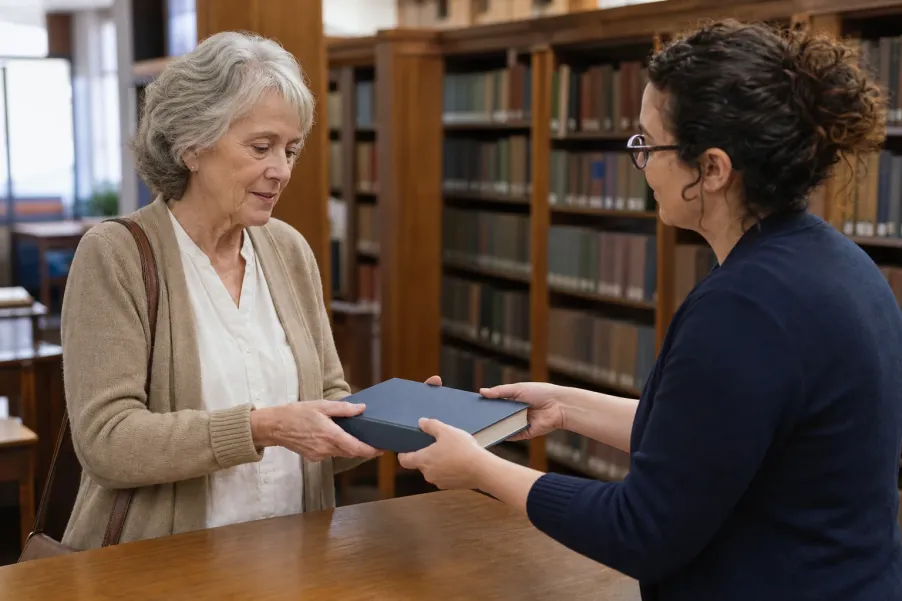
Prepare for a local history research visit by choosing one question, listing the names, dates, places, and spellings you already know, and checking which library holds the most relevant collection. Confirm hours, access, and equipment before leaving home. During the visit, note each source citation, separate confirmed facts from leads, and stop while you still have energy.
What makes a local history visit productive?
- Bring one focused question, not a request to “find everything” about a person, family, building, or neighborhood.
- Start with known names, alternate spellings, dates, addresses, and relationships, then mark each item as confirmed or uncertain.
- Check the collection and its current access rules before traveling; some useful materials are online, while others may be available only at a particular location.
- Record where every fact came from so that you or a family helper can find the same source again.
Local history research can connect a street address to an earlier neighborhood, identify the newspaper that covered a community event, or help a family understand where an old photograph fits. It can also become tiring quickly when the question is too broad. A good visit turns curiosity into one small research task, then preserves enough context to make the next task easier.
Los Angeles County has more than one public-library system and many specialized collections. LA County Library publishes local-history pages for communities it serves, while the Los Angeles Public Library’s Central Library maintains extensive history and genealogy materials. The right destination depends on the place, time period, record type, and access method—not simply on which building is closest.
How do you choose one useful research question?
Write a question that can be answered with a specific record or a short group of sources. “What was at this address in 1948?” is more workable than “Tell me the history of my house.” “Which newspaper covered this 1962 neighborhood event?” is more workable than “Find everything about our community.” A precise question tells a librarian what kind of catalog, directory, map, photograph collection, or newspaper index may help.
Person question
Where did this person live during a specific decade, and which record might show it?
Place question
What business, institution, or household was associated with one address in a chosen year?
Event question
Which local publication reported a named event within a narrow date range?
If you have several questions, rank them. Put the question that requires the most location-specific source first, then keep the others on a “later” list. This protects the visit from becoming a race through unrelated materials. It also gives a family helper a clear role: listen for the answer to the main question and capture the exact source reference.
What should you organize before the library visit?
Start with yourself and work from known information toward the unknown. The National Archives recommends collecting names, dates, places, and relationships because those details help distinguish people and locate record groups. Write alternate spellings, nicknames, former street names, approximate years, and nearby landmarks when you know them. Mark estimates with words such as “about,” “possibly,” or “family story” so they are not mistaken for proven facts.
A one-page research brief
- My question: one sentence that names the person, place, or event and a time range.
- What I know: a short list of names, spellings, addresses, dates, and relationships.
- What I checked: catalogs, family materials, indexes, or websites already reviewed.
- What would count as progress: a citation, a new date range, a record identifier, or the name of the next collection.
Bring copies or a summary rather than carrying irreplaceable originals. If you use a phone or tablet, prepare it before the visit: charge it, make space for photographs, and practice enlarging text or using the camera without flash. The public library computer session checklist offers a separate routine for login privacy, files, and session cleanup when your research will include a public computer.
If you want to digitize family prints before or after a research visit, use the family photo scanning session guide to choose a small batch, handle originals carefully, name the files, and finish with a verified backup.
How do you choose the right Los Angeles-area collection?
Use a source ladder. Begin with an official online catalog or local-history page. Move to a neighborhood branch or county collection when the subject is tied to a specific community. Use a specialized department when the record type is reference-only, on microfilm, or part of a focused historical collection. This order can answer simple questions from home and reserve travel for materials that truly require a visit.
Home-accessible sources
Search official catalogs, digital collections, local-history pages, and research guides. Save the item title, call number, collection name, or link.
Community collections
Check whether an LA County Library branch or local collection covers the community, institution, or neighborhood in your question.
Specialized departments
Use LAPL’s History and Genealogy resources when city directories, historical newspapers, maps, indexes, or reference-only materials fit the question.
Do not assume every library card opens every database or that every item can be borrowed. If you need a card for general library use, the LA County Library card application guide explains how to prepare without promising approval or access to a particular resource. The responsible library’s current catalog and staff remain the authority for collection access.
What should you confirm before leaving home?
Check the library’s official page on the day of the visit. Confirm the correct building, current hours, holiday closures, parking or transit options, accessible entrance, restroom availability, and whether the material requires advance notice. Ask whether you need a library card, researcher registration, photo identification, an appointment, or a staff retrieval request. Procedures can differ by collection and may change.
Keep the call or email concise: “I am researching one Los Angeles address between 1945 and 1950. Your catalog lists a city directory collection. Is it available on Tuesday, and do I need to request it before I arrive?” That wording gives staff the question, source type, date range, and timing without asking them to conduct the whole search.
If standing, walking, reading small print, or using microfilm will be difficult, ask what seating, magnification, workstation, or assistance options are currently available. Do not assume equipment or one-to-one research help. A confirmed limitation is useful information; it lets you shorten the visit, bring a helper, or choose a different source.
How can an older adult build a manageable visit plan?
Choose a planned start and stop time. A first visit of about an hour may be enough to learn the collection, review one source, and leave with a useful citation. Build in time for the entrance, registration, elevator, restroom, and checkout process. The research goal should fit inside the energy available after those ordinary tasks.
- First 10 minutes: check in, show the item reference, explain the one-sentence question, and learn the handling or copying rules.
- Next 35 minutes: examine one source group, record citations before details, and mark promising leads without opening a new research branch.
- Final 15 minutes: review photographs or notes, ask one follow-up question, identify the next source, and pack while attention is still steady.
Bring only what the facility permits: a simple note page, pencil if required, reading glasses, approved device, charger, and any comfort item allowed in the room. Food, drinks, bags, pens, scanners, flash photography, and personal copying equipment may be restricted around historical materials. Current room rules take priority over a general packing list.
How do you research without losing the thread?
Record the source before recording the discovery. For a book, note the title, author, publication details, call number, and page. For a directory or microfilm item, note the year, title, roll or reel identifier, page or frame, and repository. For a digital item, save the collection, item title, stable link, and access date. The Library of Congress emphasizes documenting exactly where information was found so another researcher can retrace the work.
Use one note block per source. At the top, write the citation. Under it, copy only the facts connected to the main question. At the bottom, add a short interpretation beginning with “This may mean” rather than blending interpretation into the source text. If a new surname, address, or institution appears, place it on the later list instead of immediately switching topics.
When photographing permitted material, capture the source label or title information first, then the relevant page, then a final context image if needed. Review each photograph before moving on. A sharp image without a citation can become an orphaned clue that no one can verify later.
How should you separate facts, leads, and family stories?
Confirmed fact
A source directly supports the statement, and the note includes enough citation detail to find it again.
Research lead
A clue points toward another record, date range, spelling, or location, but it has not been independently confirmed.
Family or community story
An account may preserve valuable memory and context, yet it remains attributed to the teller until supporting evidence is found.
Conflicting sources do not mean the visit failed. They may reveal a transcription error, two people with similar names, a boundary change, a renumbered street, or a story that combined separate events. Record the conflict precisely. Do not “fix” the evidence by choosing the version you prefer.
What privacy boundaries matter in family and local history?
Historical research can uncover adoption, health, immigration, criminal, financial, family, or relationship information. A record’s availability does not automatically make every detail appropriate to publish or share widely. Use extra care with living people, minors, contact information, account identifiers, and facts that could cause harm. Store working notes privately and share the minimum needed for the research purpose.
Ask permission before posting another living person’s photographs, interviews, documents, or personal story. When a sensitive discovery affects legal rights, identity records, property, benefits, or a family dispute, pause and seek the appropriate professional guidance. A library research visit can locate historical information; it does not establish legal identity, ownership, eligibility, or a medical conclusion.
What should you do after the visit?
Within a day, rename photographs and notes using a consistent pattern such as date, repository, collection, and item number. Back them up in a second location. Write a five-sentence visit summary: the question, sources checked, confirmed findings, unresolved leads, and next action. This turns a pile of images into a reusable research record.
Choose only one next step. It might be checking a second year of a directory, searching a newly identified newspaper title, or contacting a different library department. For another low-pressure library activity, the LA County Library book club preparation guide shows how to confirm format, access, and comfort needs before attending. Broader planning resources are collected in the Senior Support Guides.
Official sources to check
- LA County Library: Local History for official community local-history pages and collection starting points.
- Los Angeles Public Library: Genealogy Research Guide for current Central Library holdings, databases, directories, newspapers, maps, and access notes.
- National Archives: Start Your Genealogy Research for official record categories, finding aids, learning resources, and research-room preparation.
- Library of Congress: Charts and Forms for organizing research and preserving exact source citations.
Check each institution’s current page before traveling. Collections, hours, equipment, copying rules, identification requirements, appointments, and accessibility arrangements can change.
Frequently asked questions
Do I need to know my full family tree before visiting a library?
No. Begin with one person, place, address, or event and the names, dates, spellings, and relationships you already know. Mark uncertain details clearly. A focused question and a small amount of organized context are more useful than an incomplete large tree.
Can a librarian do the entire local history search for me?
Do not assume that service is available. Library staff may explain catalogs, finding aids, collections, and room procedures, but research depth varies by institution and workload. Ask a narrow question and confirm current reference services before the visit.
Should I bring original family photographs or documents?
Bring copies or a clear summary unless the library specifically asks to inspect an original and explains how to protect it. Irreplaceable items can be lost or damaged in transit. Keep originals stored safely and never leave them unattended.
May I photograph books, directories, maps, or archival materials?
Only when the library and collection rules allow it. Flash, scanners, tripods, personal copying devices, or photography of particular materials may be restricted. Ask first, follow handling instructions, and capture the source citation along with any permitted image.
What if two records disagree?
Record both versions and their complete citations. Check whether the sources refer to the same person, place, or time period, then look for an independent source. A conflict is a research finding, not a reason to silently choose one version.
How long should a first local history research visit last?
Choose a length that leaves time and energy for arrival, registration, research, review, and departure. About an hour can be a practical first plan, but the right limit depends on the person, facility, and material. Stop before fatigue makes notes unreliable.
Need help organizing a broader support question?
All Seniors Foundation can help Los Angeles County older adults and families think through general support-navigation questions. It does not control library collections, conduct genealogy research, guarantee record access, or establish historical or legal facts.





