
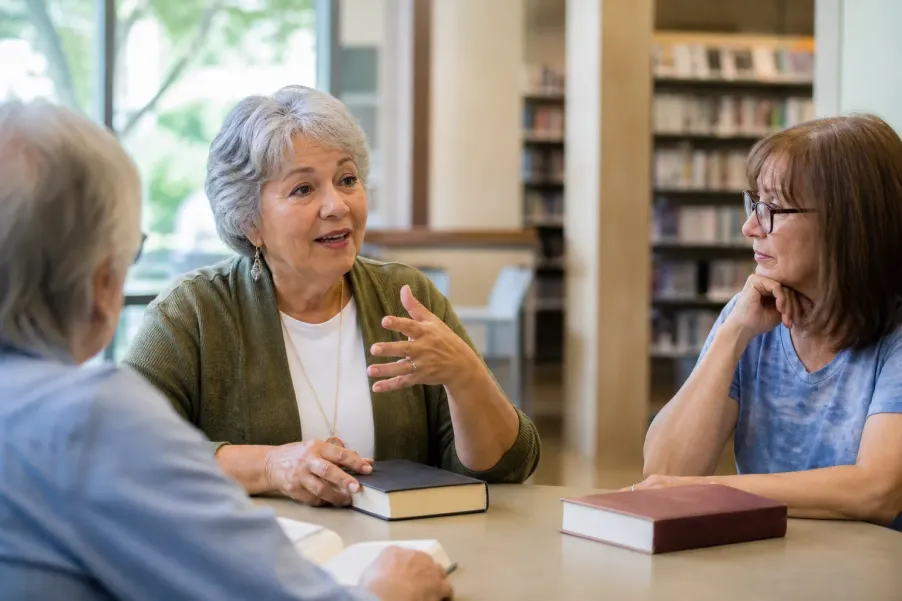
Prepare for an LA County Library book club by verifying the current event page, branch, time, registration rule, selected title, and meeting format. Ask early about accessible seating, listening or large-print options, and language help. Read what is manageable, bring two optional notes, and remember that attending quietly or leaving after one session is a valid way to test the group.
Four useful takeaways before your first meeting
- Verify the exact session, not just the club name. Branch, room, date, registration, age group, selected book, and in-person or virtual format can change.
- Ask how to get the book before assuming a copy is reserved. Some listings mention desk copies, digital options, bring-your-own reading, or limited supplies.
- Choose a participation level that feels comfortable. Finishing the book, speaking often, or agreeing with every reader is not required unless the organizer states a specific format.
- Plan the practical details. Confirm transportation, branch hours, seating, restroom access, hearing or vision needs, and whom to contact if plans change.
How do you find an LA County Library book club that fits?
Begin with the current LA County Library Events calendar. Filter for adults or older adults, Books, Poetry, & Writing, a convenient branch, and a date you can attend. Read the complete event record rather than relying on the title alone. Current listings show several formats: a group may discuss one selected book, invite readers to bring any book, meet in person, offer a hybrid option, require registration, or welcome drop-ins.
Think about the experience you want. A traditional discussion group usually expects members to read a selected title. A bring-your-own-book gathering may focus on shared reading with less preparation. A genre club may suit someone who enjoys mysteries, classics, memoirs, or another category. A hybrid or virtual meeting may reduce travel but requires a dependable device, audio, and meeting link.
Format fit
Choose in-person, virtual, hybrid, or quiet shared reading based on what makes participation manageable. Confirm the format on the exact listing.
Reading fit
Look at the title, length, genre, available formats, and pickup timing. It is reasonable to skip a selection that is not appealing or practical.
Schedule fit
Check the day, start and end time, travel window, and branch hours. A monthly label does not prove every future date is scheduled.
Use the official Library Locations directory to confirm the branch address, telephone number, hours, and available room information. A city library with a similar name may belong to a different library system, so make sure the event and location refer to the same organization.
What should you verify before committing to a meeting?
Open the exact event listing shortly before making plans and again on the day of the meeting. Note the date, time, branch, room, age group, registration status, event format, selected title, and instructions for getting a copy. If the listing says seats are limited, registration is closed, or the event is full, do not assume staff can add a walk-in place.
Call the branch through the number in the official location directory when something is unclear. Ask whether a library card is needed to attend, to register, or only to borrow the book. Many public programs may be open to adults without a card, but borrowing rules and event requirements are separate and must be confirmed for that session.
If you need a card for materials, the LA County Library card preparation guide explains how to review the current application route and identification rules without promising eligibility or immediate borrowing access.
How can you get the selected book in a usable format?
Follow the event listing first. Some LA County Library clubs state that copies are available at the information or customer-service desk, sometimes while supplies last. Other clubs direct readers to the catalog, use digital resources, or ask participants to bring their own reading. A mention of available copies is not a personal reservation until the branch confirms it.
| Possible format | Question to ask | Practical consideration |
|---|---|---|
| Standard print | Is a club copy available now, and when is it due? | Check print size, weight, lighting needs, and whether the copy can be renewed. |
| Large print | Does the catalog have this title in large print at this or another branch? | Allow time for a hold or transfer; not every title is issued in large print. |
| eBook | Which library platform carries the title, and is there a wait? | Confirm device compatibility, text-size controls, loan period, and sign-in before meeting day. |
| Audiobook | Is an audio edition available on disc or through a library platform? | Check listening time, playback speed, headphones, and whether the edition is unabridged. |
The best format is the one you can use comfortably. The large-print, eBook, or audiobook reading-format trial offers a simple way to compare formats. If travel to obtain materials is difficult, the Books by Mail guide explains a separate service-navigation path; it does not guarantee that a club title will be available through that program.
What if you cannot finish the book before the club meets?
Start by checking how many days remain and how long the book or audiobook is. Divide the reading into small sessions that fit your attention, energy, vision, and schedule. For example, a 300-page book with 15 days remaining suggests about 20 pages a day, but a slower plan or selected chapters may be more realistic. Audiobooks can be planned by hours rather than pages.
Use a manageable reading routine
- Choose print, large print, eBook, or audio
- Mark the meeting date and a personal stopping date
- Schedule short sessions with breaks
- Use comfortable light, seating, and text size
- Write only brief notes, not a chapter summary
- Stop if reading becomes tiring or frustrating
- Ask whether partial reading is welcome
- Avoid spoilers if the group has a stated rule
Finishing is useful but not always necessary. Contact the organizer if the expectation is unclear. You may still be able to listen, discuss the portion you read, or attend a bring-your-own-book format. Be honest about where you stopped so other members can decide how to handle spoilers.
How do you plan accessibility, language help, and transportation?
Ask the branch as early as possible about the specific support you need. That could include an accessible entrance, nearby seating, room location, space for a mobility device, a quieter position, assistive listening information, large-print material, or a way to participate virtually. The library’s website accessibility commitment addresses digital access, but it does not prove that every requested in-person accommodation or book format is available for every event.
If you prefer another language, ask what help is available for the program and whether the selected book or discussion is offered in that language. LA County Library states that it seeks to provide meaningful language access, but staff languages and interpretation arrangements can vary. Make the request early and confirm what the branch can provide.
Before leaving
Confirm the event, branch address, room, travel time, weather, parking or drop-off point, and return ride. Bring only the mobility and hearing supports you normally use.
At the branch
Arrive with enough time to ask staff where the group meets. Choose a seat that supports hearing, vision, movement, and an easy exit.
If plans change
Call the branch or check the current event page. Do not travel based only on an old calendar entry or assume a canceled session moved online.
For a virtual or hybrid group, test the device, sound, camera choice, and meeting link in advance. The family video-call practice guide offers a low-pressure way to rehearse basic joining and audio controls before using an unfamiliar meeting platform.
What can you prepare to make discussion easier?
Two or three short notes are enough. Choose one moment, character, idea, setting, or question that stayed with you. Add the page or chapter only if it helps you find the passage. Avoid writing a full review, searching for the “correct” interpretation, or memorizing an answer.
A useful note can be as simple as: “I was surprised when…,” “I understood this choice differently because…,” or “What did others think the ending suggested?” If you did not finish, say, “I read through chapter six and would like to listen today.” This gives the facilitator clear information without an apology.
A small discussion card
- One part you enjoyed, questioned, or found memorable
- One open question for the group
- One connection to another book, place, time, or experience
- One boundary, such as preferring not to discuss a personal subject
Share personal experiences only when you want to. A discussion about family, identity, health, grief, money, politics, or other sensitive themes does not require disclosure. You can redirect to the text, pass on a question, or step out. Respect other readers’ privacy and do not repeat their personal stories outside the group without permission.
What should you expect at the first meeting?
Check in with staff or the facilitator, especially if registration was required. Ask where to sit and whether the group has a speaking order, spoiler rule, name introductions, or break. Keep your phone silent unless it is needed for the book, accessibility, transportation, or an urgent contact.
Listen for the group’s rhythm before deciding how much to speak. Let the facilitator manage turns, avoid interrupting, and disagree with an idea rather than criticizing a person. If several people are waiting, keep a first comment brief and return later if invited. It is fine to say, “I saw that differently,” or “I would like to hear another view.”
Do not photograph or record participants unless the organizer and everyone affected have clearly agreed. A public library program can still include personal conversation. If an unfamiliar participant asks for money, account details, a ride, or private contact information, you can decline and speak with library staff.
How do you decide whether the book club is a good fit?
After the meeting, rate the practical experience rather than judging yourself. Was the location manageable? Could you hear and follow the discussion? Did the facilitator make room for different views? Were the reading pace and book format workable? Did the time and travel burden feel reasonable?
One difficult title does not necessarily mean the group is wrong, and one pleasant session does not guarantee every month will be the same. Ask about the next selection and date, then decide whether to return, try a different branch or format, or take a break. Do not assume that a club meets on the same day forever; verify each listing.
Good practical fit
The route, room, format, pace, access, and conversation felt manageable, even if you did not finish or speak often.
Needs one adjustment
A different seat, format, ride, title source, or earlier access request might make the next session easier.
Try another option
The schedule, reading load, environment, or group style did not fit. Explore another official listing without treating the first visit as a failure.
Which official resources should you use?
- LA County Library Events is the primary place to check current adult and older-adult programs, dates, locations, formats, registration, age groups, and event-specific instructions.
- LA County Library Locations provides current branch addresses, public telephone numbers, hours, and selected facility details.
- LA County Library Accessibility explains the library’s digital accessibility commitment and how to report a website access issue.
- LA County Library Contact Us provides official email, telephone, text, chat, and Ask a Librarian routes for current questions.
Event details, inventory, branch hours, and available support can change. Recheck the exact official listing and contact the responsible branch before traveling. The Senior Support Guides hub offers other practical Los Angeles County planning resources. All Seniors Foundation can help organize a non-emergency support question when help is available, but it does not operate LA County Library events, reserve seats or books, provide accommodations, or control club discussions.
Frequently asked questions
Do I need an LA County Library card to attend a book club?
Check the exact event listing or call the branch. A card may not be required to attend, but it may be needed to borrow the selected book or use certain digital materials.
What if I cannot finish the book before the meeting?
Ask the facilitator whether partial reading is welcome. You may be able to listen, discuss what you read, or choose a bring-your-own-book group with a different preparation style.
Are copies of the book always available at the library?
No. Some listings mention desk copies or digital options, often while supplies last. Confirm availability, format, pickup instructions, loan period, and any wait before relying on a copy.
Can I attend without speaking during the discussion?
Often you can listen, but group expectations vary. Tell the facilitator that you are new and prefer to observe, then follow any participation rule stated for that specific program.
How do I request accessibility or language help?
Contact the responsible branch or event organizer as early as possible, describe the specific support you need, and confirm what can be arranged before traveling or registering.
How do I know whether the next meeting is still scheduled?
Recheck the current LA County Library event page and contact the branch if needed. Do not rely only on a past meeting, monthly label, saved calendar entry, or old flyer.
Need help organizing one next question?
All Seniors Foundation can discuss non-emergency senior-support navigation in Los Angeles County when help is available. The foundation does not operate library book clubs, reserve materials, guarantee accommodations, or promise a particular social experience.





