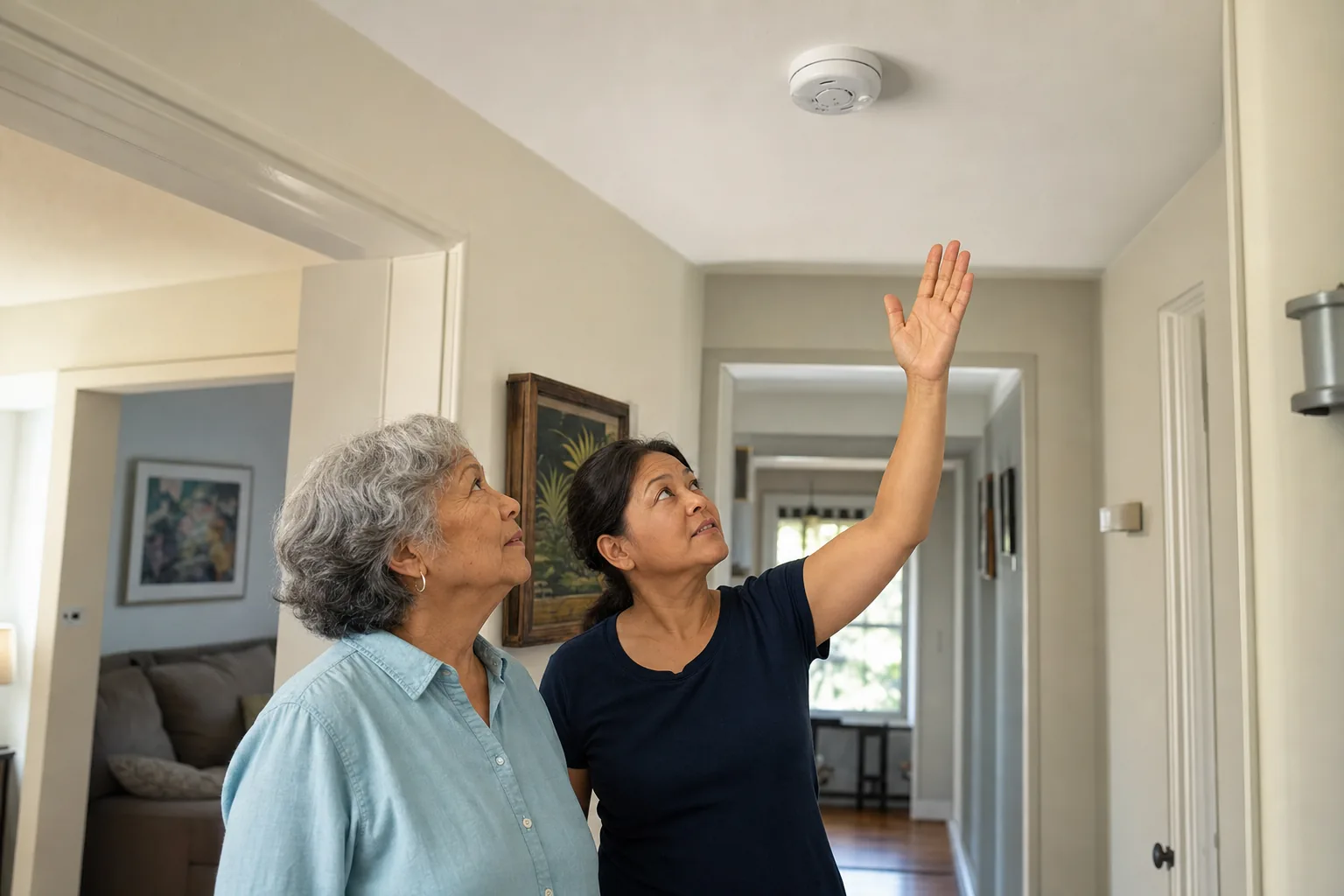
Short answer: Once a month, an older adult and helper can make a safe, room-by-room listening check: announce the test, use only a safely reachable manufacturer test control, listen from bedrooms and behind closed doors, and record what sounded and was recognized. Never climb, open, rewire, disable, or diagnose an alarm during this check.
Key takeaways for a safer alarm sound check
Listen, do not repair
This routine checks whether a household hears and recognizes a test sound. Installation, wiring, replacement, and repair belong to the responsible property manager or qualified professional.
Stay on the floor
Use a test control only when it is safely reachable according to the alarm’s instructions. Do not climb on a chair, stool, counter, or ladder.
Check real listening locations
Listen from sleeping areas, a usual sitting area, and behind a closed door. A loud sound beside the alarm may not answer whether it is heard elsewhere.
Treat a real alarm as real
A smoke or carbon monoxide alarm outside a planned test is not a maintenance exercise. Leave and follow emergency instructions; do not search for the source first.
Why is a listening check different from a quick button press?
A test sound can answer more than “did the unit make noise?” It can also show whether a person recognizes that noise, whether it reaches a sleeping room, whether a closed door changes what is heard, and whether household members know what to do next. Those are practical questions for an older adult living alone, a couple, or a family helper coordinating a monthly safety routine.
The Los Angeles Fire Department smoke-alarm guidance says to test alarms at least monthly with the test button and make certain family members recognize the sound. It also advises discussing and practicing the home fire escape plan during the monthly check. The U.S. Fire Administration likewise recommends monthly testing and following the manufacturer’s instructions.
This article keeps the task deliberately narrow. A button test does not authorize someone to open the alarm, handle wiring, change placement, diagnose a chirp, or declare that a home meets every fire or building requirement. Different alarms have different controls, sound patterns, power sources, and replacement instructions. Use the exact manual or manufacturer support for the model in the home.
What should you prepare before making any test sound?
Pick a calm daytime window. Tell everyone in the home that a planned test is about to occur, including a caregiver, visitor, neighbor in a connected unit, or anyone who may be startled. Move pets to a comfortable place if loud sound causes distress. Do not run a test when someone is sleeping, using hearing equipment that could be uncomfortable, or handling a task where a sudden sound could cause a fall.
Walk through the home while the alarms are quiet. Identify the units and their normal listening areas without touching them. Note whether the test control is reachable from the floor. If it is not, stop there. Do not solve a reach problem with furniture or a ladder. A landlord, property manager, fire-safety program, electrician, alarm professional, or manufacturer may be the appropriate next contact depending on ownership and the type of system.
- Name two roles: one person operates a safely reachable test control; the other listens from agreed locations.
- Choose listening locations: each sleeping area, the usual chair or living area, and at least one closed-door location.
- Know the planned signal: review the model instructions so a test pattern is not confused with a real alarm or trouble signal.
- Prepare communication: agree on a simple thumbs-up, spoken “heard,” or written pass/follow-up mark.
- Keep emergency exits clear: the routine should never block a doorway or delay leaving if an unplanned alarm occurs.
If the alarm is part of a monitored, shared-building, or hardwired system, confirm the approved testing process before touching a control. Do not assume a household routine applies to a building fire-alarm panel or a device maintained by someone else.
How do you run a room-by-room listening walk?
Use the same short sequence for each alarm. Consistency makes the result easier to compare next month and reduces the chance that a person presses controls repeatedly while others are unsure what is happening.
- Announce the planned test. Say which alarm will be checked and remind everyone that an unexpected alarm outside this planned moment is treated as real.
- Place the listener. Start in the nearest sleeping area or usual resting place. For a second pass, close the door naturally; never lock it.
- Use only the approved, safely reachable control. Follow the model instructions. If the control cannot be reached with both feet on the floor, record “not safely reachable” and stop.
- Listen for sound and recognition. The listener reports whether a sound was heard clearly and whether it was recognized as the intended alarm test—not merely that “something beeped.”
- Move to the next practical location. Check another sleeping area, a common sitting area, and any location where normal household noise or a closed door may matter.
- End the test and review. Confirm that the test signal stopped as described by the manufacturer. Record the result without opening, silencing permanently, or modifying the alarm.
For interconnected alarms, the household may expect more than one unit to sound, but the exact behavior depends on the system. Confirm it in the product instructions or with the responsible installer. The U.S. Fire Administration recommends interconnected smoke alarms because when one sounds, they all sound, but a household should not assume interconnection merely because alarms look alike.
Do not create smoke, use an aerosol, hold a flame, or imitate a carbon monoxide exposure to “make the test more realistic.” The safe household routine described here uses only the manufacturer’s approved test method.
What is the simplest useful way to record the result?
Use one line per alarm or location and avoid technical diagnosis. The goal is to hand off a clear observation to the responsible person. A neutral record can say the date, room, observed result, and next owner. Do not write access codes, detailed health information, or assumptions about why an alarm behaved a certain way.
| Observed result | What it means for this routine | Next action |
|---|---|---|
| Sounded and recognized | The planned test sound was heard and correctly identified at the listening location | Record pass for that location and continue the monthly routine |
| Sounded but not recognized | A sound was heard, but the person could not identify which alarm it represented | Review the manufacturer’s sound guide and consider an accessibility follow-up |
| Could not be heard clearly | The listener could not reliably hear the planned signal from an important location | Do not improvise; ask the responsible professional about alerting options |
| Did not sound as instructed | The approved test did not produce the expected response | Treat it as needing prompt responsible follow-up; do not diagnose or disable it |
| Chirping or trouble signal | The unit made a different recurring sound | Use the exact model instructions or qualified support; do not guess from another brand |
| Not safely reachable | The household cannot operate the control while staying safely on the floor | Contact the property owner, manager, manufacturer, or qualified professional |
A sample entry is: “July 27 — hallway alarm — heard in bedroom with door closed; recognized — Ana owns next monthly check.” Another is: “Kitchen-adjacent unit — test control not safely reachable — property manager follow-up by Tuesday.” These notes describe observations without pretending to certify the device.
Keep essential follow-up contacts in a separate large-print phone list. If a model is subject to a safety notice, use the official manufacturer or government recall information; the household product recall guide explains a cautious verification process.
Who should handle a failed, unclear, or unreachable check?
Choose the owner by the situation, not by whoever is standing closest. A renter may need the landlord or property manager. A homeowner with a hardwired alarm may need a qualified electrician or alarm professional. A person with a model-specific question may need the manufacturer. A local fire department’s nonemergency resource may explain community programs, but availability and scope must be confirmed.
LAFD says a smoke alarm that does not sound when the test button is pressed, chirps every few minutes, or is more than 10 years old should be replaced. USFA also gives general replacement guidance and repeatedly directs households to the manufacturer’s instructions. Do not apply a smoke-alarm rule to every combination or carbon monoxide unit without checking its exact instructions.
Stop and refer
- The unit is too high to reach safely.
- Wiring or a building panel is involved.
- The expected test response does not occur.
- A recurring chirp or trouble signal is unclear.
- The alarm appears damaged, painted over, loose, or missing.
Do not improvise
- Do not remove a battery to stop nuisance sound.
- Do not cover or disable the alarm.
- Do not relocate it based on a generic internet tip.
- Do not mix replacement parts or batteries without model instructions.
- Do not mark a failed location as safe because another alarm sounded.
If a helper makes the follow-up call, use the model name, observed behavior, location, and ownership situation. Avoid claiming a diagnosis. A useful script is: “We completed the approved test from the floor. The hallway unit did not produce the expected test sound. We did not open or disable it. Who is responsible for prompt inspection or replacement?”
What if an older adult cannot hear or recognize the alarm?
Do not respond by turning the volume question into a hearing test or medical conclusion. Record the practical result: where the signal was not heard or recognized. Then discuss the need with the older adult and the responsible alarm professional, property owner, or qualified program.
The U.S. Fire Administration’s disability fire-safety guidance notes that alarms for people who are deaf or hard of hearing may use a vibrating pad, flashing light, or strobe light, and it still recommends monthly testing. Product choice, compatibility, placement, installation, and any building requirement must be confirmed for the home and resident.
Recognition matters too. If a household has different smoke and carbon monoxide patterns, use the manufacturer’s official sound guide and practice the action associated with each. Do not rely on memory from an older unit or another brand. Keep the explanation short enough to recall under stress.
For a broader emergency-communication setup, review the emergency alert setup guide. A phone alert is not a substitute for required home alarms, and a home alarm is not a substitute for an evacuation plan.
When does a sound check become an emergency?
The planned routine ends immediately if there is smoke, fire, a suspected carbon monoxide problem, illness, or an alarm that is not clearly part of the announced test. Leave the home and call 911 from outside. Do not search rooms for the source, collect belongings, silence the alarm, or reenter until emergency responders say it is safe.
The U.S. Consumer Product Safety Commission carbon monoxide guidance says never to ignore an alarming CO alarm: move outside to fresh air, call emergency services or 911, account for everyone, and do not reenter until responders give permission. That emergency response is completely different from a scheduled maintenance sound check.
After a completed monthly check, connect the result to the household escape conversation: two ways out when possible, a meeting place outside, and who may need assistance. LAFD recommends discussing and practicing the home fire escape plan during the monthly smoke-alarm check. Adapt the plan to the person’s mobility and the actual home with qualified local guidance. The Senior Support Guides page collects other practical Los Angeles aging-in-place routines.
For a room-by-room walk-through, use the home fire escape plan practice guide for older adults to check clear routes, usable exits, an outdoor meeting place, household roles, and the points that need local fire-department or building guidance.
Need help locating a current senior-support resource? Contact All Seniors Foundation for educational information and resource-navigation options in Los Angeles County. ASF does not inspect, install, repair, certify, or monitor smoke or carbon monoxide alarms and cannot provide emergency response.
Frequently asked questions
How often should smoke and carbon monoxide alarms be tested?
LAFD and USFA recommend monthly smoke-alarm testing, and CPSC recommends monthly smoke and carbon monoxide alarm testing. Always follow the instructions for the exact model and building system.
Should an older adult climb to reach the test button?
No. If the approved test control cannot be reached safely with both feet on the floor, record it as not safely reachable and contact the responsible property manager or qualified professional.
Does a button test prove the alarm detects every hazard?
No. A household button test checks the response described by the manufacturer; it is not a full sensor certification, code inspection, or guarantee of protection.
What if the alarm sounds but cannot be heard in a bedroom?
Record the exact location and do not improvise a device change. Ask the responsible professional about compatible alerting, interconnection, placement, or accessibility options.
What should I do about a chirping alarm?
Use the exact model’s instructions or qualified support because chirps and trouble signals vary. Do not remove a battery, disable the unit, or guess from another brand.
What should I do if a carbon monoxide alarm sounds unexpectedly?
Move everyone outside to fresh air, call 911 or emergency services, account for everyone, and do not reenter until responders give permission.
Educational boundary: This guide describes a low-risk listening and handoff routine. It does not replace manufacturer instructions, a landlord’s duties, a qualified inspection, accessibility assessment, fire-code guidance, medical advice, or emergency services.