Quick answer
Older adults in Los Angeles County can prepare for a power outage by placing tested flashlights along the routes they actually use, charging the phone and one compatible power bank, saving the correct utility contact, and practicing the first five minutes in daylight. All Seniors Foundation recommends a simple check that avoids candles and keeps medical-device planning with the responsible provider.
A general emergency kit is useful, but it does not answer a very practical question: Can you reach light and a working phone without crossing a dark room? This guide turns that question into a short home check. It is for older adults, family members, and trusted helpers who want a repeatable routine, not a complicated equipment project.
The plan is intentionally narrow. It does not explain generator installation, electrical repairs, medical-device backup specifications, or food and medication decisions. Those subjects require current instructions from the responsible utility, manufacturer, clinician, pharmacist, or emergency authority. The goal here is to improve reach, lighting, communication, and the first safe decision.
What should a power outage lighting and phone check cover?
Start with the parts of the home used after sunset. For many people, that means the bed or favorite chair, bathroom route, front door, kitchen edge, and the place where the phone normally charges. The check should answer four questions:
- Can a light be reached before standing? A flashlight in a distant closet does not help with the first dark step.
- Does the light work now? Test the switch, beam, batteries, and any charging cable while the room is bright.
- Can the phone stay usable? Confirm the phone charges from its regular charger and from the intended backup power bank.
- Is the correct reporting route available? Save the responsible utility’s official outage page and phone number without assuming every Los Angeles County address has the same provider.
Ready LA County advises residents to identify critical items that require power, keep mobile devices and backup batteries charged, determine whether a home telephone will work during an outage, and keep flashlights with extra batteries available. The county’s current power outage guidance also directs people who depend on powered medical devices or refrigerated medication to make a specific plan with their medical provider.
How do you create a safer light path through the home?
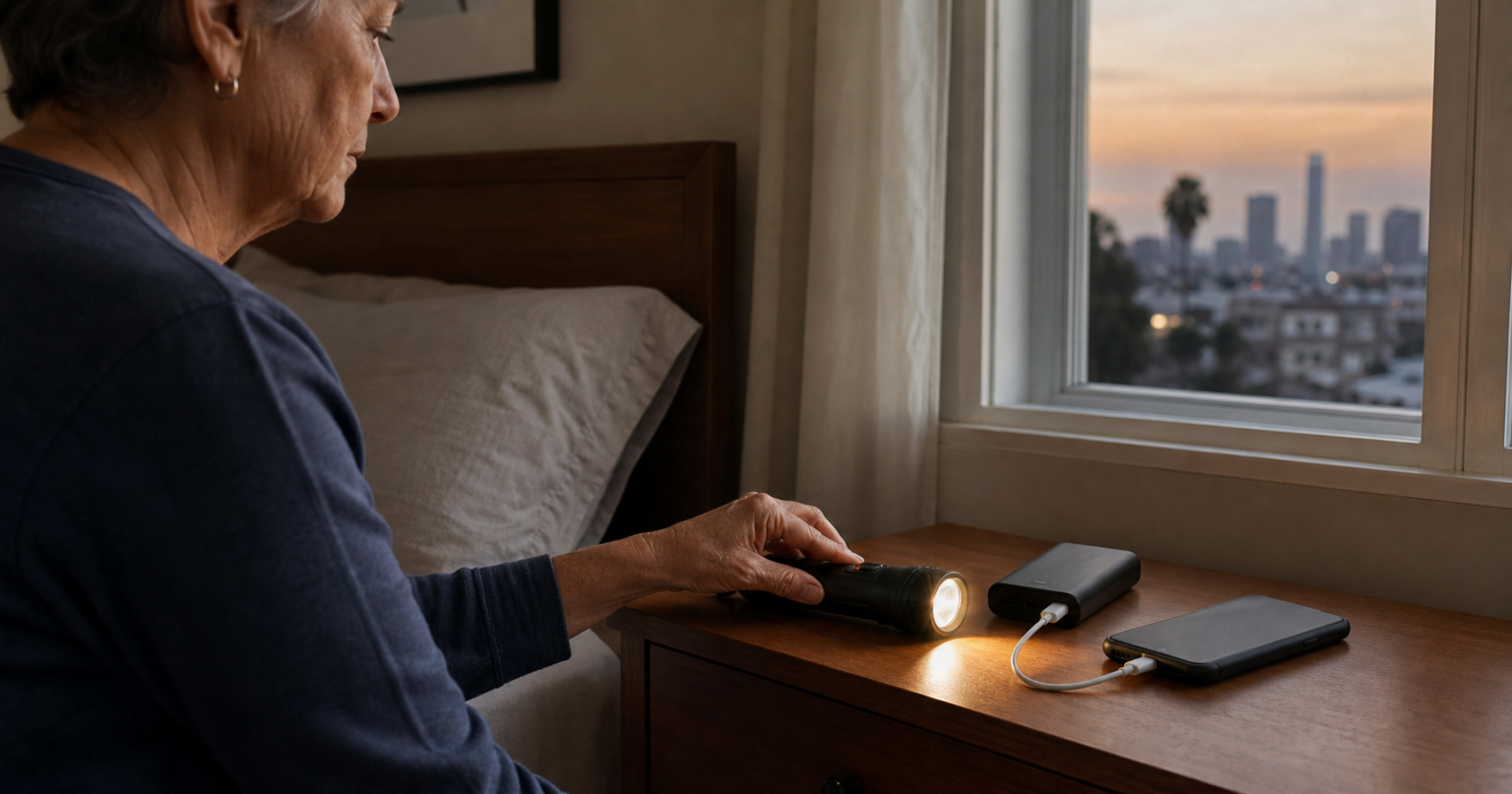
Do the route check in daylight with the normal furniture in place. Do not turn off all lights and create a fall test. Instead, stand or sit where the person is usually located at night and point to the first flashlight. The person should be able to reach it without crossing the room.
1. Choose the first-light location
Place one tested flashlight on a stable surface beside the bed or chair, not under loose papers or behind objects. Use a location that is easy to describe: “right side of the bedside table” is clearer than “somewhere in the bedroom.” Keep the walkway and the surface free of charging cords that could be pulled across the path.
2. Trace only the essential routes
Walk the route to the bathroom, the main exit, and the phone-charging location. Look for loose rugs, small furniture, pet items, or stored boxes that become harder to see in low light. This is not a full home-modification assessment. Move only ordinary clutter that the resident agrees is safe to move, and ask a qualified person about any permanent electrical, handrail, stair, or building change.
3. Add a second light where the route changes
If the route turns, crosses a hallway, or reaches another level, place another tested light at a stable point that can be found by touch. A plug-in night-light may not work when power is out unless it is specifically designed and tested for outage use. Read the product instructions rather than assuming a device has battery backup.
For broader room and household planning, use the living-alone guide for older adults and the disaster preparedness guide for seniors as separate resources. This Article remains focused on the reachable-light and phone-power layer.
How do you test flashlights and batteries without making the system complicated?
A flashlight test should take less than a minute per light. Pick up the flashlight, turn it on, point it at the floor or wall, and confirm the beam is steady. Check that the switch can be operated with the person’s usual grip. If it is rechargeable, connect it to the charger named in its instructions and confirm the charging indicator behaves as the manufacturer describes. If it uses replaceable batteries, store the correct size nearby in the original package, away from children and heat.
- Use a flashlight that feels stable and can rest flat without rolling into the walkway.
- Keep the lens and switch easy to identify by touch.
- Remove leaking, swollen, damaged, or unusually hot batteries from use and follow local disposal guidance; do not handle a damaged battery more than necessary.
- Do not mix battery types, ages, or brands when the device instructions warn against it.
- After a real outage or long use, test the light again and recharge or replace batteries according to the instructions.
LADWP’s current power outage safety page says to keep a flashlight and extra batteries nearby and not to use candles during a power outage or other emergency. Southern California Edison similarly advises placing flashlights in handy locations and testing them regularly in its official repair-outage preparation guidance.
How do you prepare a phone and power bank for an outage?
Backup power is useful only when the cable, connector, and device work together. Charge the phone with its normal charger. Then connect the phone to the intended power bank for a brief test. Confirm that the phone shows its normal charging indicator and that the cable stays connected when the power bank rests on a table. Do not buy or connect an unfamiliar adapter during the outage.
One small outage record
Electric utility for this address: __________________________
Official outage phone or saved page: _____________________
First flashlight location: _______________________________
Second flashlight location: ______________________________
Power bank tested on: __________________________________
Person to contact if help is needed: _____________________
Keep the record where the resident expects it, but do not include passwords, account numbers, medical details, door codes, or financial information. A large-print phone list can hold trusted contacts separately. If the phone has emergency alerts enabled, the Los Angeles County emergency alert setup check explains how to review those settings without turning this outage routine into another alert guide.
During an outage, reduce optional battery use: lower screen brightness if comfortable, close unneeded apps, and use calls or messages thoughtfully. Do not shut off a feature the person needs for accessibility or safety merely to save power. If the phone is the only way to reach help, make the alternative-contact plan before the battery is low.
Which utility outage route should a Los Angeles County household save?
Los Angeles County includes more than one electric utility. Identify the provider from a current bill, official utility account, landlord or building notice, or another reliable service record. Do not choose a phone number from an unsolicited text, advertisement, or caller.
| What you know | What to save | What not to assume |
|---|---|---|
| The bill says LADWP | The official LADWP outage page and `1-800-DIAL-DWP (1-800-342-5397)`. | That an outage alert always means every home in the neighborhood is affected. |
| The bill says Southern California Edison | The official SCE Outage Center and the emergency/reporting number shown on SCE’s current page. | That a restoration estimate is guaranteed or that every Los Angeles address is in SCE territory. |
| The provider is unclear | Confirm with the building manager, current bill, or official account before the outage. | That a search result, old card, or neighbor uses the same provider. |
LADWP states that outage calls are available through its Customer Contact Center and provides current reporting and map routes on its official page. SCE tells customers to use its Outage Center to report or review an outage. If a line is down, sparking, or touching a person, vehicle, tree, fence, or water, stay away and call `911`; then use the responsible utility’s emergency route from a safe place.
What should you do in the first five minutes of a power outage?
- Pause before standing. Reach for the first flashlight and turn it on before taking a step.
- Check immediate danger. If there is smoke, fire, a downed line, a medical emergency, or another immediate threat, call `911` and follow emergency instructions.
- Confirm the scope without going outside near hazards. Look for safe indicators, such as whether more than one room is affected. Do not approach electrical equipment or downed lines.
- Protect phone power. Connect the tested power bank only when needed and avoid optional screen use.
- Use the correct utility route. Report or check the outage through the official provider information saved during the practice check.
- Follow current official guidance. Keep refrigerator and freezer doors closed, and use the broader Ready LA County guidance for heat, food, medication, and powered-device decisions.
Do not use a gas stovetop or oven to heat the home. Do not run a generator, grill, or vehicle in a home, garage, or other enclosed area. This Article does not provide generator instructions; follow current fire, utility, manufacturer, and emergency guidance.
How can a family member or trusted helper run the practice check respectfully?
The older adult should lead the route. A helper can carry a note card, steady an ordinary item when asked, and describe what they observe. The helper should not rearrange the home without permission or decide that one location is “better” when the resident cannot reach it.
- Ask where the person normally sits or sleeps when it is dark.
- Have the person point to the first flashlight before standing.
- Test one light and one charging cable at a time.
- Use plain location names that both people understand.
- Confirm the utility from an official record, then save only the official route.
- Write one unresolved issue, such as “power bank cable does not fit,” and solve that issue before adding more equipment.
- Repeat the first-five-minutes sequence in daylight until both people can explain it.
If a device setup question remains, prepare it with the technology help session checklist. All Seniors Foundation may be able to help an older adult or family in Los Angeles County organize practical support questions and identify an appropriate next conversation, but it does not replace the utility, emergency services, a clinician, pharmacist, equipment supplier, electrician, or building professional.
Frequently asked questions
Should older adults use candles when the power goes out?
No. LADWP and emergency-preparedness authorities recommend flashlights rather than candles during an outage. Keep tested flashlights where they can be reached before crossing a dark room.
How many flashlights should be in the home?
There is no single number for every home. Start with one reachable before standing and add tested lights where an essential route changes, such as near the bathroom path or main exit.
How often should a flashlight and power bank be tested?
Choose a recurring household reminder and test again after use, an outage, a cable change, or long storage. Follow each battery and device manufacturer’s charging, storage, and replacement instructions.
What if the phone normally uses Wi-Fi calling?
Home internet equipment may stop when power is out unless it has compatible backup power. Ask the phone and internet providers how the setup works, and keep an alternate contact plan that does not assume Wi-Fi will remain available.
What if someone uses powered medical equipment or refrigerated medication?
Make a device- and medication-specific outage plan with the treating provider, pharmacist, equipment supplier, utility, and building contact as appropriate. A flashlight and phone-power check is not a substitute for that plan.
How do I know whether to contact LADWP or Southern California Edison?
Check a current electric bill, official account, or reliable building record before the outage. Los Angeles County has multiple electric providers, so do not assume a neighbor, search result, or old contact card identifies yours.
Choose one practical next step
Put one tested flashlight within reach of the place used most after dark, then confirm one phone cable works with the intended power bank. For broader senior-support planning in Los Angeles County, explore the All Seniors Foundation resource hub.
Source note: Safety and local-resource statements were checked against Ready LA County, LADWP, and Southern California Edison official guidance on July 19, 2026. Utility pages and contacts can change; verify the current official route for the service address.