
Quick answer
Use one written record before you return a voicemail
Play the message twice, write down what the caller claims and what action was requested, then pause. Find a trusted number on a card, statement, official app, or official website instead of using the number in the message. Call only after the story and contact route make sense, and keep the voicemail until the matter is resolved.
Four rules to remember
Why a voicemail log helps
A voicemail can combine a name, a callback number, a deadline, and a request in less than a minute. That is a lot to hold in memory while deciding whether the message is routine, important, or suspicious. A short written log slows the process down and gives you one place to compare the message with a trusted contact source.
The log is useful even when the message is legitimate. It can prevent repeated listening, make a callback more focused, and help you remember who answered. It also gives a family member or trusted helper a clear record to review without taking over the decision. The goal is not to investigate every call. The goal is to create enough space to choose the next safe step.
If hearing, vision, dexterity, or phone settings make voicemail difficult, use the accessibility features that work for you. Some phones offer playback-speed controls, speaker mode, or a transcription. Apple notes that voicemail playback, transcription, sharing, and deletion features can vary by carrier, country, and region. Treat any transcription as a convenience, not as a perfect record; replay names, numbers, dates, and amounts before relying on them. A planned technology help session can be a good time to learn the controls on your own phone.
Step 1: make a one-message log
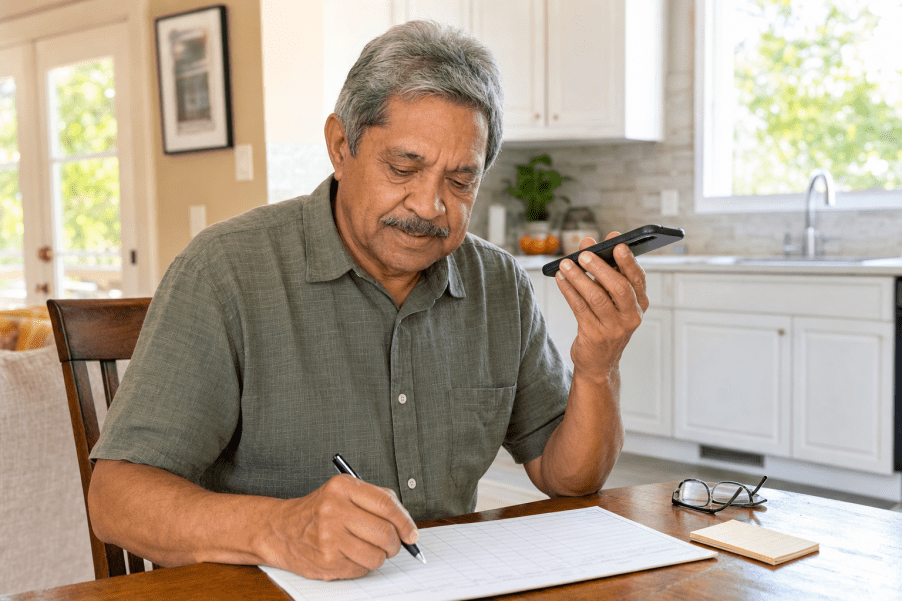
Use a full sheet of paper, a notebook page, or a large-print form. Work with one voicemail at a time. Put the phone on a table, turn on speaker mode if appropriate, and have a pen ready. Play the full message once without writing. On the second play, pause after each useful detail.
Write these fields in this order
| Field | What to write | Why it matters |
|---|---|---|
| Date and time | When the voicemail arrived | Helps you place it in order |
| Claimed caller | Name and organization stated | Records the claim, not proof |
| Reason | One sentence about the message | Keeps the issue clear |
| Requested action | Call, visit, pay, sign, send, or wait | Shows what the caller wants |
| Deadline | The exact date or time stated | Lets you judge urgency calmly |
| Message number | The callback number stated | Keeps it separate from a trusted number |
| Trusted number | Number found independently | Creates a safer callback route |
| Result | Who answered and what happened | Closes the loop |
Label the two number fields clearly. The number stated in a voicemail is evidence about the message, but it is not automatically a safe callback number. The trusted number is the one you obtain independently. Your large-print phone list can hold verified numbers for family, doctors, banks, utilities, insurance plans, and other organizations you use often.
Do not copy passwords, one-time codes, full account numbers, Social Security numbers, or medical details onto the log. A short description such as “question about my appointment” or “asked about my bank account” is usually enough. Store completed logs where visitors and casual helpers cannot read sensitive information.
Step 2: decide what the message needs
After writing the message, choose one of three lanes. This is a decision aid, not a judgment about the caller. When uncertain, use CHECK FIRST.
CALL
The message matches something you expected, the request is ordinary, and you have a trusted number for the person or organization. Call through that trusted route, not through a link or number supplied in the message.
CHECK FIRST
The topic might be real, but the timing, name, number, or request is unclear. Ask a trusted helper, check a recent statement or official app, or contact the organization through its known website before deciding.
DO NOT RETURN
The voicemail demands money, gift cards, cryptocurrency, passwords, one-time codes, remote access, or secrecy; threatens immediate punishment; or asks you to call a number you cannot verify. Save the message if you may report it, and do not engage.
An unexpected urgent message about money deserves a pause. In January 2026, the Federal Trade Commission advised people who receive calls claiming their money is at risk to get basic details, end the call, and contact the company through an official app, website, recent statement, or the number on the back of a card. The FTC also warns that a caller may know personal details without being trustworthy.
If the message describes immediate danger, a fire, a medical emergency, or a crime in progress, do not spend time researching a callback number. Call 911. For a routine appointment, delivery, account question, family update, or service reminder, the written process can continue.
Step 3: verify the caller independently
Caller ID and a familiar-looking area code do not prove who called. The FTC explains that scammers can falsify the name and number shown on caller ID. Los Angeles County’s Department of Consumer and Business Affairs has also documented spoofing that made a call appear to come from a County number. Its advice is direct: do not return the number shown on the phone; find the organization’s number on its website and dial it manually.
- Name the claim. Write “claims to be my bank,” “claims to be my clinic,” or “claims to be my grandson.” This language keeps the claim separate from confirmation.
- Choose a trusted source. Use a number already saved from an earlier verified contact, the back of a physical card, a recent statement, an official app you already use, or the organization’s official website.
- Do not rely on a search advertisement. The FTC notes that scammers can buy paid search ads that place fake numbers near the top of results. Prefer a known official address or document.
- Compare the story. Ask the verified organization whether it tried to contact you and whether the stated issue exists. Do not volunteer extra account information just to help the first caller’s story fit.
- Record the source. Next to the trusted number, write “back of card,” “statement dated July 10,” “official app,” or the official website address.
A voice can also be imitated or taken out of context. If a message claims to be from a relative and asks for urgent help, call that relative on the number you already have. If the person does not answer, contact another family member through a known number. The Los Angeles family verification guide offers a separate household plan for suspicious requests.
Step 4: return the call with a simple script
Once you have a verified number, prepare before dialing. Keep the voicemail log in front of you. Write one question at the top of the page: “Did your organization leave this message, and what do I need to do next?” If an account is involved, have only the ordinary information you would normally use with that organization. Never read a one-time code to someone who called you.
Callback script
“Hello. I received a voicemail from someone who said they were with your organization. I found this number through my card, statement, app, or official website. Can you confirm whether your organization tried to reach me? Please tell me the safest next step without using the number or link from the voicemail.”
If the representative confirms the contact, write the person’s name or department, the time, and the next action. If the organization cannot confirm the message, ask where suspicious messages should be reported. End the call if the representative pressures you to move faster than you are comfortable with, asks for a password or one-time code, or directs you to a payment method you do not normally use.
When the message is from a person you know, a shorter script works: “I received your voicemail about ____. I am calling you on the number I already have. Is this the message you left?” This avoids repeating private details until the person confirms the context.
Step 5: close the loop without losing the record
Do not delete the original voicemail immediately after making a callback. Keep it until you know whether the matter is complete, especially if the message involved an appointment, a service request, a delivery problem, a disputed account action, or a suspicious contact. Phone and carrier storage rules vary, so save or share a message only when you understand where the copy will go and who can access it.
Mark one finish status
- DONE: The message was confirmed and the action is complete.
- WAITING: You called a verified number and are waiting for a response.
- CHECKING: A helper or organization is reviewing the message.
- REPORTED: You used an official complaint or fraud-report route.
- NO ACTION: You decided not to return the message.
Add the date beside the finish status. Then delete the voicemail only when you no longer need it, following the instructions for your device or carrier. Shred or securely store any paper log containing personal information. If the issue will continue, transfer only the necessary next step to a calendar or task list rather than keeping an open-ended pile of message sheets.
How to help another person without taking over
A trusted family member, friend, or caregiver can make the process easier, but permission still matters. Ask what kind of help the older adult wants: replaying the message, writing the log, finding an official number, sitting nearby during the callback, or speaking after the older adult gives permission. Do not impersonate the person or access an account without authorization.
Use a teach-back approach. After reviewing the message, ask: “What did the caller claim, where will we find a trusted number, and what is the next step?” This confirms that the process makes sense without turning the helper into the only person who can manage it. For families coordinating from a distance, the out-of-town family support guide offers a broader way to share responsibilities.
Permission-based helper script
“Would you like me to write while you listen, find the official number, or stay with you while you call? You can choose one step. We can stop if the request does not feel right.”
If the voicemail involves financial loss, identity theft, abuse, a legal deadline, medical advice, or a benefits decision, use the responsible organization or qualified professional. A family helper can organize the message and support the call, but should not invent an answer or promise an outcome.
Los Angeles and federal reporting routes
For a suspicious consumer voicemail in Los Angeles County, begin with the agency that owns the issue. Contact a bank through its official fraud number, a health organization through its patient or member service line, a delivery company through its official app or website, or a County department through a number published on a County website.
The Los Angeles County Department of Consumer and Business Affairs publishes local scam alerts and consumer information. Its County spoofing alert advises people not to call back a displayed number and not to give personal or medical information to an unexpected caller. Because individual scam patterns change, use the current DCBA website rather than relying on an old screenshot or forwarded social post.
The Federal Trade Commission accepts fraud reports at ReportFraud.ftc.gov and publishes current phone-scam guidance. The Federal Communications Commission’s Consumer Inquiries and Complaints Center accepts unwanted-call, unwanted-message, and spoofing complaints. The FCC explains that complaints help its enforcement and policy work, but it does not resolve each individual unwanted-call complaint. Keep your voicemail log nearby so you can provide dates, numbers, claims, and requested actions without guessing.
All Seniors Foundation can share general educational navigation and help families think through a next-step checklist, but it does not verify callers or decide whether a message is legitimate. For general questions about available ASF information, use the All Seniors Foundation contact page. Confirm any service, agency, appointment, or account matter with the responsible organization.
Common voicemail mistakes to avoid
- Calling the message number first. Record it, but obtain a separate trusted number before deciding.
- Trusting a local caller ID. A Los Angeles area code or familiar organization name can be falsified.
- Acting on the transcription alone. Replay the audio for names, numbers, dates, and amounts.
- Writing sensitive information on the log. Use a short topic label instead of passwords, codes, or full identifiers.
- Deleting the voicemail too early. Keep it until the issue is confirmed, closed, or reported.
- Letting a helper take control without permission. Agree on the exact help wanted before sharing the phone or account details.
- Searching while panicked. Urgency is a reason to slow down and use a known official route.
- Assuming silence proves a scam. A legitimate organization may not be able to find a message immediately; keep the log and ask for the correct department.
The routine does not need to be perfect. If you capture the claim, requested action, deadline, and a separately verified contact route, you have enough to make a calmer decision.
Frequently asked questions
Should I call back every voicemail?
No. Return a voicemail only when the message needs a response and you can use a trusted number. Unknown sales calls, pressure messages, and requests for sensitive information may need no response or an official report instead.
Can I trust the phone number shown on caller ID?
No. Caller ID can be falsified. Record the displayed number, but find the organization through a card, statement, official app, saved verified contact, or official website before calling.
What if the voicemail says the matter is urgent?
Write the exact deadline and pause. For immediate danger call 911. For money, account, appointment, or service claims, contact the responsible organization through a trusted route and ask whether the issue is real.
Should I use a voicemail transcription?
A transcription can help, but it may mishear names, numbers, dates, or amounts. Replay the original audio before relying on an important detail, and follow the instructions for your phone and carrier.
How long should I keep the original voicemail?
Keep it until the matter is confirmed, completed, or reported. Storage and deletion rules vary by phone and carrier, so follow your device instructions and avoid sharing a message that contains private information.
Can a family member return the call for me?
A family member can help when you give permission and the organization allows it. Agree on the exact task, use a verified number, and do not let anyone impersonate you or access an account without authorization.
Sources used for this guide





