
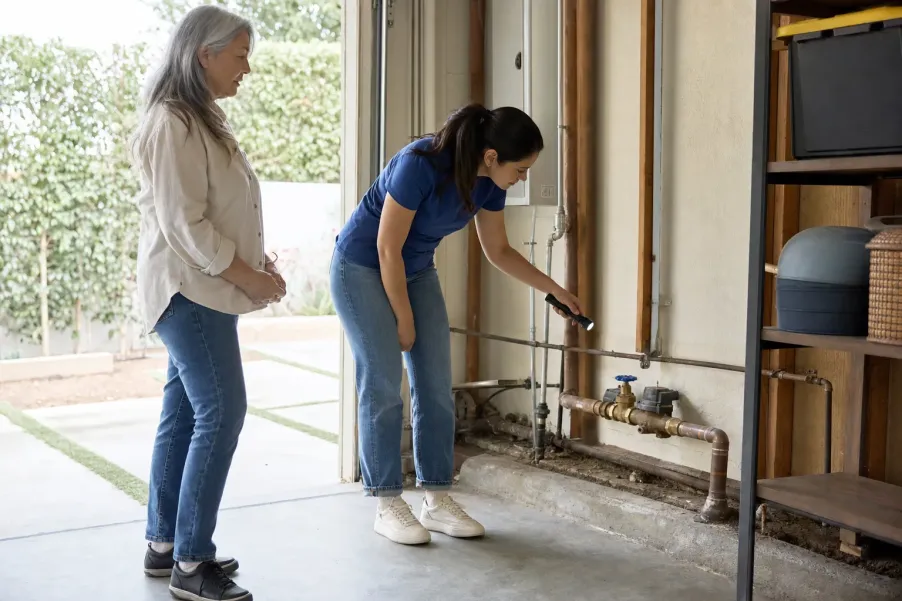
A practical household preparedness check
A home water shutoff valve check is a preparation task, not a plumbing repair. The goal is to know where the correct household valve is, who can reach it safely, and whom to call if water is flowing and the situation is unclear. That distinction matters in Los Angeles County, where housing types, water providers, meter arrangements, and property responsibilities vary.
Key takeaways
Locate before an emergency
Find the point where the water supply enters the home while the area is dry, bright, and calm.
Confirm, do not guess
Ask the responsible provider or professional to identify the household-side valve and explain whether a special tool is appropriate.
Plan for safe access
Remove stored items and assign a helper if reaching the valve requires unsafe bending, kneeling, climbing, or force.
Know the escalation route
Use the property manager, water provider, licensed plumber, or 911 according to the actual hazard and property responsibility.
What does a home water shutoff valve check include?
A complete check answers five questions: Where is the household shutoff? Has the correct person confirmed its identity? Can someone reach it without a fall or strain risk? Does the household know what not to touch? Is there a current call route for a leak?
Los Angeles County Ready includes knowing the location of water, gas, and electricity shutoffs among the essential actions in a household emergency plan. The County’s current Emergency Survival Guide says the water shutoff is generally found where the water supply enters the house and advises residents to ask their water company whether a special tool is needed.
This Article focuses only on water. Gas and electricity have different hazards and procedures. Never treat one utility valve as practice for another.
What should you confirm before looking for the valve?
Begin with the property arrangement. A detached home may have a household valve near the point where the service line enters. An apartment, condominium, accessory unit, or shared property may use individual unit valves, common building controls, or restricted utility equipment. A resident should not open a street-side meter box, cross a locked service area, or operate equipment controlled by the water provider.
Gather three facts before the walkthrough:
- Responsible contact: the current water provider, property manager, maintenance contact, or licensed plumber who can confirm the setup.
- Property boundary: which valve is resident-accessible and which equipment belongs to the utility or building.
- Physical limits: whether the older adult can safely walk to, see, and reach the area without climbing, crawling, kneeling, or moving heavy storage.
If an unfamiliar person arrives and claims that a valve or meter requires immediate access, pause and independently verify the visit. The utility-worker visit verification checklist explains how to use an official number rather than a number supplied at the door.
How can an older adult and helper complete the check?
Choose a calm, dry time
Do the walkthrough in daylight when no leak is active. Wear stable shoes and bring a flashlight for seeing behind pipes, not for entering a dark or restricted space.
Trace the likely entry area
Look where the water supply appears to enter the home, such as a garage wall, exterior wall, basement, crawlspace entrance, or utility room. Observe only from a safe standing position.
Ask for positive identification
Have the property manager, water provider, or licensed plumber confirm the exact household shutoff. Ask what is resident-controlled and what must remain untouched.
Check the approach
Clear light storage from the path. Do not move heavy shelving, reach through sharp materials, or stand on a stool. Choose a helper if the route is awkward.
Record plain directions
Save a current photo and a short location description, such as “garage, right wall, below the small window.” Keep the directions with the household emergency contacts.
Confirm the tool and motion
Ask whether the confirmed valve is hand-operated or requires a specific tool. Do not buy a generic wrench and assume it belongs on every valve.
Rehearse the call plan
Practice saying the address, where water is visible, whether electricity is nearby, and whether the household valve was professionally identified. Rehearse words, not a live shutoff.
The location description should be understandable to a family member who does not live in the home. A clear street number also helps responders and service professionals find the property; use the home address number visibility check for that separate task.
A short call script for a family helper
Keep the first call factual: “I am calling about water at this address. The water appears to be coming from the kitchen wall, and it is moving toward the hallway. The household shutoff was identified by our plumber in the garage, but I do not know whether it is safe to operate now. There is no standing water near electricity that I can see. What should we do next?” Change every detail to match the real scene. If electricity, a damaged ceiling, fire, injury, or another immediate danger is present, leave the unsafe area and call 911 instead of reading a routine script. The purpose of the script is to communicate location, spread, known hazards, and valve certainty without guessing.
What should you do when a leak is actually happening?
Use the safest route that matches the conditions. Water can create slip hazards and can become especially dangerous near electrical equipment, damaged ceilings, or unstable materials. Do not step into standing water to reach a valve.
| What you observe | Safer next step | What to avoid |
|---|---|---|
| A small fixture leak with a familiar local stop valve | Use the fixture control only if it was previously identified, turns normally, and can be reached safely; then arrange repair. | Forcing a corroded handle or reaching behind energized appliances. |
| Water is spreading, but the household valve is confirmed and safely accessible | Follow the exact instructions previously provided by the responsible professional or water provider, then call for repair. | Experimenting with nearby valves or using an improvised tool. |
| The valve is unknown, stuck, shared, or restricted | Call the property manager, water provider, or licensed plumber and describe the location and flow. | Entering a utility meter box or turning a shared-building control. |
| Water is near electrical equipment, a ceiling is bulging, or the structure looks unsafe | Leave the hazardous area and call 911 when there is an immediate threat to life or safety. | Walking through water, touching equipment, or remaining under a damaged ceiling. |
For City of Los Angeles customers, LADWP says that a customer with an active leak who needs help turning water off for emergency repairs should report it by phone or in person, and should not use email for an emergency. LADWP also states that it does not repair leaks on private property. Confirm the current route for your address because not every Los Angeles County household is served by LADWP.
How can families make the plan easier to use?
For limited balance or reach
Assign a helper who can approach the valve without kneeling or climbing. Keep the older adult’s role focused on calling, giving directions, and moving to a safe area.
For low vision
Use a high-contrast location photo and a spoken description. Improve general lighting without attaching homemade labels to utility equipment unless the responsible professional approves.
For memory support
Keep one short direction in the household contact list and share the same wording with the designated helper. Avoid multiple conflicting notes.
For renters or shared buildings
Save the after-hours property contact and ask who may operate building controls. Do not assume a unit resident has authorization.
Ready.gov preparedness guidance encourages households to learn utility shutoff procedures in advance. Learning in advance means getting instructions from the responsible utility or professional; it does not require an older adult to perform a live test.
Keep the water plan alongside other small, separate household routines. The power-outage flashlight and phone charging check covers lighting and communication, while the smoke and carbon monoxide alarm sound check covers audible alerts. The broader home safety plan can help families place these routines in context.
When should the household review the plan?
Review the location and call route after moving, remodeling, plumbing work, a change in property management, a new water provider, or a change in the older adult’s mobility or vision. A brief annual check is also reasonable because storage can slowly block access and contact information can change.
A ready plan can be explained in one minute
- The confirmed household valve is in a known, safely accessible location.
- The family knows which utility or building equipment must remain untouched.
- One helper and one backup contact know the same location description.
- The property manager, water provider, plumber, and emergency routes are current.
- No one needs to climb, crawl, force a handle, or enter standing water.
If a family needs help organizing several practical tasks, browse the Senior Support Guides. All Seniors Foundation can help Los Angeles County older adults and families navigate general support information, but it does not identify water valves, direct utility operations, or replace a licensed plumber, property manager, water provider, or emergency responder.
Frequently asked questions
Where is a home water shutoff valve usually located?
It is often near the point where the water supply enters the home, but the exact location varies by property. Ask the property manager, water provider, or a licensed plumber to confirm the household valve.
Should an older adult practice turning the valve?
No live practice is required for this preparedness check. First confirm the valve and the correct procedure. A stuck, corroded, shared, or unfamiliar valve should be handled by the responsible professional.
Can I use the valve inside the water meter box?
Do not assume that meter-box equipment is resident-controlled. Utility rules and property arrangements vary. Contact the water provider or property manager before entering a box or operating a street-side valve.
What if the valve is hard to reach?
Do not climb, crawl, kneel unsafely, or move heavy storage. Clear only a safe approach and assign a capable helper. Ask a licensed plumber whether an accessible household-side control is appropriate.
Who should I call during an active water leak?
Call the property manager, water provider, or a licensed plumber according to the property and leak location. Call 911 for an immediate life-safety hazard, such as water near electricity or structural danger.
Does LADWP repair a leak inside my home?
LADWP states that it does not repair leaks on private property. City of Los Angeles customers who need help turning water off for emergency repairs should use LADWP’s current phone route, not email for an emergency.
Choose one next step today
Start by asking the responsible property or water contact to confirm the household valve. If your family also needs help navigating non-emergency senior support information in Los Angeles County, All Seniors Foundation can help you find the right general starting point.
Educational boundary: This Article provides general household preparedness information. It is not plumbing, utility, electrical, legal, medical, or emergency advice. Follow current instructions from the responsible water provider, property manager, licensed professional, or emergency responder.





