
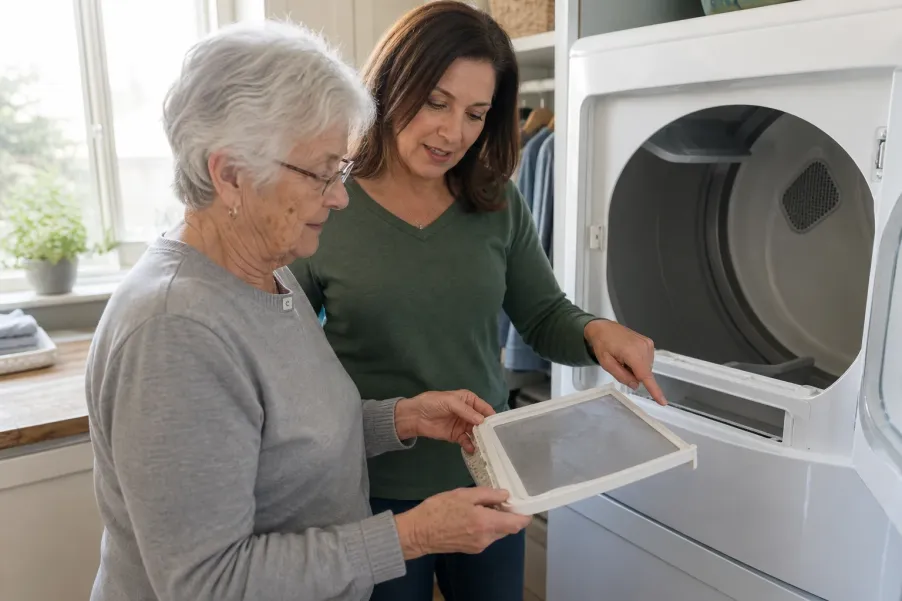
A small laundry habit with a clear stop point
A clothes dryer lint filter and vent check is a short household routine, not a repair project. It helps an older adult, family member, or trusted helper separate the parts that are safe to observe from the parts that should be handled by a qualified professional. The goal is consistent attention: clean the removable screen, look for obvious airflow problems, and act early when the dryer behaves differently.
This guide applies to ordinary residential clothes dryers in Los Angeles County. Dryer designs vary, and ventless or heat-pump models may not use an outdoor exhaust duct. Always follow the manufacturer’s current instructions for the exact appliance. Renters should coordinate repairs and access with the property owner or manager. No checklist can prevent every fire or replace professional service.
Key takeaways
Clean the screen every load
Remove lint from the appliance’s accessible filter before or after each drying cycle. Reinstall the filter correctly before the dryer is used again.
Observe three safe zones
Check the removable lint screen, the visible floor and space around the dryer, and the outdoor vent opening. Do not move or disassemble a heavy appliance.
Notice changes in airflow
Longer drying times, damp clothes after a normal cycle, unusual heat, or little outdoor exhaust can signal a restriction that needs attention.
Know when to stop
Smoke, flames, sparks, burning odor, gas odor, a damaged cord, repeated breaker trips, or visibly crushed ducting are not do-it-yourself checklist items.
Why do dryer lint and airflow matter?
A dryer moves heated air through damp clothes, through a lint filter, and—on a conventional vented model—through an exhaust path to the outside. Lint that collects in the screen or exhaust path can reduce airflow. The U.S. Consumer Product Safety Commission explains in its official overheated-clothes-dryer safety alert that lint buildup can block airflow, contribute to excessive heat, and result in a fire in some dryers.
The U.S. Fire Administration’s clothes-dryer fire-safety checklist recommends cleaning the lint filter before and after each cycle, checking that venting behind the dryer is not damaged, crushed, or restricted, and confirming that the outdoor vent cover opens while the machine operates. Those tasks describe both a routine and a boundary: a person can clean an accessible screen and observe an outdoor flap, but repair or internal cleaning may require professional service.
Airflow also affects everyday performance. ENERGY STAR advises cleaning the lint filter after every load to improve air circulation and dryer efficiency. Its current clothes-dryer guidance notes that dryer-sheet residue can form a film on some filters and provides a regular cleaning suggestion. Use the appliance maker’s method and materials for the exact filter; do not scrub, wash, or reinstall a wet filter unless the instructions allow it.
What should you check before touching the lint screen?
Begin with the manual or manufacturer instructions. Locate the removable lint screen and learn whether the model is vented, ventless, or a heat-pump dryer. A filter may be in the door opening, on top of the machine, or in another accessible location. Do not force a part that does not lift or slide easily as designed.
Make sure the dryer is not running and the drum has stopped. Let hot surfaces cool. Use stable footwear, turn on the room light, and keep a clear standing area. If the filter is low, awkward, or difficult to grip, sit only on a stable chair positioned away from the door swing, or ask a trusted helper to perform the task. Do not balance on a stool, kneel in a cramped gap, or brace against a moving appliance.
Look at the power connection without touching exposed or damaged parts. The Los Angeles Fire Department’s current electrical-safety guidance says major appliances such as dryers should be plugged directly into wall outlets rather than extension cords or power strips. It also identifies sparks, burning smells, discolored outlets, damaged controls, and repeated electrical problems as reasons for qualified attention.
Remove laundry baskets, cleaning products, paper, and loose fabric from the immediate area. A clear path makes it easier to see fallen lint and reduces the chance that the dryer door, a basket, or a helper will block a walker, wheelchair, doorway, or exit. The same principle appears in ASF’s safer closet setup guide: keep frequently used household tasks within comfortable reach and protect the walking route.
What are the three safe observation zones?
Zone 1: removable lint screen
With the dryer stopped and cool enough to handle, remove the screen as instructed. Roll lint away with your fingers or use the approved method. Check for tears, warping, heavy residue, or a filter that no longer seats correctly. Reinstall it fully before the next cycle.
Zone 2: visible area around the dryer
Without moving the appliance, look at the reachable floor, top, sides, and open space in front. Remove loose lint and ordinary clutter you can reach safely. Do not pull the dryer forward, reach behind it, disconnect the duct, open panels, or handle wiring or a gas connection.
Zone 3: outdoor vent opening
If the dryer is a conventional vented model and the outdoor outlet is safely accessible from ground level, observe whether its cover opens and air exits while the dryer runs. Do not climb, remove a guard, enter a crawlspace, or reach near moving parts.
The outdoor observation needs two people when the controls and exterior vent are far apart: one person stays with the dryer and one watches the outlet from a safe location. Agree on a short phone call or verbal signal before starting. The outside observer reports only what they can see and feel without touching the vent: whether the flap opens, whether air appears to move, and whether lint is visibly collecting around the opening.
A screen that looks clean does not prove the full exhaust path is clear. Conversely, a ventless or heat-pump dryer may have no outside outlet at all. That is why the model instructions matter. Do not create an outdoor-air test for an appliance designed to condense or recirculate air.
What is a seven-step dryer lint and vent routine?
Stop and cool
Confirm the cycle is finished, the drum has stopped, and surfaces are comfortable to approach. Keep the door and walking path clear.
Remove the screen
Use the handle and direction shown by the manufacturer. If it sticks, stop rather than twisting or prying it.
Clear the lint
Remove the lint with the approved method. Notice tears, residue, distortion, or a loose frame that may need a replacement part or service.
Seat the filter
Return the dry, intact screen to its correct position. Never operate the dryer with the lint filter missing.
Clear the visible area
Pick up reachable lint and move baskets or supplies away from the appliance and walking route. Do not move the dryer.
Observe one normal cycle
Notice whether a typical load dries normally and whether the machine has unusual heat, vibration, noise, or odor. Do not leave a concerning dryer running for a test.
Check outdoor airflow when applicable
From a safe ground-level position, confirm that the exterior vent cover opens and air exits. Record only a simple result: normal, unclear, or stop and call.
Which signs mean clean, monitor, or stop?
Clean and continue
The intact filter removes and seats normally, the visible area is clear, a normal load dries in its usual time, and the outdoor vent opens with airflow when the model uses one. Continue the every-load lint-screen habit and follow the manufacturer’s maintenance schedule.
Monitor and arrange help
Drying takes longer than usual, clothes remain damp after a typical cycle, the room feels unusually warm, the exterior airflow is weak or unclear, residue keeps returning, the filter is damaged, or the visible duct appears kinked or crushed. Stop repeated test cycles. Ask a qualified appliance or vent professional, landlord, or property manager to inspect the correct system.
Stop use now
There is smoke, flame, sparking, a burning or gas odor, a scorched surface, a damaged plug or cord, a discolored outlet, or a repeatedly tripped breaker. Move away from immediate danger and use the appropriate emergency or qualified-service route. Do not restart the dryer to see whether the sign repeats.
CPSC notes that clothes still damp after a typical cycle or drying that takes longer than normal may indicate a blocked screen or exhaust duct. That symptom does not identify the exact location or repair. A helper should report the change, not diagnose a motor, thermostat, electrical circuit, gas connection, or hidden duct.
Keep this routine connected to other household warning systems. ASF’s smoke and carbon monoxide alarm sound check addresses a separate layer of protection. A clean lint screen does not replace working alarms, and working alarms do not make a restricted dryer safe to keep using.
How can a family member or trusted helper assist?
Ask before taking over. The older adult may prefer to clean the filter independently while a helper handles the outdoor observation or schedules service. Agree on the exact task, protect privacy, and avoid turning a short maintenance check into an inspection of unrelated belongings.
A helper can improve accessibility by placing a small lidded lint container within comfortable reach, keeping the floor clear, adding bright room lighting, and checking that the filter handle is easy to grasp. Do not store the container on the dryer if vibration could move it, and keep combustible clutter away from the appliance. The helper should not improvise replacement parts or modify a duct.
For a shared routine, choose one memorable trigger: clean the screen with every load, then perform the visible-area and outdoor-airflow observation on a regular date recommended by the manufacturer or service professional. Add the check to a shared household calendar only if the household already uses one. Record no account passwords, access codes, or private health details.
If a power outage or breaker event interrupts the dryer, do not assume the machine should resume automatically. Follow the appliance instructions and the power-outage lighting and phone charging check for household readiness. Repeated breaker trips belong with a qualified electrician or property manager, not a repeated restart attempt.
How should Los Angeles households adapt the check?
Los Angeles County laundry setups vary widely. A dryer may be in a garage, apartment closet, shared laundry room, outdoor alcove, kitchen area, or stacked unit. The safest routine depends on the actual location. Do not block a common hallway, fire door, stair, accessible route, or shared appliance while performing the check.
In a rental or shared building, the exhaust duct may pass through a wall or connect to a system that residents cannot access. Report longer drying times, absent airflow, odor, visible damage, or lint accumulation through the property’s normal maintenance route. Keep the date, appliance location, and observed symptom. Do not enter a roof, utility room, locked service space, or another resident’s area.
For a garage or exterior laundry area, perform the outdoor observation only when weather, lighting, footing, and air quality make it safe. A person should not cross a steep slope, climb a ladder, or step into traffic to find a vent. If the outlet cannot be observed safely from ground level, make that limitation part of the service request.
Make the home easy for emergency help to locate by keeping address numbers visible from the normal approach. ASF’s home address number visibility check explains that separate task. Do not delay an emergency call to finish a maintenance checklist.
Which dryer-check mistakes should be avoided?
- Running without the lint filter: reinstall the correct intact filter before using the dryer.
- Forcing a stuck part: stop and use the manual or qualified service instead of prying or bending the screen.
- Moving a heavy dryer alone: do not pull the appliance forward to reach a hidden duct or connection.
- Using a power strip or extension cord: LAFD advises connecting major appliances directly to wall outlets.
- Repeating a concerning test: unusual heat, odor, weak airflow, or longer drying should lead to inspection, not several more cycles.
- Climbing to an outdoor vent: if the outlet is not safely visible from ground level, leave the observation to qualified help.
- Treating every dryer alike: ventless and heat-pump models have different airflow and maintenance paths.
- Assuming clean means guaranteed safe: the routine supports observation and maintenance but cannot rule out hidden electrical, gas, mechanical, or duct problems.
What is the practical next step?
Today, identify the filter location, read the appliance instructions, and practice one comfortable remove-clean-reinstall cycle with the dryer stopped. Then decide whether a trusted person can safely observe the outdoor vent on a conventional vented model. Write down one of three results: normal, unclear, or stop and call.
All Seniors Foundation may help a Los Angeles County older adult or family helper organize a simple household checklist, improve access to the laundry area, or decide who will assist with observations. ASF does not inspect, repair, install, or certify dryers, vents, gas connections, or electrical systems.
Frequently asked questions
How often should the dryer lint filter be cleaned?
Clean the removable lint filter before or after every load, following the instructions for the exact dryer. Reinstall the intact filter fully before the next cycle.
Does a clean lint screen mean the dryer vent is clear?
No. A clean screen does not prove the full exhaust path is open. Longer drying, weak outdoor airflow, unusual heat, or a damaged duct needs qualified attention.
Should an older adult pull the dryer out to inspect behind it?
No. Do not move a heavy dryer, disconnect a gas line, handle wiring, or open panels. Observe only safely visible areas and arrange qualified help for hidden parts.
What if clothes suddenly take longer to dry?
Stop repeated test cycles, clean and seat the accessible filter, and arrange inspection if the change remains. Longer drying can be a sign of restricted airflow.
Do ventless and heat-pump dryers have an outdoor vent?
Many do not. Check the model instructions before looking for outdoor airflow, and follow the manufacturer’s filter, condenser, drainage, and maintenance guidance.
When should the dryer be stopped immediately?
Stop for smoke, flames, sparks, a burning or gas odor, scorched parts, a damaged cord or outlet, or repeated breaker trips. Use emergency or qualified help as appropriate.
Sources reviewed: U.S. Fire Administration, U.S. Consumer Product Safety Commission, ENERGY STAR, and Los Angeles Fire Department. Product instructions and building responsibilities vary; confirm the current requirements for the exact dryer and property.


