
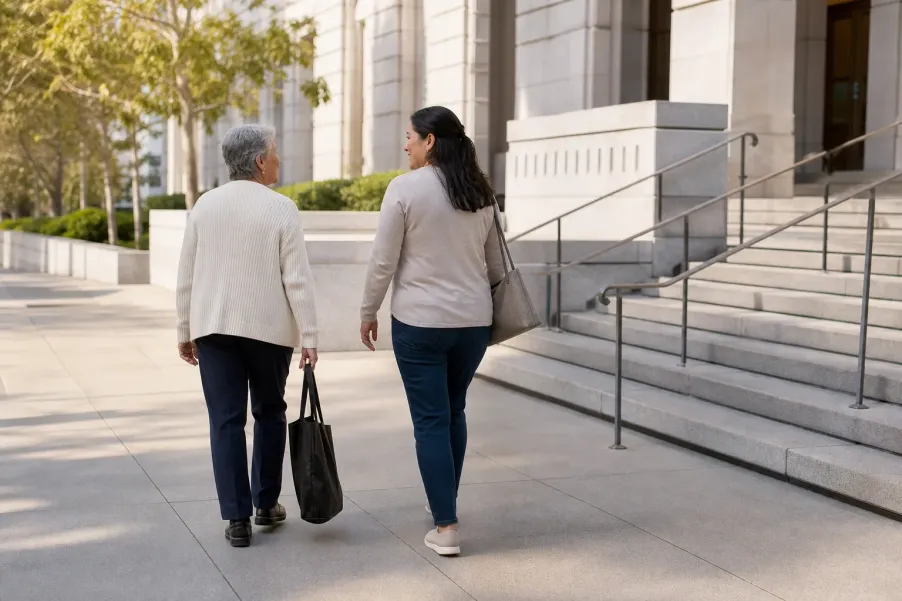
When a Los Angeles County jury summons arrives, register only through the official court channel, complete orientation, and check reporting instructions during the assigned service week. Keep the juror number and PIN private, plan the exact courthouse route, and ask early about mobility, hearing, vision, or other access needs. The summons and current court instructions always control.
Respond before planning the trip
Registration, orientation, and reporting instructions determine whether and when you must appear. Do not travel based only on the first date you notice on the summons.
Use the official court route
Start at the Los Angeles Superior Court jury website or use the telephone number printed on the summons. Keep the juror identifier and PIN away from unverified callers.
Ask about access early
Describe the functional need and the assigned courthouse. Accommodation, transfer, postponement, and excuse requests are court decisions, not promises a helper can make.
Prepare for a variable day
Confirm the route, entrance, parking or transit, permitted items, food options, medicines, and a return ride. Reporting and release times can differ from expectations.
A jury summons is an official court notice, but it is not a reason to panic or assume that every printed date requires an immediate courthouse visit. Los Angeles Superior Court uses registration, orientation, and reporting instructions to guide prospective jurors. The practical task is to keep the notice secure, respond through the correct channel, and prepare only for the instructions that actually apply to the assigned service.
This guide is for an older adult, family member, caregiver, or trusted friend organizing those steps. It does not decide whether someone qualifies, must report, may postpone, can transfer, receives an accommodation, or is excused. Those are court matters. Do not place a juror identification number, PIN, medical detail, or other private record in a public note, text thread, or shared planning document.
How should you read and secure a Los Angeles County jury summons?
Begin with the addressee, court name, assigned courthouse, service period, juror identification number, PIN, and response instructions. Read the front and back, plus every insert. Keep the complete packet together. If the name or address appears wrong, do not guess at the correction; use the court contact route identified on the notice or official jury website.
Separate public details
The courthouse name, public jury-services phone number, and official website can be written on a household calendar or ride plan.
Protect private details
The juror number, PIN, date of birth, medical information, and portal responses should stay with the prospective juror or an authorized helper.
Verify the channel
Type the official court address yourself or begin from the court jury hub. Do not follow a payment link or provide information to a caller who creates urgency.
If official mail tends to get mixed with advertisements, create one clearly labeled place for court notices and other time-sensitive records. The paper-mail sorting routine can help, but the summons itself should remain private and intact rather than copied into the general household pile.
What should happen after you receive the summons?
The Los Angeles Superior Court says prospective jurors should register after receiving a summons and complete mandatory orientation before reporting. The official jury portal and the Serve Jury telephone system are the primary routes described by the court. Follow the timing and instructions on the actual summons because portal screens, call menus, and deadlines can change.
- Open the official jury hub. Begin at the Los Angeles Superior Court website or call the number printed on the summons. Confirm the domain and court identity before entering private information.
- Register the prospective juror. Enter information accurately and preserve the final confirmation. A helper may read fields aloud, but should not choose answers without the juror.
- Complete orientation. Use the method the court currently allows. Finish it before the reporting day and note completion without copying private portal data into an unsecured place.
- Check reporting instructions. Beginning when the summons directs, use the official portal or telephone system to learn whether the juror must report, when to arrive, and whether instructions changed.
- Recheck before leaving. Confirm the assigned courthouse, date, arrival time, group or reporting status, and any courthouse-specific notice. Do not rely on a screenshot taken days earlier.
For a person who finds small text difficult, enlarge the portal before entering any information. The smartphone text-size and screen-magnification guide offers a simple practice routine. Use a private device, sign out when finished, and avoid storing the PIN in an unprotected browser note.
A simple confirmation log
Write only the date checked, the public court contact route used, the reporting result, the next time to check, and the assigned courthouse. Keep the juror number and PIN on the summons or in a protected record, not in the visible log.
How should an older adult handle an accommodation, postponement, transfer, or excuse question?
Do not treat these words as interchangeable. An accommodation supports participation. A postponement moves service to another time. A transfer asks for another court location. An excuse asks to be released from the current obligation under applicable rules. The court decides each request using current law, facts, deadlines, and documentation.
| Need | Useful preparation | Boundary |
|---|---|---|
| Mobility, hearing, vision, communication, or another disability-related accommodation | Describe the functional need and contact the assigned court early through its official route. | Do not assume a device, interpreter, entrance, seat, or schedule is available until the court confirms it. |
| A different service date | Register first if directed, then use the current postponement process and save the court response. | A request is not approval. Continue following the original instructions until the court confirms a change. |
| A different courthouse | Explain the true transportation, work, dependent-care, or impairment issue using the court process. | Convenience alone may not support a transfer, and the preferred courthouse is not guaranteed. |
| A medical or hardship excuse | Read the current court and California rules, state the facts accurately, and provide only required documentation. | Age alone does not automatically cancel a summons. Never invent or exaggerate a condition. |
The California Courts jury-service guidance explains that health, disability, transportation, dependent care, and serious hardship questions may have formal routes. Los Angeles Superior Court provides separate accommodation and request instructions. Ask early enough for the court to respond, keep medical information out of casual messages, and retain the decision or revised summons details.
How can you plan the exact courthouse visit?
Use the courthouse named in the reporting instruction, not the courthouse that seems closest. Open the court location page and identify the public entrance, jury assembly room information, parking guidance, transit options, accessibility contact, and current restrictions. Check travel time for the expected arrival period, then add time for parking, security, elevators, and finding the assembly room.
Route plan
Record one primary route, one realistic backup, the arrival target, and the public courthouse phone number. Confirm who will provide the return ride if the day runs long.
Access plan
Ask which entrance is step-free, where accessible parking is located, whether seating is available, and how to reach the jury assembly room without unnecessary walking.
Communication plan
Write the helper contact on a separate card. Agree on when the juror will check in, while respecting any court rules about phones and communications.
If the juror already uses Access Services, review the Access paratransit pickup preparation guide while planning the ride. That Article cannot determine eligibility or guarantee timing, so build a return-trip plan that accounts for uncertain release time and the provider rules that apply.
A trusted neighbor or family member can also serve as the day-of contact. The trusted-neighbor emergency support plan explains how to set clear check-in boundaries without giving someone unnecessary account or medical information.
What should you prepare for the reporting day?
Read the courthouse instructions before packing. Security rules and permitted items can differ, and courtroom restrictions may be stricter than the assembly-room routine. Bring the summons or required reporting information, government identification if instructed, necessary medicines in their labeled containers, glasses or hearing devices, and only the personal items the court permits.
- Wear comfortable, respectful layers because room temperatures and waiting periods can vary.
- Eat beforehand when appropriate and check the courthouse guidance about food, water, and nearby options.
- Carry a small amount of essential information rather than a folder of unrelated private records.
- Set medicines, mobility equipment, and hearing or vision aids out the night before.
- Use a quiet activity only if the courthouse permits it; avoid bringing prohibited electronics or tools.
- Keep the court notice, identification, keys, and transportation details in one secure bag.
- Tell the ride contact that release time may not be predictable and that the court controls the schedule.
If a phone will be used for the route or ride home, charge it fully and bring only a permitted charger. Save the public courthouse contact separately in case the phone fails. A large-print phone list can hold the public courthouse and ride-contact numbers without exposing the juror PIN.
What can a family helper do without taking over?
A helper can organize the packet, enlarge instructions, sit beside the juror during portal registration, plan transportation, call a public court line with the juror present, and help describe an access need. The juror should hear and approve each response. The helper should not pose as the juror, invent facts, submit an excuse without permission, or share private identifiers more broadly than necessary.
A respectful helper script
“I can help read the instructions, organize the dates, and plan the trip. You will choose the answers and keep control of your juror information. If the court needs a request or document, we will use the official route and wait for its decision.”
If the older adult becomes uncertain, pause rather than rushing through a portal. Call the official jury-services number together and ask a narrow question. All Seniors Foundation can help families organize questions and practical support steps, but it cannot access the court account, submit a legal request, or determine jury-service obligations.
How can you recognize a jury-service scam?
Los Angeles Superior Court publishes a jury scam warning. Treat an unexpected call demanding money, gift cards, banking information, or immediate personal details as suspicious. Do not trust caller ID, a badge number, or a threatening story as proof. End the contact, locate the official court route independently, and verify the matter without using the caller’s link or callback number.
- Never pay a supposed jury penalty through gift cards, cryptocurrency, wire transfer, or a payment kiosk.
- Never disclose a Social Security number, bank account, card number, or juror PIN to an unexpected caller.
- Do not allow remote access to a phone or computer to “clear” a warrant or correct jury records.
- Keep the suspicious message or number for a report, but do not continue the conversation.
- Use the official Los Angeles Superior Court jury website or the telephone number printed on the genuine summons to verify status.
Where should you confirm current jury-service information?
Use the current summons and official court pages for decisions. These primary sources were reviewed on August 25, 2026:
- Los Angeles Superior Court Jury Services for the official portal, jury-service topics, courthouse information, transportation programs, contacts, and current notices.
- What to do before appearing for jury duty for the court guidance on registration, orientation, reporting instructions, and employer notice.
- Los Angeles Superior Court special accommodations for current assistive-listening, interpreter, TTY, mobility, and additional accommodation routes.
- California Courts jury-service guidance for statewide qualifications, age and health context, hardship concepts, courtroom preparation, and local-court boundaries.
Also review the court’s official jury-service scam warning before responding to an unexpected payment or information request.
This Article provides educational preparation, not legal advice. The summons, Los Angeles Superior Court, assigned courthouse, and current California rules control registration, reporting, requests, accommodations, and service.
Would a calm preparation checklist help?
All Seniors Foundation can help an older adult or family organize practical questions, transportation details, and a respectful support plan while the court remains the final authority.
Frequently asked questions
Does turning 70 automatically excuse someone from jury duty in California?
No. Age alone does not automatically cancel a jury summons. California rules include specific health and hardship paths, and documentation rules can differ by request. Follow the summons and current court process, state the facts accurately, and wait for a court decision.
Should I go to the courthouse on the first date shown on the summons?
Use the summons, registration confirmation, and current reporting instructions together. Los Angeles Superior Court directs jurors to check whether and when they must report during the assigned service period. Recheck through the official portal or telephone route before leaving home.
Can a family member register for jury service for an older adult?
A trusted helper may assist with reading, typing, and organizing if the juror agrees, but the juror should understand and approve every response. The helper should not impersonate the juror, invent information, or keep the juror number and PIN unnecessarily.
How early should I ask for a disability accommodation?
Contact the assigned court as early as practical after identifying the need. Describe the functional barrier and follow the current accommodation process. Do not assume that a device, interpreter, entrance, seat, transfer, or schedule change is confirmed until the court responds.
What if transportation to the assigned courthouse is difficult?
Check the exact courthouse route, court transportation information, and any service you already use. If transportation creates a true hardship or access issue, use the official court request process. A preferred courthouse, transfer, postponement, or excuse is not guaranteed.
Will the court call and demand immediate payment for missed jury duty?
Treat an unexpected payment demand as suspicious. Do not provide financial or personal information, buy gift cards, or use the caller’s link. End the contact and verify jury status through the official Los Angeles Superior Court website or genuine summons number.
Planning another Los Angeles County civic visit?
For a nonpartisan trip plan that covers current locations and hours, accessibility questions, a small carry list, and respectful helper boundaries, use the Vote Center visit preparation guide for older adults.


