
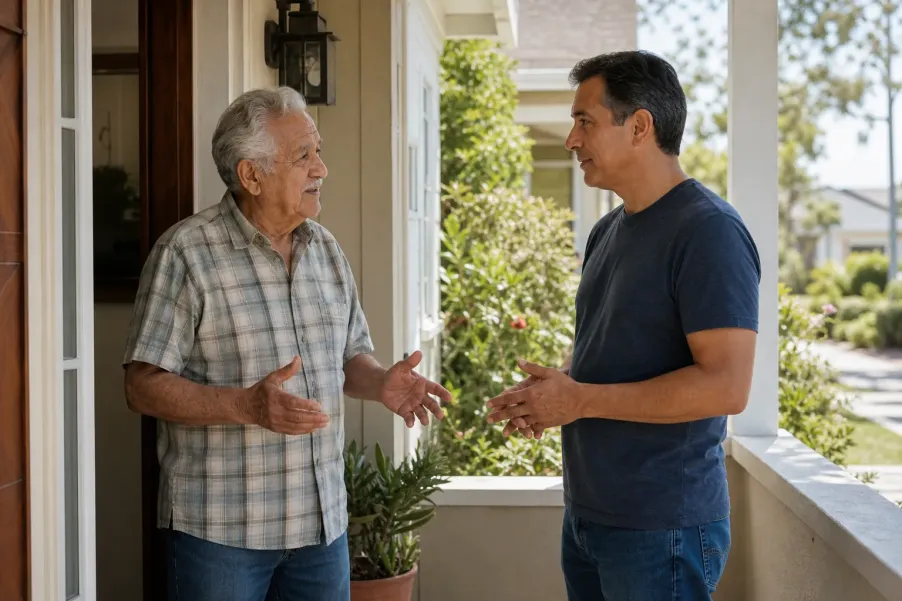
A trusted neighbor emergency support plan names two nearby contacts and one out-of-area backup, assigns only the tasks each person accepts, sets privacy and home-access boundaries, and uses a simple communication ladder. Write down the plan, share only necessary information, practice one calm check, and use 911 or current official instructions for immediate danger.
Ask before assigning
The older adult chooses who participates, what each person may do, and which details stay private. Proximity does not create permission.
Give each person one job
A short role—confirm an alert, knock after a missed check-in, or update an out-of-area contact—is easier to remember than “help with everything.”
Build a backup route
Calls, texts, internet service, power, roads, and people can be unavailable. Agree on the next contact and the point for calling 911.
Practice a simple check-in
A ten-minute tabletop check can reveal an old phone number, unclear role, inaccessible meeting place, or privacy concern before an emergency.
Who belongs in a trusted neighbor emergency support network?
Start with people, not supplies. Choose one nearby person who is usually in the area, one nearby backup who has agreed to a different or overlapping role, and one family member or trusted contact outside the immediate neighborhood. The first two may notice local conditions quickly. The out-of-area contact can receive updates when local phone lines are busy or family members are separated.
“Neighbor” means someone the older adult already knows and trusts—not simply the closest person, building employee, new volunteer, or anyone who offers help. A good participant listens, respects a no, communicates clearly, and admits when they are unavailable. They do not need to be physically strong, medically trained, or on call at all times. The plan should fit each person’s willingness and actual ability.
Ready LA County recommends considering a neighborhood network for people who may need extra support and notes that emergency plans should include every household member’s needs. Its guidance for people needing special assistance treats neighbors, friends, and coworkers as possible members of a broader support team. That is an invitation to plan together, not a promise that a specific person or service will respond.
First nearby contact
May confirm a local alert, make the first agreed call or knock, and report only what they directly observe. Choose a task they can perform safely.
Nearby backup
Acts only when the first contact is unavailable or when the plan assigns a separate task, such as checking the meeting place or a pet arrangement.
Out-of-area contact
Receives short status updates, helps family members reconnect, and keeps one agreed version of the contact list without directing local emergency response.
A nearby network is especially useful when relatives live across Los Angeles County, an older adult lives alone, a household uses mobility or communication equipment, or a local emergency could interrupt normal transportation. It should supplement the household’s broader emergency plan. It does not replace 911, first responders, public alerts, a licensed care provider, a medical alert service, or an evacuation order.
If the current need is ordinary and non-urgent—help making a resource call, arranging an errand, or explaining a support concern—use the separate guide on how neighbors can help an older adult ask for support. An emergency support plan is prepared in advance for disruption, danger, or inability to reconnect.
What consent and privacy boundaries should the plan include?
Have the conversation when everyone is calm. The older adult should lead whenever possible. Ask what kind of help feels useful, what would feel intrusive, who may receive updates, and what would cause the plan to stop. Revisit the choices if a participant, address, health need, building rule, phone number, or family relationship changes.
A respectful way to begin
“I would like a simple backup plan in case phones, power, or travel are disrupted. Would you be comfortable with one specific role? We can write down what you may do, what you should not do, who comes next, and when to call 911. It is okay to say no or choose a smaller task.”
Decide separately whether anyone may enter the home. A check-in role does not automatically authorize entry, use of a spare key, access to a gate or alarm code, handling of pets, movement of mobility equipment, or review of private documents. Apartment, condominium, senior-living, and managed properties may have their own emergency-access rules. Confirm those rules with the property owner or manager; do not improvise access.
Share the minimum necessary information. A contact may need the older adult’s preferred name, phone number, address, communication method, meeting place, and agreed role. They usually do not need bank details, passwords, one-time codes, Social Security numbers, account logins, a complete medical file, or unrelated family history. If first responders may need health or communication information, store it through a plan approved by the older adult and appropriate professionals rather than broadcasting it to the neighborhood.
Which emergency support roles are practical?
Use small, observable tasks. “Be responsible for me” is too broad. “If I miss the agreed check-in after a local alert, call once, text once, then contact the backup” is specific enough to follow. Write the role in the participant’s own words and include when it starts and ends.
Choose only the roles that fit
- Alert confirmation: send a short message that an official warning was received and ask whether the older adult received it too.
- Agreed check-in: call, text, or knock at a planned time after a named event—without treating every delayed reply as an emergency.
- Meeting-place check: confirm that an agreed nearby meeting location is open and reachable, without directing anyone into danger.
- Communication support: help the older adult hear, read, or repeat official instructions while leaving decisions with the responsible person and authorities.
- Out-of-area update: send one factual status message so distant family members use the same information.
- Pet or equipment reminder: prompt the older adult about an already approved plan; do not move an animal or device without permission and safe conditions.
Do not assign driving, lifting, transfer assistance, medical observation, electrical or gas work, firefighting, welfare checks inside a locked home, or travel through a closed area unless the person is specifically qualified, authorized, willing, and following current official directions. A useful plan makes it easier to say, “That task is outside my role; I am calling the appropriate service.”
Ready LA County’s 5-Step Neighborhood Action Kit encourages residents to organize in advance, assign responsibilities according to willingness and ability, establish meeting places, activate communication plans, and include older adults and people with mobility needs. Use those principles at a household scale without claiming that the neighbor plan is an official response team.
How do you build a communication ladder?
A communication ladder tells everyone what to try next. Keep it short enough to use under stress and test each route with permission. If phone quiet modes are part of the household’s routine, complete the Family Contact Ring-Through Test separately; a saved contact or settings screen does not prove a real call will be heard.
Start with the agreed method
Place one call or send one text using the wording everyone recognizes. State your name, the reason for the check, and whether a reply is needed.
Try the approved backup
If there is no reply within the agreed time, use the second method or contact the nearby backup. Do not flood the phone with repeated calls.
Use the agreed physical check
Only when conditions are safe and the plan allows it, knock or check from the public or approved area. Do not enter, climb, or bypass a locked barrier.
Update the out-of-area contact
Share facts: which attempts were made, when, and what was directly observed. Avoid guessing about health, location, or cause.
Escalate for danger
Call 911 for immediate danger, fire, crime in progress, a life-threatening medical emergency, or another situation requiring emergency response. Follow current official instructions.
The CDC recommends multiple ways to communicate with family, friends, caregivers, and an out-of-town contact during an emergency. Its Stay Connected guidance also notes that text messages may sometimes go through when calls do not. “Multiple” does not mean endless retries; it means agreed alternatives that protect battery, network capacity, and everyone’s attention.
Local alert systems differ by address. Use the Emergency Alert Setup Check for Older Adults to match an important location with official sign-up routes and phone-level alerts. A neighbor may confirm that an alert was received, but should not reinterpret or override the issuing agency’s instructions.
How should the plan be practiced and reviewed?
Practice as a tabletop conversation, not a surprise drill. Choose one simple scenario: “A local power outage begins at 7 p.m. and our first calls do not connect.” Each person says what they would do, in order. Nobody enters a home, activates 911, moves equipment, or simulates distress during the practice.
Check the plan at least when clocks change, before a high-risk season, after a move, after a new phone number, after a participant leaves the neighborhood, or after the older adult’s communication or mobility needs change. A short quarterly review may be easier to remember, but the right interval depends on the household. Date the page so nobody mistakes an old version for the current one.
Ready LA County’s Family Emergency Plan recommends identifying meeting places and an out-of-state contact, learning local threats and evacuation routes, making provisions for seniors and people with disabilities, and practicing the household plan. The neighbor page should connect to that broader plan rather than duplicate every supply, route, medication, or document detail.
What should a neighbor do in common situations?
No answer, no visible danger
Use the agreed communication ladder and timing. Contact the backup and share only facts. Do not force entry or announce private information to others.
Smoke, fire, gas odor, or immediate threat
Move to a safe place, call 911, and follow official instructions. Do not enter the home, investigate, operate utilities, or delay emergency contact.
Evacuation warning or order
Use the household’s approved plan and current official directions. A neighbor may confirm the message but should not invent a route or promise transportation.
Ordinary non-urgent concern
Ask permission before involving family or a service. Use the Emergency vs. Non-Emergency Senior Help guide to choose the right type of next call.
Common mistakes include assigning roles without asking, depending on one person, storing the only copy on a phone, sharing too much private information, assuming a key permits entry, promising a ride, and treating every missed check-in as proof of harm. Another mistake is making the plan so detailed that nobody can remember the first three steps.
If a participant repeatedly ignores boundaries, shares information, pressures the older adult, or uses the plan to seek money or account access, remove them from the network and update every copy. A neighbor plan depends on trust and can be changed or ended at any time.
Which official resources support the plan?
- Ready LA County: Individuals in Need of Special Assistance — household needs, neighborhood networks, and support-team planning.
- Ready LA County: 5-Step Neighborhood Action Kit — willingness-based roles, meeting places, communication plans, and whole-community preparation.
- Ready LA County: Family Emergency Plan — local threats, meeting places, out-of-state contacts, routes, household provisions, and practice.
- CDC: Stay Connected — multiple communication methods, out-of-town contacts, and family reunification planning.
Official information and local conditions can change. Recheck the responsible agency when you act. For more non-emergency planning topics, browse the Senior Support Guides in Los Angeles.
Frequently asked questions
How many people should be in a trusted neighbor emergency support plan?
A practical starting point is one nearby contact, one nearby backup, and one out-of-area contact. The right number depends on who has agreed, their availability, and the older adult’s preferences.
Should a trusted neighbor have a spare house key?
Not automatically. Discuss home access separately, follow property rules, limit permissions, and choose a secure arrangement appropriate to the household. A check-in role never creates permission to enter.
What information should an older adult share with the network?
Share only what each role needs, such as preferred contact methods, the agreed meeting place, and backup contacts. Do not routinely share passwords, one-time codes, bank details, or unnecessary medical records.
What if the older adult does not answer a planned check-in?
Follow the agreed communication ladder and timing: try the approved backup method, contact the backup person, and report only facts. Call 911 when there is immediate danger or another emergency-response need.
Does a neighbor emergency plan replace calling 911?
No. The plan organizes communication and limited nearby support. For immediate danger, a life-threatening emergency, fire, crime in progress, or another urgent threat, call 911 and follow current official instructions.
How often should the emergency support plan be reviewed?
Review it after any contact, address, phone, access, mobility, or communication change and before relevant high-risk seasons. A brief quarterly check can keep roles and numbers current.
Need help putting the plan in writing?
All Seniors Foundation can help Los Angeles County older adults and families organize practical questions and identify responsible resources when available. The Foundation is not an emergency service and does not guarantee neighbor, agency, transportation, or care availability.





