
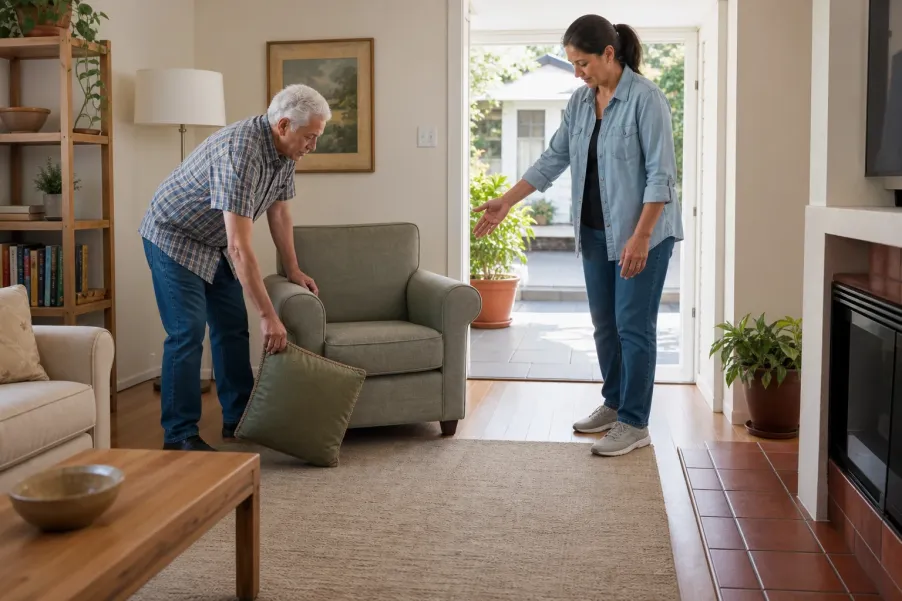
To prepare for a bulky item pickup, first identify the city, county, property manager, or waste hauler responsible for your address. Confirm each item, the pickup date, and the exact set-out location before moving anything. Save the request number, arrange help for lifting, clear a safe path, and keep sidewalks, driveways, and exits usable.
Check who serves the address
A Los Angeles County mailing address does not identify the collector by itself. The City of Los Angeles, another incorporated city, an unincorporated County area, or a private property account may use different routes.
Describe each item
A sofa, mattress, appliance, television, paint can, and construction material may follow different rules. Ask about each item by name before scheduling.
Wait for a confirmed date
Record the confirmed date, time window if provided, placement instructions, and request number. Do not rely on what happened for a neighbor or at a previous address.
Plan safe help for moving
The pickup service may collect from a designated location without moving an item through the home. Arrange appropriate help and keep a clear walking route.
Who is responsible for bulky item pickup at your address?
Start with the service address, not the postal city printed on an envelope. Los Angeles County contains the City of Los Angeles, many other incorporated cities, and unincorporated communities. Each may use its own sanitation department, contracted waste hauler, or property-account process. A search result that says “Los Angeles” may be correct for the region but wrong for the address.
The City of Los Angeles MyLA311 page lists bulky-item pickup among its service requests and offers phone, website, and app routes. Los Angeles County Public Works directs residents in unincorporated areas to identify and contact their waste hauler for bulky-item service. Other cities may have their own public works or sanitation instructions. If you rent or live in a condominium, the property manager may control the shared waste account even when a local hauler performs the pickup.
City of Los Angeles
Use the official MyLA311 route and choose the service request that matches the item. Record the service request number and the instructions returned for the address.
Another incorporated city
Open that city’s official website and look for sanitation, public works, solid waste, or bulky-item collection. Confirm that the page applies to residential service.
Unincorporated Los Angeles County
Use the County’s jurisdiction and waste-hauler lookup tools, then ask the serving hauler about accepted items, appointments, limits, placement, and possible charges.
Apartment, condo, or shared account
Ask the manager or account holder which collector serves the property and whether residents need approval, a shared appointment, or a designated collection area.
If the address is hard to classify, the 211 LA resource call preparation guide can help you organize a jurisdiction question. It does not replace the collector’s final instructions, but it can help you prepare the address, question, and follow-up notes.
Which items should you confirm before requesting pickup?
“Bulky item” is a service category, not permission to place every large object at the curb. A chair or sofa may fit the ordinary bulky-item route, while an appliance, mattress, electronic device, tire, paint container, battery, construction material, or item containing a hazardous substance may need a separate option. Requirements differ by jurisdiction and provider, so name every item and ask the collector to classify it.
| Item type | What to ask | Why it matters |
|---|---|---|
| Furniture | Is this exact sofa, chair, table, bed frame, or rug accepted? Is disassembly required? | Size, material, and safe handling rules can vary. |
| Mattress or box spring | Does the pickup accept it, and are there preparation or contamination restrictions? | California also has a mattress stewardship and recycling program. |
| Appliance | Is a separate appliance request needed? Must doors, water lines, or other parts be handled first by a qualified person? | Appliances can contain refrigerants, electronic parts, or connected utilities. |
| Television or electronics | Does the provider use an e-waste request or approved drop-off instead of ordinary bulky collection? | E-waste may follow a regulated recycling route. |
| Paint, chemicals, batteries, or sharps | Which household hazardous-waste or stewardship program applies? | These items should not be added to a furniture request. |
| Construction debris or automotive parts | Are these excluded, limited, or handled by a separate paid service? | A large size alone does not make the material an accepted household bulky item. |
CalRecycle advises residents to check local curbside or drop-off programs for materials that do not belong in ordinary bins and links to specific routes for e-waste, mattresses, tires, paint, batteries, and other categories. For paint, chemicals, batteries, and similar materials, use ASF’s household hazardous-waste drop-off checklist as a separate planning guide rather than mixing them into a furniture pickup.
What information should be ready before the request?
Prepare a short, itemized description before opening an online form or calling. This reduces guessing and helps the agent classify each object. Do not include Social Security numbers, banking passwords, medical information, or unrelated identification. The service usually needs location and collection details, not a full personal history.
Bulky pickup request checklist
- The exact service address, including unit number when the provider requests it
- The name of the city, County area, property manager, or hauler believed to serve the address
- An itemized list with plain descriptions: one armchair, one mattress, one metal bed frame, and so on
- Approximate dimensions when an item is unusually large or the form asks for them
- Whether the item is indoors, upstairs, behind a gate, or already in an approved collection area
- Questions about disassembly, bagging, doors, cushions, sharp edges, or special handling
- A safe proposed set-out location that does not block an exit, sidewalk, driveway, hydrant, or traffic view
- A callback number or email for request updates
- A place to record the request number, appointment date, and instructions
What to say when you call
“I live at [service address] and need to arrange residential bulky-item pickup. I have [itemized list]. Please confirm that you serve this address, which items are accepted, whether any need a separate request, the approved set-out location and timing, and the request number I should keep.”
If someone contacts you unexpectedly and asks for payment or private details, end the conversation and return through the official city, County, property-management, or hauler channel you verified independently. A real request can be checked using the saved service number.
How do you prepare for pickup step by step?
Identify the collector
Confirm the jurisdiction and the account owner. Save the official phone number or web route instead of relying on an advertisement or a neighbor’s old instructions.
Inventory the items
Write one line per object. Separate furniture, mattresses, appliances, electronics, hazardous materials, construction debris, and anything connected to utilities.
Confirm acceptance
Ask about each item, limits, preparation, set-out location, timing, and possible charges. Do not assume “free” or “unlimited” unless the serving provider confirms it for this address.
Save the appointment
Record the request number, submission date, pickup date, service window if provided, contact channel, and exact instructions. Take a screenshot or write a clear note.
Arrange suitable help
Decide who will move the item to the approved location and when. The collector may not enter the home. Do not plan a solo lift because an appointment has been accepted.
Clear and inspect the route
Remove loose rugs, cords, small tables, pet items, and other trip hazards. Check door width, turns, steps, gates, and lighting before the item is moved.
Set out only as directed
Use the confirmed location and timing. Keep the service record until the item is collected and the request is closed.
Preparing the route resembles the planning used before a contractor visit: define the task, identify access constraints, and keep a written record. ASF’s home repair estimate preparation guide offers a related method for organizing questions without making a rushed commitment.
How should apartment and condominium residents prepare?
Shared properties add an ownership question. The resident may not control the waste account, collection enclosure, loading zone, gate access, elevator reservation, or curb. Ask the property manager or association before moving the item. A manager may need to open the hauler request, name the approved collection area, reserve an elevator, or coordinate a date that avoids blocking other residents.
Describe the full route: unit, hallway, elevator or stairs, gate, and designated collection point. Confirm whether an item may wait in that location and for how long. Do not leave furniture in a corridor, stairwell, fire exit, accessible route, driveway, or waste enclosure unless the property and collector explicitly designate it.
A trusted neighbor or family helper can be useful for a scheduled handoff, especially when a gate or shared area is involved. The trusted neighbor support plan shows how to define a helper’s role, access, and contact boundaries without handing over unrelated personal information.
How can you prepare the set-out route without unsafe lifting?
Planning a clear route is different from moving the object. Walk the path while the item is still in place. Look for narrow doorways, tight turns, stairs, uneven surfaces, loose rugs, cords, pets, low branches, wet areas, and doors that may swing shut. Measure only if it helps decide whether the route works; do not use a successful measurement as proof that one person can lift safely.
Arrange enough capable help or an appropriate moving service for the object and route. Use equipment only when the people using it know how. Stop if the item shifts unpredictably, blocks vision, has sharp edges, contains loose parts, leaks, smells unusual, or remains connected to a utility. The safest plan may be to ask the collector, property manager, retailer, or qualified mover about another option.
Before moving day
Confirm help, footwear, lighting, the destination, door and gate access, and where people can pause without setting the item in an exit path.
Before set-out
Recheck the appointment and weather, keep children and pets away from the route, and remove small obstacles rather than stepping over them.
After set-out
Verify the item is stable and placed exactly as directed. Keep sidewalks, ramps, driveways, exits, hydrants, and sight lines clear.
For a porch, gate, or family handoff, ASF’s package delivery and porch pickup routine provides a useful model for defining who arrives, what they handle, and how the older adult avoids an unexpected doorstep exchange.
What should you do if the pickup is missed or the plan changes?
Keep the item in the approved location only as long as the responsible provider or property instructs. Use the original service number to report a missed collection. Record the date and time of the follow-up, the channel used, the person or department reached, and the new instruction. Do not create repeated requests unless the provider tells you the first one is closed or invalid.
A photo can document that the item was placed as directed, but frame it carefully. Avoid showing faces, license plates, house numbers, access codes, mail, or neighboring property details. The request number and a simple written timeline are usually more useful than many photographs.
If the object can no longer remain outside safely, ask the collector or property manager what to do. Do not drag it back through the home alone. If the wrong material was set out, use the appropriate recycling, hazardous-waste, retailer take-back, or specialty route rather than disguising it as ordinary furniture.
What common mistakes make bulky item pickup harder?
- Using the wrong jurisdiction: a postal city, old address, or search advertisement points to a collector that does not serve the home.
- Saying “some furniture”: the request lacks an itemized list, so an appliance, mattress, or electronic device is not classified correctly.
- Setting out too early: the item appears before an appointment or outside the approved timing and location.
- Assuming indoor removal: the resident expects the collection crew to enter the home even though the service is for an outside set-out point.
- Planning a solo lift: an older adult tries to move a heavy or awkward object because the pickup date is near.
- Blocking access: furniture obstructs a sidewalk, ramp, driveway, exit, gate, hydrant, or shared waste enclosure.
- Mixing waste streams: paint, batteries, e-waste, sharp objects, construction debris, or connected appliances are added without confirmation.
- Losing the request number: a missed pickup becomes harder to trace and a duplicate request is created.
Which official resources should you check?
- City of Los Angeles MyLA311 — current phone, web, and app access to City service requests, including bulky-item pickup.
- Los Angeles County Public Works recycling and hauler FAQ — current guidance for identifying a waste hauler and asking about bulky-item service in unincorporated County areas and multi-family settings.
- CalRecycle Where to Recycle — statewide routes for materials that may need a recycling or stewardship option instead of ordinary collection.
- CalRecycle Mattress Product Management — current information about California’s mattress stewardship program and facility finder.
Check the responsible provider again on the day you submit a request. Accepted items, limits, fees, appointment methods, property rules, service hours, and set-out instructions can change. This Article is educational planning guidance. It does not authorize disposal, guarantee pickup, provide moving labor, or replace instructions from the agency, hauler, property manager, retailer, or qualified professional responsible for the item.
Frequently asked questions
Who handles bulky item pickup in Los Angeles County?
The responsible provider depends on the exact address. The City of Los Angeles uses MyLA311, other incorporated cities may use their own sanitation service, and unincorporated County areas may use a contracted waste hauler. Apartments and condominiums may require the property account holder to schedule.
Should a bulky item be placed outside before an appointment is confirmed?
No. Confirm that the provider accepts the exact item, then record the approved date, timing, and set-out location before moving it. Follow property rules and keep exits, sidewalks, ramps, driveways, hydrants, and traffic views clear.
Can electronics, paint, or batteries go with furniture pickup?
Do not assume they can. Electronics, paint, batteries, chemicals, sharps, tires, and some appliances may require separate recycling, hazardous-waste, or stewardship routes. Ask the serving provider about every item and use current CalRecycle or local instructions.
Will a bulky item pickup crew move furniture out of the home?
Do not assume indoor removal is included. Many collection services expect an item at an approved outside location. Ask what the crew will and will not do, then arrange appropriate help or a qualified moving service without attempting a heavy solo lift.
What information should be saved after making the request?
Save the request number, submission date, pickup date, service window if provided, itemized list, approved set-out location, provider contact route, and any special instructions. Keep that record until the item is collected and the request is closed.
What should an apartment resident do before scheduling a pickup?
Ask the property manager who controls the waste account and where bulky items may be placed. Confirm whether the manager must schedule, whether an elevator or gate needs coordination, and how to keep corridors, stairs, exits, and accessible routes unobstructed.
Need help finding the right pickup contact?
All Seniors Foundation may help Los Angeles County older adults and families organize questions and identify appropriate public resources when available. ASF does not operate sanitation agencies, authorize disposal, schedule haulers, provide moving labor, or guarantee pickup.





