
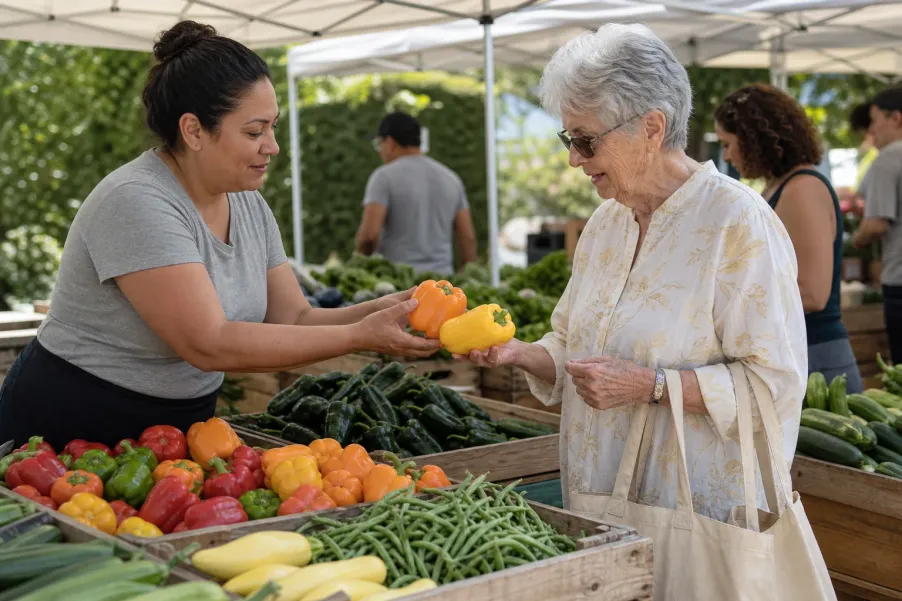
A senior-friendly farmers market visit works best when you confirm the current place and hours, choose a short shopping loop, set a realistic carrying limit, and decide what would make you leave early. Bring only the payment methods the market confirms, buy cold items last, and keep the outing small enough to remain comfortable.
Four useful takeaways before you go
Verify the exact market
A market name in an old post is not a schedule. Confirm the current address, day, hours, and organizer before leaving home.
Plan one loop
Choose a short route through the stalls, make one comparison pass if comfortable, then buy and leave. A complete circuit is optional.
Limit the load first
Decide how much weight and how many bags are manageable before seeing the produce. The return trip is part of the shopping plan.
Protect the graceful exit
Heat, crowds, fatigue, missing seating, or a changed layout are enough reasons to shorten the visit without calling it a failure.
What does “certified farmers market” mean in Los Angeles County?
The Los Angeles County Agricultural Commissioner explains that produce sold as certified is brought to the market by the farmer, a family member, or an employee, and that certified produce is California-grown. County agricultural inspectors certify participating farms and review the farmers’ paperwork. That definition is useful, but it does not tell you whether a particular market will suit your walking, seating, transportation, payment, or shopping needs.
Los Angeles County Public Health separately oversees health requirements for certified farmers markets in the county. A certified market can also include prepared-food or other vendors operating under different requirements. Treat certification as one part of the market’s identity, not as a promise about every stall, price, product, or convenience.
Use the official listing as a starting point
Begin with the Los Angeles County certified farmers market resource. Follow its current market-finder route, then confirm details with the listed market or organizer. Hours, locations, seasons, street closures, parking arrangements, and vendor attendance can change.
How do you choose a market that fits the older shopper?
The closest market is not automatically the easiest one. Compare the full outing: travel time, distance from arrival point to the first stall, surface, shade, seating, restroom access, crowd level, and the return trip with groceries. An older adult who walks comfortably for ten minutes on a smooth path may have a very different experience on a sloped, crowded block while carrying two bags.
Arrival fit
Where will the car, bus, paratransit vehicle, or rideshare actually stop? Is the pickup location clear enough to find again after shopping?
Walking fit
Ask whether the market is on pavement, grass, gravel, a slope, or several blocks. Find out whether a short partial route is possible.
Rest fit
Confirm whether seating, shade, and restrooms are available nearby. If the answer is uncertain, plan as though they may not be available.
Load fit
Choose a bag limit that works from the final stall all the way home. A wheeled cart is useful only if the route and transportation can accommodate it.
If transportation is the hardest part, use the Access paratransit pickup preparation guide to separate the pickup plan from the market plan. Confirm current rider rules and trip details directly with the transportation provider.
What five details should you confirm before leaving?
Call, email, or check the organizer’s current page close to the visit. Avoid asking only, “Are you open?” That question can return a technically correct answer while leaving the difficult parts unresolved.
- Exact place and operating window: “What address and entrance should I use today, and when do vendors begin closing?”
- Arrival: “Where is the nearest legal passenger drop-off, transit stop, or parking area?”
- Surface and distance: “Is the shopping area paved, and about how far is it from arrival to the stalls?”
- Rest options: “Is there public seating, shade, or a restroom at or next to the market?”
- Payment: “Which payment methods are commonly accepted, and must any token or voucher be obtained at a separate information booth?”
Write down the answer in plain language. If a detail is not confirmed, mark it “unknown” instead of turning a guess into a plan. An unknown restroom or pickup point may be more important than a long vendor list.
How can you build a short, low-pressure market route?
Start with a three-part route: arrive, shop one loop, return to the pickup point. Choose two or three priority items before leaving home. Put optional browsing after the priorities rather than before them. This prevents the trip from using most of its energy before the necessary purchases begin.
A practical visit can be only twenty or thirty minutes. At the entrance, pause long enough to identify the produce area, an information point if there is one, and the return direction. Walk past a few stalls before buying when comparison feels easy; otherwise, choose a suitable item at the first comfortable stall and continue. The goal is a manageable outing, not a perfect price survey.
A simple companion agreement
The older adult chooses the pace and priorities. A companion can handle the heavier bag, keep track of the pickup point, and ask a question when requested. The companion should not race ahead, replace the shopper’s choices, or turn every stall into a health lesson.
If another person will finish or unpack the shopping later, adapt the shared grocery list and delivery handoff routine so quantities, substitutions, and where items belong are clear.
What is a useful spending plan without making the visit rigid?
Set a total spending range and divide it into priorities, optional items, and a small reserve. For example: most of the budget for two planned produce items, a smaller amount for one seasonal discovery, and the reserve left untouched unless a price or quantity differs from expectation. This is easier to manage than calculating a perfect per-item budget while standing in a busy aisle.
Bring only payment methods the organizer confirms and keep them in one secure, easy-to-reach place. Do not assume every vendor accepts cards, cash, electronic benefits, market tokens, or the same combination. If a program or token matters to the trip, confirm where it is issued, what identification or card is required, which products it covers, and whether the booth will be open during the planned visit. This guide does not determine eligibility or vendor participation.
What questions help at a produce stall?
Short, concrete questions reduce decision fatigue. Ask, “Which of these is ready to eat today?” “Which will keep longer?” “Can I buy a smaller amount?” or “How should this be stored?” A vendor may have useful product knowledge, but the shopper still decides whether the answer, quantity, condition, and price fit the household.
Look at the item before it goes into the bag. Choose produce that is not bruised or damaged when practical. If a price, unit, or quantity is unclear, ask before agreeing to the purchase. It is fine to say, “Thank you, I’m still looking,” and move on. Courtesy does not require buying.
A six-second decision
Use soon, store later, or skip. If the household has a clear use and storage plan, buy the manageable quantity. If not, take a photo only when permitted or write the item down for another trip rather than buying from pressure.
How should produce and cold foods be handled on the trip home?
The FDA advises choosing produce that is not bruised or damaged, refrigerating pre-cut or packaged produce, separating fruits and vegetables from raw meat, poultry, and seafood, and washing produce under running water before preparing or eating it. Soap, detergent, and commercial produce washes are not recommended for washing produce. Review the FDA produce-safety guidance for the complete current advice.
USDA farmers market guidance recommends checking that perishable foods are kept cold, considering an insulated bag with a cold source, buying perishable items last, and keeping raw meat or poultry separate from ready-to-eat foods. See the USDA farmers market food-safety guide before a trip that may include meat, dairy, cut produce, or other cold items.
For a simple produce visit, bring a clean reusable bag, place delicate items on top, and go home soon after shopping. If the route includes another errand, decide in advance whether perishable purchases should be skipped. Anyone with a health condition or individualized food-safety concern should follow their clinician’s guidance.
How do you plan the return trip before the bags are full?
Set a bag rule before shopping: one light bag per person, one shared wheeled cart, or one companion-carried load. Spread weight across smaller bags only when that makes the trip easier; several handles can be harder to manage than one stable load. Keep keys, phone, transit fare, and pickup details separate from produce so they remain reachable.
At the halfway point, count bags and reassess energy. If the current load already feels like enough, switch the rest of the route to looking only. A market is not the right place to test a new carrying limit. The same principle applies to a cane, walker, or mobility device: do not hang bags where they change balance, block brakes, or interfere with safe use.
If the visit is partly social and food access is the larger goal, compare it with a senior congregate meal site visit. The two outings serve different purposes and have different registration, transportation, and meal arrangements.
When should you shorten or leave the visit?
Agree on an exit rule before arrival. Leave or pause when the shopper reports fatigue, dizziness, pain, overheating, confusion, or feeling unsafe; when the pickup plan is unclear; when bags exceed the carrying limit; or when the market is substantially different from what was confirmed. For urgent symptoms or immediate danger, use emergency services rather than relying on an article or market staff.
| What you find | Practical response |
|---|---|
| Market is open and the route feels manageable | Shop the priority loop, reassess once, and leave with the planned load. |
| Market is open but crowded or hotter than expected | Buy only the top item, rest if a safe place is available, or leave. |
| Parking, drop-off, seating, or restroom is not as confirmed | Use the backup arrival plan or reschedule; do not force the original plan. |
| Payment method or token process is unavailable | Do not improvise with unfamiliar financial steps; confirm and return another day. |
| The shopper wants to stop | Stop. A shorter visit still counts as useful information for the next outing. |
A later park meal can be planned separately with the senior-friendly LA County park picnic guide. Keep a shopping trip and a picnic as two manageable plans unless the group has confirmed the full route, food handling, rest, and transportation.
Farmers market visit checklist
Before leaving
- Confirm address, date, hours, and organizer.
- Confirm arrival point, surface, seating, shade, and restroom.
- Choose two or three priority items.
- Set spending, bag, time, and weather limits.
- Bring confirmed payment and a clean bag.
At the market
- Identify the return direction before shopping.
- Walk one short loop at the shopper’s pace.
- Ask about price, quantity, ripeness, and storage.
- Buy cold or perishable items last.
- Reassess energy and load halfway through.
Going home
- Keep pickup details and keys accessible.
- Protect delicate produce from heavy items.
- Keep raw animal products separate.
- Refrigerate items that require it promptly.
- Note one change that would improve the next visit.
For more practical planning resources, browse the Senior Support Guides in Los Angeles. All Seniors Foundation provides educational navigation and community support; market operations, accessibility, prices, schedules, vendor participation, transportation, and program rules must be confirmed with the responsible organization.
Official sources used
- Los Angeles County Agricultural Commissioner / Weights and Measures: certified farmers market definition and current market-finder route.
- Los Angeles County Public Health: county certified farmers market health oversight.
- U.S. Food and Drug Administration: selecting, storing, separating, and washing produce safely.
- U.S. Department of Agriculture Food Safety and Inspection Service: farmers market cold-food, separation, and reusable-bag guidance.
Sources reviewed August 26, 2026. Market details and agency guidance can change; confirm current information before relying on it.
Need help organizing the next step?
All Seniors Foundation can help Los Angeles County older adults and families think through community-resource questions and practical support options. We do not operate farmers markets or guarantee market conditions, transportation, benefits, prices, or vendor availability.
Frequently asked questions
How can I find a certified farmers market in Los Angeles County?
Start with the Los Angeles County Agricultural Commissioner’s certified farmers market resource and its current finder. Then confirm the exact address, entrance, date, hours, and organizer before traveling because listings and operating details can change.
Does certified mean every vendor accepts the same payment methods?
No. Certification describes the direct-marketing status of qualifying agricultural producers; it does not guarantee that every vendor accepts cash, cards, electronic benefits, tokens, or the same payment combination. Confirm the current process with the market.
What is a reasonable first visit length for an older adult?
There is no universal length. A short twenty- or thirty-minute priority loop may be more useful than attempting every stall. Base the plan on the person’s usual walking tolerance, weather, crowding, carrying load, transportation, and preferences.
Should produce from a farmers market be washed before eating?
FDA guidance says to wash produce thoroughly under running water before preparing or eating it, including produce from a farmers market. Do not wash produce with soap, detergent, or commercial produce wash. Follow current FDA guidance and individualized clinical advice.
What should I do if the market is more crowded or hotter than expected?
Shorten the route, buy only the top priority item, rest in a safe place if one is available, or leave. A changed plan is appropriate when heat, crowding, fatigue, discomfort, or an unclear pickup point makes the visit harder.
Can All Seniors Foundation confirm a market’s schedule or accessibility?
All Seniors Foundation can help with general resource navigation, but the market or responsible public agency must confirm current hours, location, surface, seating, restroom, parking, accessibility features, vendor participation, payment methods, and program rules.





