
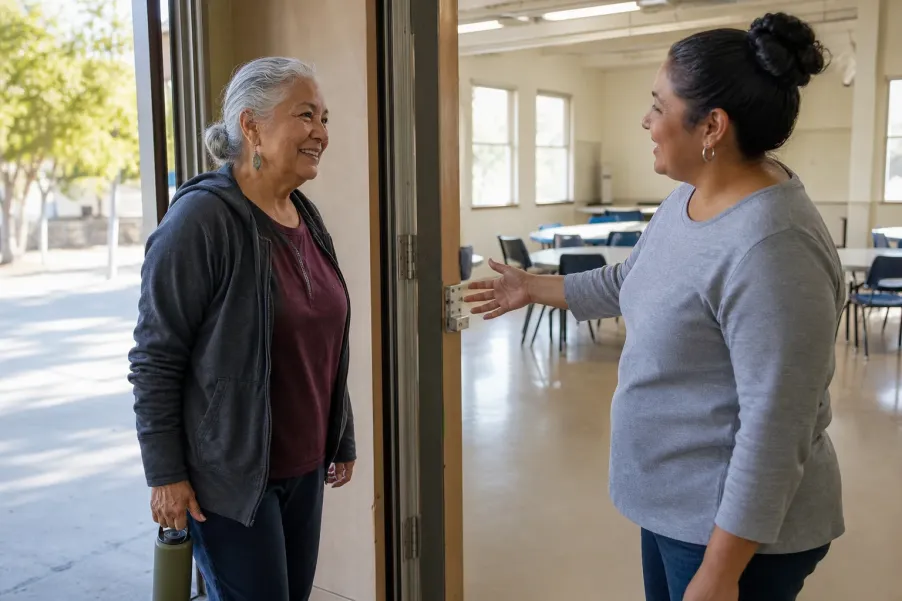
Before a senior congregate meal site visit in Los Angeles County, call the listed provider to confirm the exact location, meal time, advance registration, current availability, accessibility, transportation options, and food limitations. Plan how you will arrive, what you need to bring, who will accompany you, and how you will record the next step after the meal.
Confirm the exact site
A center may offer many programs but serve congregate meals only on certain days or through a contracted provider.
Register before traveling
Los Angeles County says advance registration is required. Ask what the local provider needs and when to complete it.
Ask food questions early
Do not assume a site can meet a medical, allergy, texture, religious, or cultural food need. Get the current site-specific answer.
Plan the whole trip
A successful first visit includes the ride home, mobility and restroom access, waiting time, and a clear follow-up plan.
What is a senior congregate meal program?
A congregate meal program serves meals in a group setting, often at a senior center or another community location. It is different from home-delivered meals because the participant goes to the meal setting and eats as part of the program. The Los Angeles County Elderly Nutrition Program describes group dining, nutrition education at some locations, and activities that may occur before or after meals.
That countywide description is a starting point, not a promise about one building. Los Angeles County uses contracted agencies and multiple sites across five Supervisorial Districts. A center directory entry may show that a building exists, but it may not tell you every current meal day, registration deadline, menu, language option, or access feature. Those details should be confirmed with the provider serving the specific site.
The program is meant to provide more than a plate of food. California and federal agencies describe congregate nutrition as a way to support nutrition and social connection and to connect older people with community resources. Still, a first visit can feel unfamiliar. The useful task is to reduce uncertainty before leaving home—not to predict how the program will feel or what services a person will receive.
What should you confirm before a first meal-site visit?
Start with the official Los Angeles County Elderly Nutrition Program page or the County Community and Senior Centers directory. Then call the program contact connected to the location. If you found the center through a search engine, map, flyer, or old note, compare that information with the current official listing before you travel.
Before-you-call confirmation list
- Site identity: Say the full center name and street address. Ask whether this is the correct meal location.
- Date and time: Confirm the meal day, serving time, recommended arrival time, and any closure or holiday change.
- Advance steps: Ask whether registration, an intake, a reservation, or a same-day check-in is required.
- What to bring: Ask whether the provider requests identification, emergency-contact information, or another item. Bring only what the provider confirms.
- Cost or contribution: Ask how voluntary contributions are handled. Never hand money to an unofficial intermediary.
- Access: Confirm the entrance, elevator or ramp, restroom, seating, walker or wheelchair space, and where a ride may drop off.
- Food: Ask about the current menu and any ingredient, texture, allergy, vegetarian, cultural, or religious limitation that matters to you.
- Companion: If someone will accompany you, ask whether that person may attend and whether separate registration applies.
A short call can prevent the most common first-visit problem: arriving with an assumption that belongs to a different provider or location. The County currently lists Information & Assistance at 1-800-510-2020, but phone numbers and routing can change. Verify the number on the official page when you call.
A simple site-question script
“Hello. I am planning my first congregate meal visit at [center name] on [date]. Could you confirm the address, arrival time, registration step, what I should bring, and the best entrance? I also need to ask about [food or access need]. If this site is not the right one, which official contact should I use next?”
How should you handle food, mobility, and communication needs?
Bring up an important need before the visit, even if it feels easier to wait. Los Angeles County’s current program page says special diets are not available and that vegetarian options are offered, but the practical meaning can vary by provider and menu. Do not treat “nutritious,” “low sodium,” or “vegetarian” as proof that a meal is safe for a particular allergy, swallowing concern, medical diet, or religious requirement.
If a clinician has given you food instructions, use those instructions when speaking with the provider. This Article cannot decide whether a menu fits a medical need. Ask for the most specific information the site can provide, and decide with the appropriate clinician or caregiver if uncertainty remains. It is reasonable to skip a meal that you cannot verify safely and ask about another program route.
For mobility, describe the actual task rather than asking only, “Is it accessible?” For example: “I use a walker and need a place to sit while waiting. Is the entrance step-free, how far is it from drop-off, and is there space beside the dining chair?” That phrasing gives staff a clearer question. If transportation is the main barrier, review All Seniors Foundation’s senior transportation help overview, then confirm any ride directly with its provider.
If hearing, vision, language, or memory affects the call, ask for the information slowly and repeat it back. A trusted helper may join the call with the older adult’s permission. Keep the older adult involved in choices, including whether to attend, what to ask, where to sit, and when to leave.
What does a calm first-visit timeline look like?
Reconfirm essentials
Check the date, meal time, address, registration status, menu information, access plan, and ride. Put the provider’s direct number in an easy-to-find place. Choose comfortable clothing and any usual mobility aid.
Use a small carry plan
Take only confirmed items, a charged phone if you use one, needed glasses or hearing equipment, and a plain water bottle if the provider permits it. Do not carry original sensitive documents unless specifically required.
Pause at the entrance
Use the entrance and check-in point the provider named. Introduce yourself as a first-time participant. Ask where to wait, where the restroom is, and whom to tell about the food or access question discussed by phone.
Keep your own pace
You do not have to join every conversation or activity. Choose a seat that works for your hearing, mobility, and comfort. If something about the meal is unclear, pause and ask staff rather than guessing.
Confirm the next step
Ask whether another reservation is needed, where schedule changes are posted, and who to call with questions. Confirm the ride home before stepping away from the staffed area.
After returning home, write down only the information you will need again: the correct provider, direct phone number, reservation timing, transportation lead time, entrance, and any unresolved question. For a broader set of practical local planning resources, visit the Senior Support Guides in Los Angeles.
Which preparation step matters most for your situation?
If food uncertainty is the barrier
Prioritize the current menu, ingredient information, texture, and limits on accommodation. Do not travel based on a general program description alone. If the answer is incomplete, ask what alternative resource contact the provider recommends.
If mobility or stamina is the barrier
Prioritize drop-off distance, steps, ramps, elevator status, waiting seats, restroom access, walker or wheelchair space, and the ride-home handoff. Ask how long the full visit usually lasts without treating the estimate as a guarantee.
If uncertainty or anxiety is the barrier
Ask whether a trusted person may accompany you and whether you can arrive a little early. Use the script above and request one named check-in point. A predictable first five minutes often matters more than planning every detail.
If the site is not a fit
Do not force the visit. Ask the provider or County Information & Assistance for the next official route. If eating in a group setting is not workable, learn how congregate meals differ from senior meal delivery without assuming eligibility.
What mistakes should you avoid?
Do not rely on a generic map result. Similar center names, moved programs, and provider changes can send a visitor to the wrong door. Verify the full address and program name with an official source.
Do not assume every senior center serves meals every day. Los Angeles County says services are delivered at multiple locations and that some centers offer activities, but each site has its own current schedule and process.
Do not promise a companion that they will receive a meal. Eligibility and registration rules for spouses, companions, volunteers, and people with disabilities should be confirmed by the provider.
Do not use a voluntary contribution as a reservation shortcut. The County and California describe contributions as voluntary and confidential. Follow the provider’s official procedure, and question any pressure to pay an unofficial person.
Do not share more personal information than the intake requires. Ask why information is needed, how to submit it, and whether a copy is sufficient. Keep original documents and sensitive numbers secure.
Do not turn one difficult visit into a permanent conclusion. A closed door, changed menu, or confusing check-in may be a site-specific issue. Record what happened, contact the provider, and ask for a clear next step. The community-center resource guide for staff also explains how a respectful senior-support handoff can work.
Which official resources should you use?
- Los Angeles County Aging & Disabilities: Elderly Nutrition Program — current local program overview, advance-registration statement, contacts, group-dining details, and food-accommodation limits.
- Los Angeles County Community & Senior Centers — official location directory and center-service context. Confirm meal participation directly.
- California Department of Aging: Meal Programs — statewide Older Californians Nutrition Program background and Area Agency on Aging route.
- Administration for Community Living: Basics of Congregate Nutrition — federal program context and the role of social connection and supportive-service referrals.
Frequently asked questions
Do I need to register before visiting a congregate meal site?
Los Angeles County currently says advance registration is required. Ask the specific provider how to register, what information it needs, and whether a separate meal reservation or check-in is required for your planned date.
Are congregate meals free for every older adult?
Do not assume a site-specific cost. Los Angeles County and California describe participant contributions as voluntary and confidential, but you should confirm the provider’s current process and eligibility rules before visiting.
Can a congregate meal site accommodate a special diet?
Los Angeles County currently says special diets are not available and vegetarian options are offered. Ask about the actual menu and ingredients, then use guidance from an appropriate health professional when a medical diet or allergy is involved.
May a family member or caregiver come with me?
Possibly, but do not promise that a companion can participate or receive a meal. Tell the provider who will accompany you and ask about registration, eligibility, seating, and any contribution process for that person.
What should I bring to my first congregate meal visit?
Bring only what the provider confirms, plus your usual glasses, hearing equipment, mobility aid, and ride information. Avoid carrying original sensitive documents unless the official provider specifically requires them.
What if the listed site is closed or the visit does not work out?
Stay in a safe staffed area if possible, contact the provider using the verified number, and ask for the next official step. Record the closure or problem, but do not travel to an unverified alternative location.
Need help preparing for the first visit?
All Seniors Foundation can help Los Angeles County older adults and families sort practical questions and identify the responsible resource to confirm. Availability and program decisions remain with each provider.





