
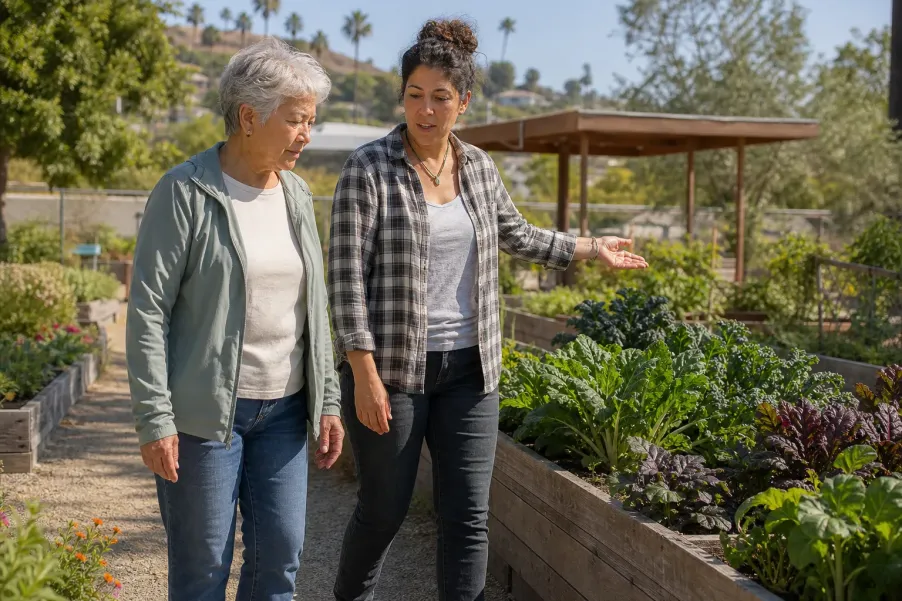
Prepare for a community garden orientation by confirming who manages the garden, how its wait list works, and what the visit will cover. Bring questions about paths, raised beds, water, tools, storage, fees, shared duties, and helper access. Observe the site without committing, then choose a plot, class, container garden, or later follow-up that fits your routine.
Four useful takeaways before you visit
- Rules and availability belong to the individual garden. Confirm the current manager, application path, wait list, costs, and orientation expectations directly.
- A good orientation is a fit check, not a test. Look at the route from arrival to plot, water access, shade, seating, restrooms, tools, storage, and the tasks members actually share.
- Choose a manageable commitment. A smaller plot, shared task, class, container, or occasional volunteer day may fit better than taking on a full plot immediately.
- Personal activity limits are individual. Ask an appropriate health professional about concerns, and adjust outdoor plans to current heat, air, and site conditions.
What should a community garden orientation accomplish?
A community garden orientation should help you understand one real site well enough to decide whether its participation path fits your time, transportation, comfort, and interests. It is not a promise that a plot is open, that the garden has a particular accessibility feature, or that membership will be approved. It is a chance to replace assumptions with current information from the people who manage that garden.
Los Angeles County includes County-operated facilities, the City of Los Angeles, many other incorporated cities, nonprofit gardens, school or faith-community sites, and independent neighborhood organizations. Similar gardens can have different owners, boundaries, fees, wait lists, locks, watering systems, work requirements, and visitor rules. Start with the exact garden name and manager rather than relying on a general countywide description.
Learn how participation starts
Ask whether the first step is a phone call, online form, orientation, class, volunteer shift, application, or wait-list entry. Confirm what happens after that step and who provides updates.
See the site as it operates
Notice the arrival route, gates, paths, beds, water points, tool areas, compost areas, gathering space, shade, seating, and posted boundaries. Ask before entering member-only areas.
Leave with one clear action
Your next step might be joining a wait list, attending a beginner class, asking one follow-up question, trying a container at home, or deciding that this site is not the right fit.
If you are still exploring outdoor community activities, the separate guide to LA County Parks class registration explains how to compare a program before enrolling. A garden orientation is narrower: it focuses on one garden’s real participation rules and physical setup.
What should you confirm before leaving home?
Call or use the garden’s current official contact route before traveling. Ask whether an orientation is required, whether visitors need an appointment, where to meet, how long the visit usually takes, and whether another person may attend with you. Confirm the address and entrance—not just the park or neighborhood name—because garden gates can be separate from a main building or parking lot.
Ask what to wear and what not to bring. For an observation-focused orientation, you may not need tools, seeds, gloves, documents, or payment. Do not bring cash, identification, account information, plants, soil products, chemicals, or equipment unless the manager says they are required for that specific step. Keep the first visit simple.
A short confirmation checklist
- Exact garden name and managing organization
- Orientation date, time, length, and meeting point
- Current visitor, appointment, or check-in rule
- Parking, drop-off, transit, and gate information
- Whether a trusted helper may attend
- Language or communication support to request
- What to wear for the site’s surfaces and weather
- What, if anything, the manager asks you to bring
How can you check access and day-to-day comfort?
Look at the whole route, not only the plot. Start where you would arrive and trace the path to the gate, check-in point, bed, water source, tool area, seating, and exit. Notice slopes, loose surfaces, narrow turns, hoses, thresholds, glare, and places where people or carts commonly pass. Observe; do not test a questionable surface or move garden equipment without permission.
Ask whether the site has raised beds, but do not assume that “raised” means it will fit your reach, posture, mobility aid, or preferred task. Bed height, edge width, approach space, and assigned availability can vary. Ask whether a particular feature is available to new members now and whether it is shared, reserved, or wait-listed.
| What to observe | Question to ask | What a workable answer sounds like |
|---|---|---|
| Arrival and gate | “Which entrance should I use, and is it open during the times members may garden?” | A specific entrance, access method, and current schedule you can repeat back accurately. |
| Paths and turning space | “May we walk the route I would use from the entrance to the bed and water point?” | A route you can observe without stepping over hoses, borders, or stored materials. |
| Bed and reach | “Which bed types may become available, and may I see the actual dimensions and approach?” | Current facts about the site, not a general promise that every bed is accessible. |
| Shade and rest | “Where may members pause, and when is this area shaded?” | A realistic option that matches the hours you might attend; shade changes by season and time. |
| Restroom and handwashing | “What facilities are available during garden hours?” | A direct current answer, including any limits or nearby alternative the manager can confirm. |
A trusted companion can help take notes or observe the route, but the older adult should make the fit decision. The companion should not speak over the gardener, disclose health details unnecessarily, or promise to perform work every week unless that arrangement is permitted and genuinely sustainable.
Which garden rules and shared resources matter most?
Community gardens are shared spaces, so the important rules extend beyond what can be planted. The University of California’s community-garden planning materials identify topics such as plot selection, fees, water, tools, plot-care duties, gates, parking, compost, structures, trash, and chemical-use policies. These are planning prompts, not proof of any one garden’s rules. Ask the local manager what applies today.
Plot and wait-list rules
Ask how names are added, how updates are sent, whether orientations expire, how plots are assigned, and what happens if a person cannot accept an offered plot. Do not submit duplicate applications unless instructed.
Water and tool rules
Confirm who supplies hoses, watering cans, hand tools, locks, or carts; where they may be stored; and whether personal tools must be labeled or removed after each visit.
Shared-work expectations
Some sites may assign common-area work, meetings, cleanup, or service hours. Ask what counts, how often it occurs, whether alternatives exist, and how absences are handled.
Growing boundaries
Ask about approved plants, structures, soil additions, pest-management methods, compost, harvest, guest access, and abandoned-plot procedures before buying anything. If the orientation raises a mosquito or standing-water concern, use this vector control inspection request guide for older adults in Los Angeles County to identify the responsible public agency and prepare a bounded report instead of guessing at treatment. If a member plans to bring City-provided material to the plot, review this self-serve mulch pickup preparation guide before confirming the site rules, product, amount, containers, and unloading plan.
Write the answers in plain language and read them back: “So members provide their own small hand tools, the shared hose stays here, and the gate is locked after the posted closing time—is that right?” A repeat-back catches misunderstandings without turning the conversation into a negotiation.
How do you match garden work to a realistic routine?
Think in terms of repeatable tasks rather than an idealized harvest. A plot can involve checking moisture, watering under the site’s rules, light weeding, observing pests, tying or supporting plants, removing spent material, and visiting often enough to follow maintenance expectations. The practical question is not “Do I like gardening?” but “Which of these tasks can I do or arrange consistently at this site?”
Ask the manager to describe a typical week during a warm month and a cooler month. Then compare that routine with transportation, energy, other appointments, caregiver schedules, and weather. Do not assume a helper may take over the plot; some gardens limit guests or require the assigned member to remain responsible.
Use a three-level task check
- Comfortable: tasks you can perform reliably with the site’s allowed setup and without rushing.
- Possible with a confirmed adjustment: tasks that may work only if the garden permits a raised bed, a lighter tool, a seated approach, a different time, or an approved helper role.
- Not a fit right now: tasks that conflict with your current limits, transportation, schedule, or the garden’s rules. Holding that boundary is useful information, not failure.
If you want a broader introduction to available support context, review All Seniors Foundation’s senior gardening program page and confirm current details directly. The existence of a webpage does not guarantee a plot, activity, schedule, eligibility result, or opening at the garden you are visiting.
What belongs on a one-page orientation question card?
Keep the card focused on decisions you cannot make from a website. You do not need a medical history, financial documents, passwords, account logins, or a long equipment list. Write the garden name, manager contact, meeting point, and eight questions with room for brief notes.
- Who manages this garden, and what is the current participation path?
- Is there a wait list, and how are offers or updates communicated?
- What fees, deposits, meetings, service hours, or renewals apply?
- Which bed types may become available, including raised or shared options?
- What are the water, tool, storage, compost, and pest-management rules?
- What days and hours may members enter, and how does gate access work?
- May an approved helper attend, and who remains responsible for the plot?
- What is the next step if I want time to decide?
Add one final line: “Information confirmed with ___ on ___; next check by ___.” This prevents an old answer from quietly becoming a permanent assumption. If no one can confirm a material rule, mark it “unconfirmed” and wait before paying, buying supplies, or committing.
How should you choose the next step after orientation?
Do not decide based only on a friendly welcome or an attractive bed. Review the route, rules, recurring work, communication, and timing together. Choose the smallest next action that gives you useful experience without creating an obligation you cannot sustain.
| If the orientation shows… | A reasonable next step may be… | Confirm before acting |
|---|---|---|
| The site and routine appear workable, but no plot is open. | Join one official wait list and save the confirmation. | How updates arrive, whether renewal is required, and when to check again. |
| You want skills before taking a plot. | Try a current beginner class, demonstration, or permitted volunteer session. | Registration, physical tasks, supplies, weather plan, and whether observation is allowed. |
| A full plot feels too demanding. | Ask about a smaller, raised, shared, or container option—or start at home. | Actual availability and who is responsible for regular care. |
| Access or rules do not fit. | Thank the coordinator and compare another garden or activity. | Use the next site’s own current information; do not assume rules transfer. |
| You need time or professional guidance. | Hold the decision and write the one question that remains. | Any deadline, fee rule, or follow-up date stated by the manager. |
For another low-pressure local outing example, the senior-friendly farmers market guide uses a similar fit-first approach. If you prefer a social planning resource rather than a gardening commitment, browse the Senior Support Guides.
Which mistakes and boundaries should you keep in mind?
Do not buy first
Wait to learn the site’s rules before purchasing plants, soil amendments, tools, locks, structures, or watering equipment. A useful item at home may be prohibited, unnecessary, or difficult to store at the garden.
Do not promise weekly help for someone else
A family member should not accept a plot or recurring duty on an older adult’s behalf. Confirm consent, site rules, transportation, and the helper’s real availability.
Do not treat a wait-list estimate as a guarantee
Availability can change. Save the method and date for official follow-up, but avoid repeated calls, duplicate applications, or plans that depend on an unconfirmed opening.
Do not ignore outdoor conditions
Heat, smoke, rain, wet paths, and site work can change the day’s plan. Check current conditions and follow official or professional guidance instead of pushing through.
The CDC notes that adults age 65 and older can be more prone to heat-related health problems. Use that as a reason to plan conservatively, not to diagnose yourself or another person. Confirm shade and water rules, choose an appropriate time, know where you can cool down, and leave if conditions no longer match your safe plan.
Which official Los Angeles resources can support your planning?
- LA County Parks community and garden information explains that local community gardens may use small plots, may have wait lists, and should be contacted directly for current participation details.
- UC Agriculture and Natural Resources community-garden resources for Los Angeles County provides local navigation and Master Gardener context.
- UC ANR’s community-garden planning worksheet shows the range of local policy questions that managers may need to answer, including water, tools, fees, plot care, compost, gates, parking, and chemical use.
- CDC heat guidance for adults 65 and older offers general information for adapting plans during hot weather. Personal medical questions belong with a qualified professional.
Official pages and schedules can change. Recheck the exact garden’s current route shortly before visiting. If you need broader non-emergency senior-support navigation in Los Angeles County, the Free Senior Help guide explains how to prepare one practical question before contacting the foundation.
Frequently asked questions
Do all Los Angeles County community gardens require an orientation?
No. Each garden may have its own application, orientation, class, volunteer, membership, or wait-list process. Confirm the current first step with the exact garden manager before traveling or submitting information.
Does attending an orientation guarantee a garden plot?
No. An orientation can explain the site and participation process, but it does not guarantee a plot, placement, approval, accessible bed, fee, start date, or other outcome. Ask how availability and wait-list updates are handled.
What should an older adult bring to a community garden orientation?
Bring only what the garden confirms, plus a short question card and ordinary personal items needed for the visit. Do not bring payment, tools, plants, chemicals, documents, or account information unless the manager specifically requires them.
Can a family member or caregiver attend the orientation?
Ask the garden first. A trusted helper may be useful for transportation, notes, or communication, but guest and helper rules vary. The older adult should remain in control of the decision and personal information.
What if a full garden plot feels like too much work?
Ask whether the site offers smaller, raised, shared, container, class, demonstration, or volunteer options, but do not assume they are available. It is also reasonable to decline, wait, or compare another activity.
How can I judge whether the garden is a practical fit?
Compare the arrival route, paths, bed approach, water, shade, tools, storage, shared duties, schedule, communication, and transportation with your real routine. Mark unconfirmed details and decide only after the material questions are answered.
Need help organizing the next question?
All Seniors Foundation can discuss non-emergency senior-support navigation in Los Angeles County when help is available. The foundation does not control garden admissions, plots, fees, schedules, accessibility features, or outcomes.





