
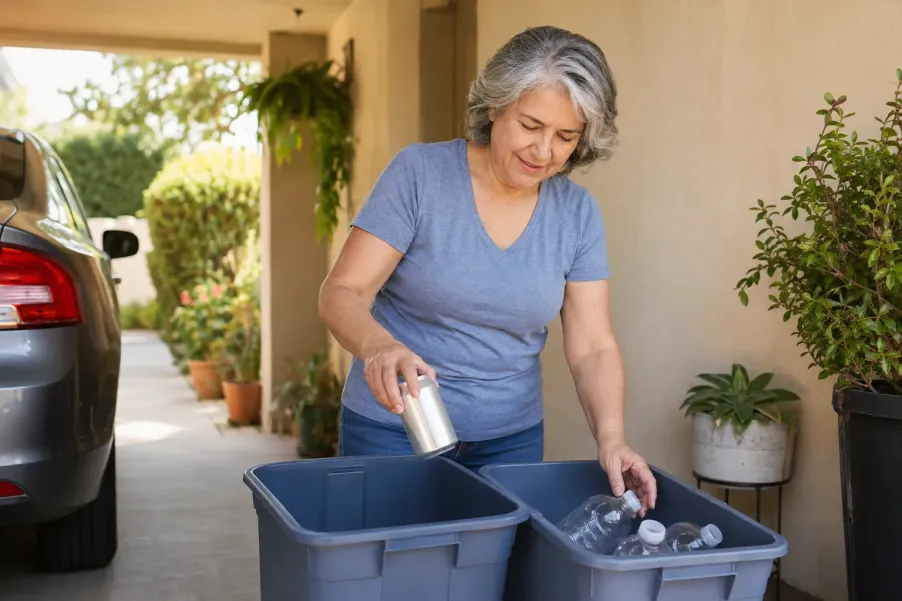
Prepare for a beverage container recycling visit by sorting a small batch by material, checking each container for current California Redemption Value eligibility, and confirming the chosen site before leaving. Bring only what you can move comfortably, keep the containers empty and organized, and ask the recycler whether count or weight is the better method for your batch.
What makes a recycling-center visit easier?
- A current official location check instead of relying on an old map result or remembered schedule.
- A manageable batch separated into aluminum, glass, plastic, and any other accepted container category.
- A simple decision about count versus weight before containers reach the scale or counting area.
- A comfort plan that avoids awkward bags, unstable boxes, long standing, and lifting beyond your ability.
Saving beverage containers can turn an ordinary recycling habit into a useful errand, but the visit is easier when the household treats it as a short process rather than one enormous cleanup. California’s Beverage Container Recycling Program covers specific beverage packages and offers current ways to locate redemption options. The site, hours, accepted materials, and operating method can still vary, so preparation begins with a fresh check.
Older adults may want to limit bending, carrying, standing, heat exposure, noise, and complicated sorting at the counter. A family member or friend can help move containers while the older adult keeps control of the decision and receipt. The aim is a clear, repeatable routine that can be stopped at any point without leaving loose containers in a walkway or vehicle.
What should you decide before gathering containers?
Choose one modest purpose for the visit. You might redeem the containers collected during the past two weeks, learn how one nearby center works, or test whether a smaller bag is easier to carry. A first visit does not need to empty every stored container in the household. Finishing a comfortable batch teaches you more than loading a vehicle with material you have not checked.
Decide who will sort, who will lift, who will speak with staff, and where any refund or receipt will go. If another person is helping, agree that uncertain containers stay in a separate review bag instead of being argued over at the center. Browse the All Seniors Foundation Articles for other step-by-step household and community routines.
A practical first-visit goal
“We will sort one small week’s batch, check the official locator, call before leaving, carry two light containers, ask how this site handles count and weight, keep the transaction receipt, and note one change that would make the next visit easier.”
Which beverage containers may qualify for CRV?
Start with the California Redemption Value message on the beverage package. CalRecycle describes eligible beverage containers as specific aluminum, glass, plastic, bi-metal, and certain box, bladder, pouch, or carton packages included in the state program. The program page also lists categories that are not eligible, including milk, medical food, infant formula, food and non-beverage containers, and some juice packaging.
Do not judge a container only by its shape. A plastic food jar and a plastic drink bottle may look similar but belong to different programs. Read the package marking while it is still available, and place anything unclear in a review group. Program labeling and covered categories can change, so use CalRecycle’s current page rather than a printed list saved years ago.
Likely ready to sort
The empty beverage package has a visible California redemption message and matches a material the chosen redemption site currently accepts.
Pause and verify
The package is unusual, the marking is difficult to read, the product category is unclear, or the site’s material list is not current.
Use another route
The item is food packaging, household trash, e-waste, hazardous waste, or another material outside beverage-container redemption.
Keep other recycling errands separate. Old phones and computers need a different preparation process; use the e-waste preparation guide for that task. Papers with private information belong in a secure workflow such as the community shredding event guide, not in a beverage-container load.
How do you sort a manageable batch?
Empty every container completely. Remove obvious non-container contents and keep the work area dry enough to avoid slips. There is no need to create a complicated home processing line. Follow current program and site instructions, and avoid wasting water or using strong cleaning products merely to make ordinary empty beverage containers look new.
Separate containers by material before the visit: aluminum together, glass together, and plastic together. If the current program includes a less familiar package type in your batch, keep it in its own group. Sorting at home makes it easier to see how much you have, find a leaking or broken item, and choose containers that will not become too heavy.
Empty
Drain each beverage container and set aside anything with unknown residue, sharp damage, or another safety concern.
Read
Check for the California redemption message and use the current official eligibility information when the package is unclear.
Separate
Group aluminum, glass, plastic, and other accepted package categories so the batch stays understandable.
Limit
Stop filling a bag or bin while it remains easy to grip, lift, and place without blocking a walking path.
Glass becomes heavy quickly, so use a smaller stable container and do not fill it to the point that bottles press against the rim or shift unexpectedly. Keep broken glass out of an ordinary redemption batch and ask the responsible local program how it should be handled. Never reach blindly into an opaque bag.
How do you find and confirm a current redemption site?
Use CalRecycle’s official beverage-container page or its continuously updated program locator as the starting point. Search by ZIP code, then open the details for a realistic nearby option. A location appearing in a search result does not prove it is open today, accepts every material, or uses the same process shown in an older review.
Before leaving, confirm the street address, entrance, operating day and hours, accepted materials, whether the site may stop accepting customers before the posted close, and whether you need to bring identification or follow a site-specific rule. Ask about the walking surface, unloading point, line arrangement, seating, and accessible path if those details matter. Do not assume a supermarket must redeem containers merely because it once did; CalRecycle explains that dealer obligations depend on current program and convenience-zone conditions.
A short call-ahead script
“I found your location through the current CalRecycle information and plan to bring a small household batch. Are you open at the time I plan to arrive? Which container materials do you accept today? May I request payment by count for a small sorted batch, and where should I park or unload if I need a short, level route?”
Record only what you need: site name, confirmed time, accepted materials, and one arrival instruction. If the person cannot confirm a detail, treat it as uncertain and choose a flexible plan. Leave enough time to return home safely if the line is long, the weather changes, or the location is unexpectedly unavailable.
Should you ask for payment by count or by weight?
CalRecycle says customers may ask to be paid by count for up to 50 eligible beverage containers of each material type per transaction. Larger batches are commonly handled by weight. The current program page describes the rules; the chosen center should explain its actual sequence and any material-specific limits.
Counting can be easy for a small, already separated batch because you know approximately how many containers you brought. Weight may be simpler when there are many containers, but it can involve moving bags or bins to a scale. Neither method is automatically best for every older adult. Choose the one that makes the load and transaction easier to understand.
Count may fit
You have no more than the current per-material count allowance, the containers are separated, and the site confirms it can handle the request.
Weight may fit
You have a larger batch, prefer not to count at home, and can move the container to the scale without strain or confusion.
Ask before choosing
The batch includes unusual package types, site procedures are unclear, or you need staff to explain the safest unloading sequence.
Do not make the visit depend on an estimated refund amount. Current refund values and methods belong to the state program and the actual transaction. Count your money or review the receipt before leaving, but step away from vehicle traffic and busy scales to do so.
How should an older adult pack containers for comfort?
Use several light, stable containers instead of one oversized bag. Reusable bins with easy-to-grip edges can keep materials separated, while lighter bags may be easier for aluminum or plastic. Choose whatever can stand upright in the vehicle and can be moved without twisting. Keep the driver’s view, pedals, doors, and passenger foot space clear.
Place the heaviest group closest to the vehicle opening so no one reaches across other items. Bring closed-toe shoes, weather-appropriate clothing, water for the person rather than for rinsing containers at the site, and a mobility aid if normally used. Avoid the hottest part of the day when possible, but confirm the center’s actual schedule before choosing a time.
- Each bag or bin can be lifted without holding your breath, leaning far forward, or losing balance.
- Glass is stable and visible rather than loose in a dark bag.
- Materials remain separated enough to follow the site’s process.
- A helper knows which items to move and waits for staff directions.
- The return plan includes empty containers or bins, the receipt, and a safe place for any rejected items.
What happens during a beverage container recycling visit?
Park or queue only where the site directs. Before unloading, observe whether customers carry materials to a counter, move them to a scale, or wait for staff. Ask where each material belongs. Keep hands clear of compactors, carts, moving vehicles, broken containers, and another customer’s load.
Tell staff at the beginning if you want to request count for an eligible small batch. Otherwise, follow the weighing sequence and keep the material groups distinct. Watch that your containers enter the intended category, then review the amount or receipt using the site’s stated method. Ask one calm question at a time if something does not match your expectation.
Finish the complete loop before driving away: collect the receipt or payment, secure empty bins, account for rejected containers, and check that nothing rolled under a pedal or seat. At home, return the bins to their storage place and note the actual visit time, easy entrance, difficult step, and preferred batch size for next time.
What should you do if a container is rejected?
Do not argue, abandon the item, or move it into another customer’s pile. Ask which rule affected it: the package may not be in the CRV program, the material may not be accepted at that site, the redemption marking may be missing, or the center may have a current operational limit. Keep the answer with the item only long enough to choose the right next step.
Return rejected items home in a stable container unless staff directs you to an appropriate on-site recycling route. Use the responsible city or county recycling information for non-CRV material. The self-serve mulch pickup guide is a separate example of confirming a local environmental program before travel; it is not a destination for beverage containers.
If glass breaks, a container leaks unknown material, or the area feels unsafe, step away and notify staff. Do not sort sharp or unknown material by hand. If the location is closed or unavailable, do not leave the load outside a gate. Secure it for the return trip and use the official locator again.
Which Los Angeles County resources should you use?
CalRecycle manages the statewide Beverage Container Recycling Program and provides the core eligibility information plus a current center finder. Los Angeles County’s CleanLA site also routes residents to local recycling information. Because center participation and hours can change, use these official resources close to the planned visit and confirm the exact site directly.
All Seniors Foundation does not operate recycling centers, decide CRV eligibility, set refund values, or guarantee a location’s hours. It can help older adults and families navigate general support information and related planning guides. Visit the Senior Support Guides in Los Angeles when another household or community task needs a step-by-step starting point.
Official beverage container recycling sources
- CalRecycle: Beverage Container Recycling for current CRV eligibility, covered and excluded beverage categories, refund information, count-versus-weight rules, and the center finder.
- CalRecycle Data Central for the state’s continuously maintained facility and recycling-business lookup routes, including CRV recycling centers.
- CalRecycle: Retailers and Dealers for current explanations of retailer redemption duties, convenience zones, and other official redemption options.
- Los Angeles County Public Works: CleanLA for local environmental program information and its route to nearby beverage-container recycling resources.
Program categories, labels, locations, hours, accepted materials, and transaction procedures can change. Verify the exact container and site through current official information before travel. Do not lift, carry, or sort a load that feels unstable or painful.
Frequently asked questions
How can I tell whether a beverage container is eligible for CRV?
Look for the California redemption message and compare the beverage and package type with CalRecycle’s current eligibility information. Do not rely on shape alone. Put an unclear container in a separate review group and ask the recycler before adding it to the transaction.
Do I need to crush cans or plastic bottles before redemption?
Do not change the containers merely because an old tip says to crush them. Keep them empty, sortable, and identifiable, then follow the current instructions of the program and chosen site. Ask first if altering a container could affect how it is accepted or counted.
Can I ask to have a small batch paid by count?
CalRecycle says customers may request payment by count for up to 50 eligible containers of each material type per transaction. Separate the batch before arrival and confirm how the chosen site handles that request under the current program rules.
Should I trust the hours shown in an old map listing?
No. Start with CalRecycle’s current locator, review the site details, and confirm the planned day, time, entrance, and accepted materials directly when possible. A saved listing, old review, or previous visit does not prove that the same center is operating today.
What is the easiest way to carry glass bottles?
Use a small, stable container that keeps glass visible and upright without becoming heavy. Do not overfill it, reach blindly into a bag, or lift beyond your ability. Ask a helper to move the load while you keep track of the sorted material.
What should I do when the recycling center rejects an item?
Ask which rule affected the item, keep it separate, and take it home unless staff identifies an appropriate on-site route. Do not abandon it outside the center or mix it into another load. Use current local guidance to find the correct recycling or disposal path.
Need help finding a practical support route?
All Seniors Foundation can help Los Angeles County older adults and families navigate general support information while leaving recycling eligibility, site procedures, hours, and payments to CalRecycle and the responsible local operator.





