
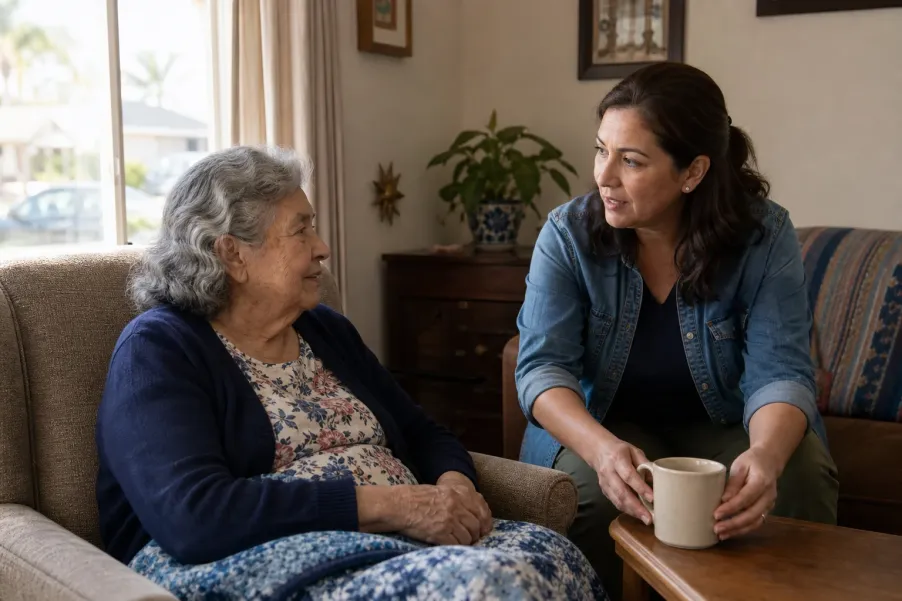
Create a family care visit handoff note with the older adult’s agreement, then record only five things: what was completed, what was noticed, what remains a question, who promised the next step, and when someone will check in. Use neutral facts, share only with approved people, and send urgent or clinical concerns to the appropriate professional.
What makes a family visit handoff useful?
- The older adult knows the note exists, helps choose what belongs in it, and decides who may receive it whenever possible.
- Each update separates completed tasks, neutral observations, questions, promises, and the next contact.
- The wording reports what happened without diagnosing, judging, or turning a guess into a fact.
- The note stays short enough for the next helper to read before acting.
A family support visit may include groceries, laundry, transportation planning, a friendly meal, mail sorting, or a quick home check. The next relative or trusted helper often needs a small update, but a stream of texts can mix facts, opinions, and old information. A consistent handoff note creates one current snapshot without trying to become a full care plan.
The National Institute on Aging recommends dividing caregiving responsibilities among family and friends and keeping caregivers up to date. A short visit note supports that coordination when it remains practical, consent-aware, and easy to correct. It is especially useful across Los Angeles County, where travel time and different work schedules may mean relatives support an older adult on different days.
How do you agree on the handoff note?
Start with the older adult, not the template. Explain the purpose in plain language: “Would it help if we kept a short update for the people you have asked to help?” Discuss which routine topics are useful, which topics should stay private, where the note will live, and who may read it. Agreement is not permanent; the older adult can change the topics or audience.
Name one owner for the current version. That person does not control the household or make decisions for everyone. The owner simply keeps duplicate versions from circulating, corrects outdated items, and makes sure every promise has a name and date. If several people edit the same note, use a visible “updated on” line so the reader can tell which entry is current.
Three questions before you begin
- Purpose: What practical problem should this note prevent?
- People: Who has the older adult approved to read or update it?
- Limits: Which personal, financial, health, or family topics do not belong here?
A visit handoff is different from legal authority. Being a relative, receiving the note, or helping with errands does not automatically authorize someone to make health, financial, housing, or other decisions. Use the older adult’s existing professional and legal documents for those questions, and ask the responsible organization what authorization it requires.
What belongs in a five-part family care handoff?
Use the same five headings after every routine visit. Repetition makes the note faster to scan and exposes missing ownership. Write “none” when a heading has no update instead of leaving the reader to wonder whether it was forgotten.
Completed
List finished household or coordination tasks: groceries put away, ride confirmed, lightbulb replaced, or library books returned.
Noticed
Record a direct observation with time and context, not an interpretation: the front lamp did not turn on, or the refrigerator shelf was empty.
Asked
Capture the older adult’s open question in their own words when possible, plus the person or office that should answer it.
Promised
Name the helper, action, and due date: “Maya will call the repair company by Tuesday.” Avoid vague “someone should” tasks.
Next
State the next planned contact, who is responsible, and what should be checked first. Confirm the plan with the older adult.
The note should make the next action obvious. “Kitchen faucet still drips; Elena will call the landlord Monday; Sam will check in Tuesday evening” is more useful than a long account of the visit. For recurring household responsibilities, the shared household calendar guide offers a separate way to assign dates without crowding the visit note.
How do you write observations without diagnosing or judging?
Describe what a person said, what you directly saw, and when it happened. Avoid labels such as “confused,” “noncompliant,” “unsafe,” or “fine” unless you are quoting a qualified professional and the information is appropriate to share. A household note should not convert one moment into a medical conclusion.
Too vague
“Everything was handled.” The next helper cannot tell what was actually completed or what remains open.
Too interpretive
“She seemed confused about the appointment.” This assigns a condition without enough context.
Neutral and useful
“At 11 a.m., Rosa asked twice whether Thursday’s ride was confirmed. We checked the calendar together; Jamal will verify the pickup time today.”
Attribute preferences and decisions. Write “Mr. Lee asked that Carlos call before visiting” rather than “No surprise visits.” Write “Priya chose not to discuss the bill today” rather than “Priya refused help.” This preserves the older adult’s voice and reduces the chance that a helper’s opinion will be repeated as fact.
Keep corrections visible but simple. If an appointment time was wrong, strike or archive the old entry, add the verified time, and note who confirmed it. Do not silently edit a screenshot or forwarded message that others may still rely on.
How can a family share only the minimum information needed?
Use a topic-by-topic audience. A neighbor who brings in a package may need the delivery window, not financial or health details. A relative arranging transportation may need the pickup place and accessibility request, not the full reason for the appointment. Share the smallest useful update with the person responsible for that task.
U.S. Department of Health and Human Services guidance explains when covered health care providers may communicate relevant information with family, friends, or other people involved in a person’s care. That guidance governs providers and health plans; it does not turn a family notebook into a clinical record or grant relatives automatic access. The practical lesson is to center the older adult’s choices and limit sensitive information to what is relevant.
- Do not include account numbers, passwords, Social Security numbers, door codes, copies of identification, or security answers.
- Do not place private information in a large group text merely because the group is convenient.
- Ask before including health, financial, family-conflict, legal, immigration, or housing details.
- Remove outdated contacts and stop sharing with people who no longer have a role.
If a professional needs information, use that professional’s approved communication route. A visit note can help the older adult remember a question, but it should not replace a provider portal, agency form, medication list, legal document, or emergency record.
When is a family handoff note not enough?
The note is for routine coordination. It is not a place to postpone an urgent response. If someone appears to face immediate danger, call emergency services. If the concern involves a new or worsening symptom, medication, treatment, fall, injury, or change in function, contact the appropriate licensed professional or follow the person’s established care instructions rather than inventing a response in the family note.
For a non-urgent service question, write the question and owner: “Nora will ask the clinic whether the appointment is in person or by phone.” Do not write the answer until it is confirmed. For a household repair, write the observed defect and next call; do not declare the home safe or unsafe based on one family member’s guess.
A separate backup plan may be needed when one person holds every key task. The trusted neighbor emergency support plan explains how to define a limited backup role without giving broad access. Keep emergency information and routine visit notes distinct so an urgent instruction is not buried in ordinary updates.
Should the handoff be on paper, in a message, or in a shared file?
Choose the simplest format the older adult and approved helpers can use consistently. A paper page may work for one household, but it should not contain information that would create harm if misplaced. A group message is quick, yet old details are easy to forward or mistake for current. A shared digital document can maintain one version, but only if access settings, passwords, and update habits are understood.
Paper
Best when the approved readers visit the same home and can keep the page in a private, agreed location. Add the date and writer to every entry.
Small message group
Best for brief logistics among a clearly limited group. Start each update with the visit date and avoid sensitive attachments.
Shared document
Best when helpers work at different times and need one current version. Review who has access and remove people whose role has ended.
Do not maintain all three as equal copies. Pick one source of truth and use the others only to alert approved people that it changed. If technology itself is the barrier, the technology help session checklist can help prepare a focused, privacy-aware learning request.
How do you close a care visit in one minute?
Read the handoff back to the older adult before leaving whenever possible. Use five short sentences: “Today we completed ___. We noticed ___. Your question is ___. ___ promised to __ by ___. The next check-in is ___.” Ask what is missing, what should be removed, and who may receive the update.
Then send or store it once. Avoid adding a second version from memory later. If a relative has a follow-up question, add the answer to the same current note after checking with the older adult and the responsible source.
Sixty-second closeout check
- Is every statement a fact, attributed preference, or clearly labeled question?
- Does every promised action have one name and a date?
- Has the older adult approved the audience and sensitive topics?
- Is an urgent or professional issue being routed outside this note?
- Can the next helper understand the first action in under a minute?
How can families review patterns without making assumptions?
Review several entries for repeated unfinished tasks, unanswered questions, or responsibilities that always fall to one person. Count concrete events rather than labeling the older adult or a helper. “Three rides were not confirmed until the morning of the appointment” is actionable. “The family is disorganized” is a judgment.
Use the pattern to change the process: assign ride confirmation two days earlier, choose a backup caller, or move a recurring item to the shared calendar. If the pattern suggests that the current support arrangement is not enough, ask a qualified local resource or professional for options rather than expanding the family note into an improvised assessment.
Where can Los Angeles County caregivers ask for help?
Los Angeles County Aging & Disabilities describes a Family Caregiver Support Program with information, education, care coordination, counseling, training, respite, and supplemental supports, subject to current intake and eligibility. The county directs callers to 1-800-510-2020 to ask for the provider serving their area. Confirm current requirements directly; a family note does not establish eligibility or guarantee a service.
The California Department of Aging also maintains routes to regional Caregiver Resource Centers and local family caregiver services. For a broader local navigation call, the 211 LA resource call preparation guide can help organize one clear question without promising a particular referral. More educational planning tools appear in the Senior Support Guides.
Official sources to check
- National Institute on Aging: Caregiver Worksheets for official tools on dividing responsibilities and coordinating caregiving tasks.
- U.S. HHS: Family Members and Friends for current consumer guidance on provider communication, involvement, permission, and relevant information.
- Los Angeles County Family Caregiver Support Program for current local program categories, intake route, and provider information.
- California Department of Aging: Caregiver Resources for statewide links to Caregiver Resource Centers and local family caregiver services.
Programs, phone routes, intake rules, eligibility, provider assignments, and available services can change. Confirm current information with the responsible agency before relying on it.
Frequently asked questions
Does a family care visit handoff note replace a professional care plan?
No. It is a household coordination tool for routine completed tasks, observations, questions, promises, and the next contact. It does not replace a clinician’s instructions, agency record, medication list, legal document, emergency plan, or professional assessment.
Should the older adult read every visit handoff?
Include the older adult whenever possible and ask what they want recorded and shared. Reading the short update together helps correct mistakes and preserve preferences. Different rules may apply when a legally authorized representative is involved, so use the applicable documents and professional guidance.
Can we include medical information in the family note?
Use caution and include only information the older adult has agreed is needed for the approved person’s role. Route symptoms, medication, treatment, and clinical questions through the responsible licensed professional and approved communication system. Do not use the note to diagnose or change care.
What if family members disagree about what happened?
Record direct observations, dates, and attributed statements rather than choosing a winner. Ask the older adult for their preference when possible, verify practical facts with the responsible source, and label unresolved items as questions. Do not silently rewrite another person’s account.
How long should a visit handoff note be?
A useful update is usually short enough to read in about a minute. Use the five headings and include only current information needed for the next action. Move recurring dates to a shared calendar and keep professional records in their proper systems.
How long should we keep old family handoff notes?
Keep only what still serves an agreed purpose. Review old entries, resolve open tasks, and remove unnecessary sensitive information. Ask a qualified professional about any legal, tax, insurance, employment, agency, or clinical record-retention requirement; a household routine is not a universal retention rule.
Need help organizing a broader support question?
All Seniors Foundation can help Los Angeles County older adults and families think through general support-navigation questions. It does not replace emergency services, licensed care, legal advice, agency decisions, or the older adult’s authority and preferences.





