
Quick answer
What is bathing assistance for older adults?
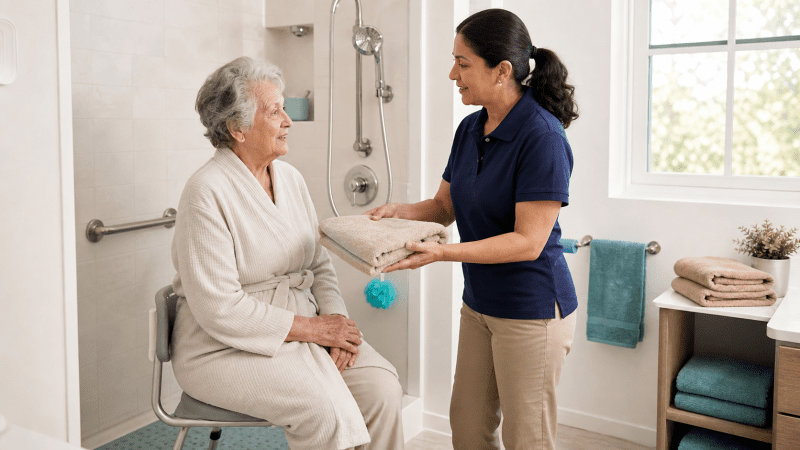
Bathing assistance is respectful help that allows an older adult to wash safely while doing as much as possible independently. Support can range from setting out supplies and giving reminders to standing nearby for safety, helping with transfers, or providing hands-on personal care.
The right level depends on mobility, balance, pain, vision, memory, skin condition, medical instructions, bathroom setup, and the senior’s preferences. Good assistance protects privacy, asks permission, explains each step, and never uses force.
Five levels of bathing support
Setup help
Preparing towels, clean clothing, soap, a shower chair, and a comfortably warm room while the senior bathes independently.
Prompting and cueing
Giving calm reminders or one-step directions for a person who has memory, vision, or sequencing difficulty.
Standby assistance
Remaining close enough to respond while the senior washes, without providing hands-on help unless it is requested or needed.
Hands-on assistance
Helping with safe transfers, hard-to-reach areas, drying, dressing, or another task identified in the care plan.
Alternative hygiene routine
Using a seated wash, sponge bath, no-rinse products, or a different schedule when a tub or shower is unsafe or distressing. A clinician should guide care when wounds, surgical sites, medical devices, or serious skin problems are present.
Signs an older adult may need help with bathing
- They have fallen, slipped, or nearly fallen in or near the bathroom.
- They avoid bathing because stepping into the tub, standing, reaching, or turning is painful or frightening.
- Clothing, hair, skin, or body odor suggests the normal routine has become difficult.
- They forget steps, leave water running, use unsafe water temperatures, or become confused in the bathroom.
- A recent hospital stay, surgery, stroke, illness, or mobility change has made the old routine unsafe.
- The family caregiver is lifting, pulling, or improvising without training or suitable equipment.
- Rashes, pressure areas, bruises, skin tears, or wounds are noticed during personal care.
Ask the older adult directly what feels difficult and what kind of help would feel acceptable. A change in bathing may reflect pain, weakness, depression, memory change, fear of falling, a bathroom barrier, or another health concern that deserves attention.
Dignity, consent, and privacy come first
Bathing is personal. The caregiver should knock, explain why help is offered, ask permission before touching, keep doors and curtains closed, cover areas that are not being washed, and offer reasonable choices about timing, caregiver gender, products, water temperature, and bathing method.
If the person refuses, pause and look for the reason. Pain, cold, embarrassment, fatigue, confusion, or fear may be driving the response. Unless there is an immediate safety emergency, forcing a bath is not an appropriate solution.
Bathroom safety checklist
The CDC recommends practical fall-prevention steps such as securely installed grab bars and better lighting. MedlinePlus also advises non-slip surfaces and notes that towel racks are not safe substitutes for grab bars.
- Use grab bars that are secured to the wall in the correct location.
- Use a stable shower chair or transfer bench when appropriate for the person’s needs.
- Place a non-slip surface inside the tub or shower and a firm non-skid mat outside it.
- Keep the floor dry and the path free of cords, loose rugs, clutter, and unstable furniture.
- Provide bright, even lighting and keep commonly used supplies within easy reach.
- Check water temperature before the person enters, especially when sensation or memory is reduced.
- Use a handheld showerhead when it makes seated bathing easier and safer.
- Ask an occupational therapist or qualified professional when transfer technique or equipment selection is uncertain.
A calm bathing-assistance routine
- Plan together. Agree on the time, method, products, clothing, and level of help before starting.
- Prepare first. Gather towels, soap, clean clothing, mobility equipment, and any care-plan supplies so the senior is not left alone.
- Check the environment. Make sure the room is warm, the floor is dry, lighting is good, and equipment is stable.
- Support independence. Let the person complete every step they can manage safely and offer one instruction at a time when cueing is needed.
- Protect privacy. Keep the person covered where possible and explain before helping with a transfer or personal area.
- Finish safely. Dry the skin gently, help with stable footwear and clothing, and leave the bathroom dry and uncluttered.
Bathing assistance for a person with dementia
The National Institute on Aging explains that bathing may feel frightening, embarrassing, or physically uncomfortable for a person with Alzheimer’s disease. Familiar routines, a warm room, simple choices, step-by-step cueing, and allowing the person to hold a washcloth can make the experience less stressful.
Watch facial expression and body language. If the person becomes distressed, slow down, cover them, reduce noise, and try again later or use a simpler hygiene routine. Never leave a person who needs supervision alone in a tub or shower.
When to ask a clinician for instructions
Personal-care assistance is not the same as skilled nursing. Get instructions from the appropriate licensed healthcare professional when bathing involves a recent surgical site, open wound, pressure injury, feeding tube, catheter, oxygen equipment, dialysis access, cast, serious rash, fragile skin, or a transfer restriction.
Contact a healthcare professional about new skin breakdown, spreading redness, drainage, fever, severe pain, sudden weakness, repeated dizziness, or a new inability to transfer. Call 911 for a serious fall, loss of consciousness, chest pain, severe trouble breathing, or another medical emergency.
Questions to ask a caregiver or home-care agency
- What training does the caregiver have in personal care, transfers, dementia support, and fall prevention?
- How is the senior’s preferred routine, privacy, language, and caregiver-gender preference documented?
- What happens if the senior refuses, becomes dizzy, falls, or has a skin concern?
- Which tasks are nonmedical personal care, and which require a licensed professional?
- How are changes reported to the family, case manager, or healthcare team?
- Is the caregiver physically able and authorized to provide the level of transfer help required?
Finding bathing and in-home support in Los Angeles County
All Seniors Foundation helps qualifying older adults, families, caregivers, and case managers understand practical senior-support options in Los Angeles County. We do not promise a particular caregiver, benefit, number of hours, or free hands-on bathing service.
Our team may help a family organize needs and connect bathing questions with IHSS guidance, personal care services, home health questions, medical equipment assistance, and the in-home senior support guide. Eligibility, coverage, provider availability, and program rules vary.
Call (818) 581-4101 or use the contact page. A senior, family member, caregiver, case manager, discharge planner, or healthcare professional may contact the organization.
Bathing assistance frequently asked questions
Does bathing assistance always mean hands-on care?
No. Some older adults need only setup, reminders, or someone nearby for safety. The least intrusive level that safely meets the person’s needs is usually the most respectful starting point.
How often should an older adult bathe?
There is no single schedule for everyone. Skin condition, continence, activity, culture, preference, medical instructions, and tolerance all matter. A clinician can help when skin or health concerns affect the routine.
Can a family caregiver provide bathing assistance?
A family caregiver may help when the senior agrees and the task can be done safely. Transfer training, suitable equipment, and outside help are important when lifting, balance, dementia, or medical devices make care more complex.
Does Medicare pay for bathing assistance?
Medicare generally does not cover ongoing custodial personal care by itself. Coverage may differ when limited personal care is part of an eligible home-health plan. Confirm current rules with Medicare, Medi-Cal, the health plan, or qualified benefits help.
What if the older adult refuses to bathe?
Pause and look for pain, fear, cold, fatigue, embarrassment, confusion, or a preference that has not been respected. Offer simple choices or a less demanding hygiene option and seek professional guidance when refusal is persistent or health is affected.
Authoritative sources
Important information
This page provides general education and senior-support navigation. It is not medical advice, a caregiver training course, or a substitute for an in-person safety or clinical assessment. Follow the senior’s care plan and instructions from qualified professionals.

