
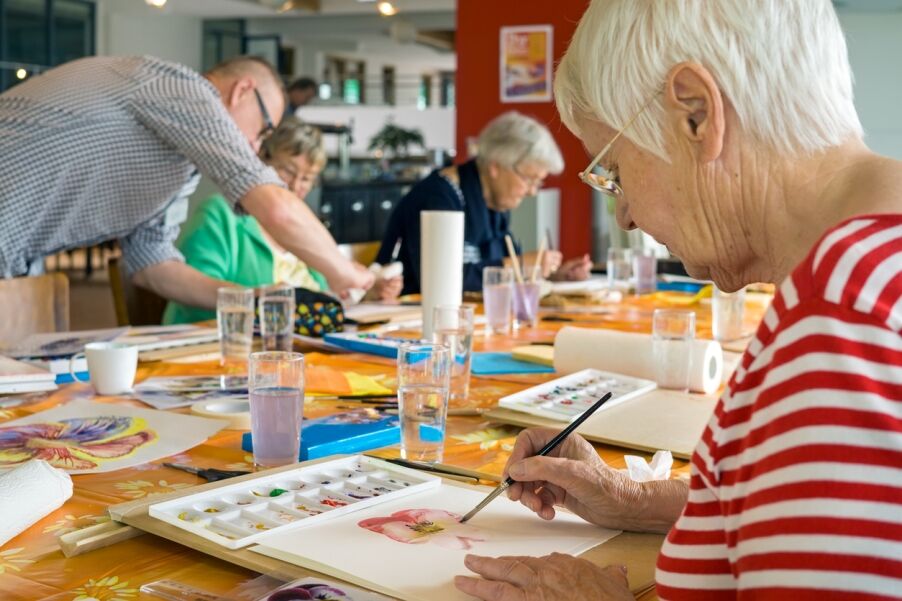
A watercolor session for older adults can begin with one blank page instead of a long supply list or formal lesson. The goal is not to produce a perfect picture. It is to make one clear set of choices, try two basic ways of moving color with water, finish at a comfortable stopping point, and record what would make a future session easier.
Four key takeaways
- Choose a page-sized idea before opening supplies: one leaf, cup, window, flower, horizon, or other familiar shape is enough.
- Limit the first palette to three colors, then use a small test strip to see how each color looks on dry and damp paper.
- A helper prepares reach, light, water, and cleanup only with permission; the painter controls the subject, colors, marks, and finish point.
- Judge the session by clarity and comfort, not by realism, speed, comparison with another painter, or a promised health result.
Who is a one-page watercolor session for, and when is it useful?
This session is for an older adult who wants to try watercolor at home, revisit a familiar hobby with a smaller setup, or paint beside a relative or friend. It also gives a permitted helper a defined role without turning that helper into an instructor. The painter may work alone, share the table, ask for setup assistance, or stop before any paint reaches the page.
Use it when a large project feels unnecessary, when supplies have been sitting unused, or when a person wants to learn what table height, light, brush, paper, and session length fit their own preferences. For a wider menu of activity ideas, see ASF’s senior activity planning guide. That broad guide and this focused lesson answer different questions: this page teaches one repeatable watercolor session from setup through storage.
Do not use the activity as a test of memory, vision, mood, coordination, independence, or willingness to accept help. A person can enjoy one color, make two marks, watch someone else paint, or decide that watercolor is not a good fit. None of those choices needs to be corrected or graded.
What do wash, dry-paper mark, and wet-on-wet mean?
Watercolor changes when the paper or brush holds more water. Three plain-language terms are enough for this session. They describe what the materials do; they are not levels a painter has to master.
Dry-paper mark
Paint touches paper that has not been dampened first. The painter can usually see a more defined edge and can change the pressure, direction, or spacing of each mark.
Wash
Diluted color is brushed across part of the page in a broad, connected area. A wash can become a sky, background, shadow, or simply a color field.
Wet-on-wet
Color touches paper that is already damp. The pigment may spread beyond the brush path, mix with another color, or create a softer edge.
Technique source: The J. Paul Getty Museum Education handout on watercolor techniques demonstrates wetting paper, making a wash, loading and cleaning a brush, and using paper towels while experimenting. This Article adapts those basic observations to one small page; it does not reproduce the Getty lesson or promise the same result.
How should the table and materials be prepared?
Start with a stable, uncluttered table and a chair the painter has already chosen. Keep the paper fully supported. Place the brush, palette, water, and paper towel within the painter’s comfortable reach rather than arranging them according to someone else’s dominant hand. Keep cords, bags, and extra containers out of the walking path.
For the first page, use watercolor paper or another paper the product instructions say is suitable, one medium brush, a palette with three chosen colors, two low and stable water cups, a paper towel, and a pencil only if the painter wants a guide. One cup is for the first rinse; the other is for cleaner water. A tray or washable table cover can define the work area without crowding it.
Read every paint and supply label before opening the material. The U.S. Consumer Product Safety Commission’s Art and Craft Safety Guide emphasizes product labels, appropriate ventilation, careful storage, and using materials as directed. Keep food and drinks separate from art water, do not point a wet brush with the mouth, and do not assume that an unlabeled or old material is suitable.
If broader household routines or workspace choices are becoming difficult to organize, ASF’s living-alone independence guide offers a separate planning framework. It does not evaluate whether any art activity or physical setup is safe for a particular person.
How does a watercolor session for older adults work in seven small steps?
-
Choose one page-sized subject
Ask the painter to choose one familiar shape or simple view: a leaf, cup, flower, window, fruit, house outline, horizon, or color pattern. A reference object or photo can sit beside the page if the painter wants it. The subject is a starting point, not a requirement to copy every detail.
-
Pick three colors and name the finish point
Let the painter select three colors from the available, label-compliant palette. Write a finish cue such as one filled shape, one background wash, three color areas, or the planned stop time. A finish cue keeps the page bounded; it is not a deadline to work faster.
-
Make the dry-and-damp test strip
Use a narrow edge or a separate scrap of matching paper. On the left, place one stroke of each color on dry paper. On the right, dampen three small areas with clean water and touch each color into its area. Wait and observe the edges before deciding which effect belongs on the main page.
Dry side
Try a line, short stroke, and gentle press. Notice edge, color strength, brush drag, and whether the mark is easy to see.
Damp side
Try one color in a small wet area. Notice spread, soft edges, color mixing, and whether the water remains inside the planned space.
-
Place the largest shape first
The painter may sketch a light guide, paint the outside edge, or begin with a broad wash. Start with the largest area rather than tiny details. Leave unpainted paper wherever light or open space is wanted. The helper should not redraw or repaint the shape unless the painter directly asks.
-
Add one contrast, texture, or second layer
After the first area settles, choose only one next move: a darker edge, a second color, three small marks, a dry-paper texture, or a soft wet-on-wet area. The purpose is to observe a change, not to fill every empty space. Stop adding water if the paper begins to pill, tear, or behave unlike the product instructions.
-
Pause before deciding the page is finished
Set the brush down and look from a comfortable distance. Ask: What area do I like looking at? Is one more mark necessary, optional, or likely to make the page busier? The painter may finish early, rotate the page, leave it incomplete, or make one final mark.
-
Label, dry, and store the page
Place the page flat in a protected area according to the material instructions. On the back, add the date, three colors, and one note for next time only if the painter wants that record. Clean and store supplies according to their labels. Do not frame, post, share, or give away the page without the painter’s permission.
What belongs on the ONE PAGE session card?
Fill this card before painting or speak the answers aloud. It protects the session from expanding into a shopping trip, a formal lesson, or a helper-led project. The painter can change any answer during the session.
- O — One subject
- The single shape, view, object, pattern, or memory cue chosen by the painter.
- N — Needed materials
- One page, one brush, three colors, two water cups, paper towel, and optional pencil.
- E — Easy reach
- Where the page, palette, rinse water, clean water, and towel will sit.
- P — Palette
- The three colors selected for this page and where each appears on the test strip.
- A — Assistance
- What the painter wants the helper to set up, hold, move, read, or leave alone.
- G — Gentle stop
- The planned stop time, fatigue or frustration signal, and no-explanation-needed pause phrase.
- E — End cue
- The visible point that can make the page complete, plus one optional note for next time.
The card records session choices, not medical or personal history. Do not add diagnoses, medication lists, test scores, account credentials, or private family details. For a different kind of structured conversation about everyday priorities, use ASF’s quality-of-life check-in guide.
How can a helper support the painter without taking over?
A helpful role is specific and permission-based: steady the paper, move a water cup, read a product label, rinse a brush, adjust the lamp, or write the painter’s note. A helper should not choose the subject, correct proportions, replace colors, finish an area, photograph the page, or compare the work unless the painter requests that action.
If the painter says stop, the session stops. If the painter wants to watch, switch subjects, use one color, or throw the page away, the helper does not need to persuade them otherwise. A pause is not a failed activity, and an unfinished page does not need to be rescued.
Los Angeles County residents who want an optional public activity route can search the current Los Angeles Public Library Events Calendar or LA County Library Events. Use the live filters and contact the listed branch to confirm audience, date, registration, supplies, language, and accommodation details. A calendar listing is not a guarantee that a specific event or seat remains available.
ASF’s library resource-navigation guide explains how to prepare a narrow question for library staff. It does not promise that a branch offers watercolor instruction or that staff can provide individual assistance.
Should the painter try another watercolor page?
Give one point for each true statement. The PAINT AGAIN score measures whether the session setup should repeat, not the quality of the picture or the painter’s ability.
- 1Choice: the painter controlled the subject, colors, marks, helper role, and stop point.
- 1Setup: the page, brush, water, palette, light, and cleanup materials were easy enough to use.
- 1Test: the dry-and-damp strip made at least one watercolor behavior understandable.
- 1Pace: there was time to pause, change direction, or stop without pressure to finish more.
- 1Next note: one keep, change, or skip decision is clear for a future creative session.
Five points: repeat the setup only if the painter wants another page. Three or four: change the missing condition before repeating. Zero to two: choose a smaller setup, another material, a shared demonstration, or a different activity. No score requires another session.
A person looking for group activities rather than a home session can use ASF’s senior social clubs fit guide to compare participation questions without assuming that one setting works for everyone.
For other low-risk planning routes, browse the Senior Support Guides hub. The hub is a discovery route, not a promise that a particular program or activity is available.
Which watercolor-session mistakes and boundaries matter most?
- Opening every supply: keep the first session to one page, one brush, and three colors unless the painter asks for more.
- Using food cups for paint water: use clearly separate, stable containers and keep food and drinks away from the art area.
- Skipping the label: read current directions and cautions before use; an old or unlabeled material should not be guessed at.
- Correcting the picture: ask before touching the paper, brush, palette, reference, or finished page.
- Calling the page therapeutic: describe the activity and choices without promising memory, mood, mobility, health, or functional benefits.
- Working through discomfort: stop when the painter asks, when the setup no longer feels usable, or when a professional or product instruction says to stop.
- Sharing without permission: do not photograph, post, display, sell, donate, or give away the page unless the painter agrees.
- Assuming a library listing is current forever: verify the live calendar, branch details, registration, and accessibility route before travel.
Did the session reveal a broader support-planning question?
If the ONE PAGE card reveals a separate nonemergency question about organizing everyday support, share the unresolved issue—not private health details or account credentials—through ASF’s contact route. All Seniors Foundation does not claim to provide watercolor supplies, art instruction, therapy, classes, transportation, event registration, or guaranteed program access.
Frequently asked questions
Does an older adult need painting experience for this session?
No. The session uses one page, three colors, one brush, and two small tests so the painter can observe the materials without completing a formal lesson. The painter may make one mark, watch a helper demonstrate with permission, stop early, or choose a different activity.
What materials are needed for one watercolor page?
Use suitable paper, one medium brush, three chosen watercolor colors, two stable water cups, a paper towel, a protected table area, and an optional pencil. Read and follow every current product label before use. Do not use an old or unlabeled material by guessing.
Why does the plan start with only three colors?
Three colors keep the palette easy to identify and leave room for simple mixing on the test strip. The number is a session boundary, not an art rule. The painter can use one, two, three, or more colors when the setup remains clear and the product directions allow it.
What should a helper do during the watercolor session?
A helper can move supplies, read labels, prepare clean water, steady paper, or write a note only with permission. The painter controls the subject, palette, marks, pace, and finish point. The helper should not correct or complete the painting unless the painter directly requests that action.
How long should the finished watercolor page dry?
Drying time varies with paper, paint, water, room conditions, and the product instructions. Place the page flat in a protected area and follow the material guidance. Do not promise a fixed drying time, stack a damp page, or use heat unless the relevant instructions clearly permit it.
Does All Seniors Foundation provide watercolor classes or supplies?
This Article does not claim that All Seniors Foundation provides watercolor supplies, instruction, art therapy, classes, transportation, or event registration. Readers may check current official library calendars and confirm details directly. The ASF contact route is only for a separate broader nonemergency support-planning question.





